Stock Analysis · Albany International Corporation (AIN)
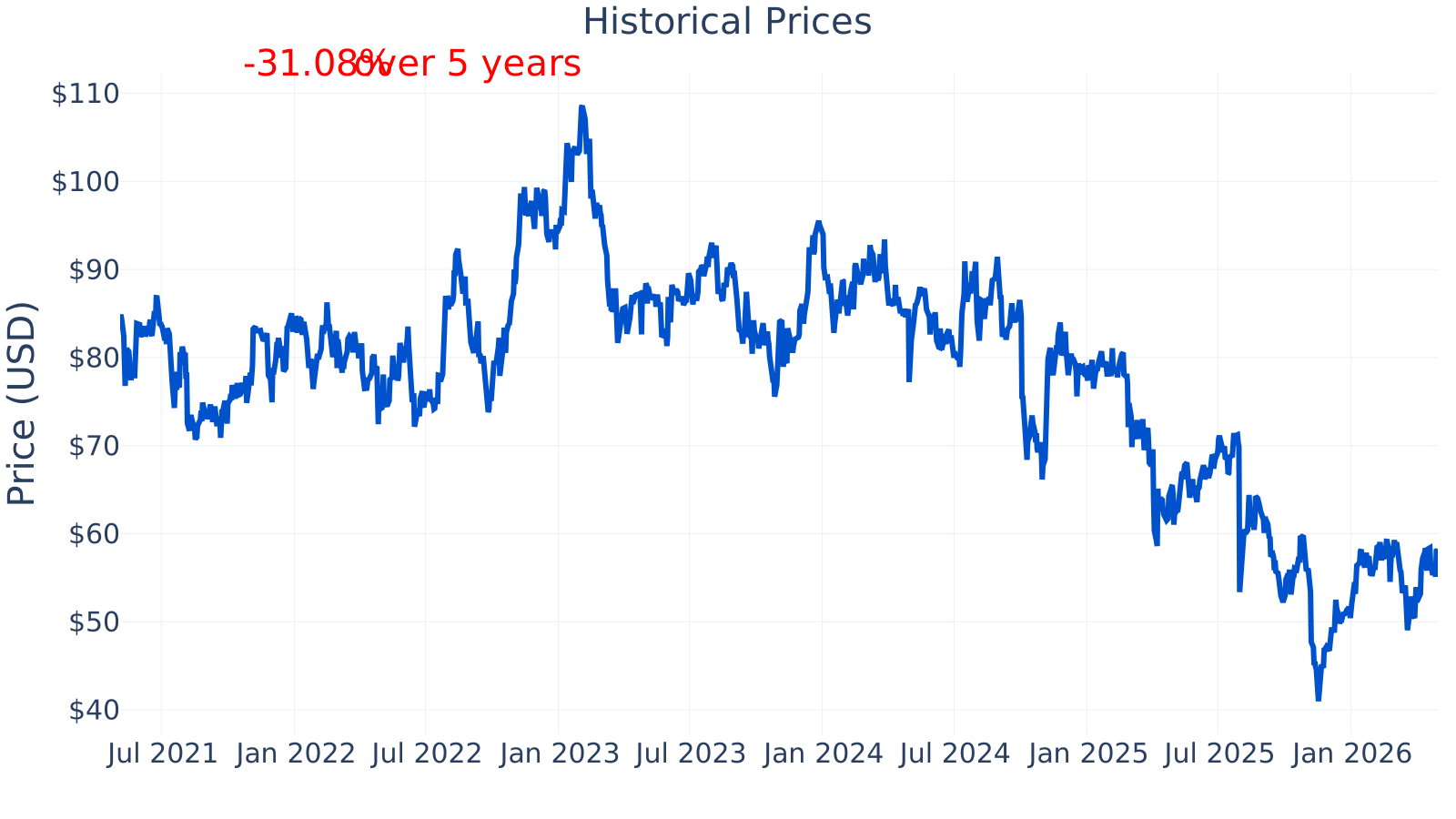
Overview
Albany International Corporation is a manufacturing company that focuses on engineered materials used in industrial production. It operates primarily through two business areas described in its filings: a business that makes engineered fabrics and belts used in paper manufacturing processes, and a business that makes advanced composite materials used in aerospace and other high-performance applications.
In practical terms, the company earns money by supplying specialized, high-specification components that customers rely on to run large, capital-intensive operations (such as paper mills) or to build complex products (such as aerospace structures). These products tend to require tight quality control and long-term customer relationships, because performance and reliability matter and switching suppliers can be costly or risky.
Based on company reporting, revenue is mainly organized by its two operating segments:
- Machine Clothing (engineered paper machine clothing and related products for paper, packaging, tissue, and nonwovens manufacturers)
- Albany Engineered Composites (advanced composites structures and parts, primarily for aerospace/defense and other industrial uses)
The exact percentage split can change by year and should be taken from the most recent annual report segment note; the company’s filings are the authoritative place for the latest breakdown.
Looking across recent years, total revenue grew from about $929 million (2021) to about $1.23 billion (2024), then eased to about $1.18 billion (2025). Profitability weakened materially in 2025, with operating income turning negative and net income also negative, which is a major change versus prior years.
Key Figures
| Metric | Value | Industry ⓘ |
|---|---|---|
| Date | May 04, 2026 | |
| Context | ||
| Sector | Consumer Cyclical | |
| Industry | Textile Manufacturing | |
| Market Cap ⓘ | $1.65B | |
| Beta ⓘ | 1.19 | |
| Fundamental | ||
| P/E Ratio ⓘ | N/A | |
| Profit Margin ⓘ | -4.93% | |
| Revenue Growth ⓘ | 7.80% | |
| Debt to Equity ⓘ | 65.33% | |
| PEG ⓘ | 1.44 | |
| Free Cash Flow ⓘ | $92.23M | |
Albany International’s market capitalization is about $1.65 billion, placing it in the small-to-mid-cap range. The stock’s beta of ~1.19 suggests it has tended to move somewhat more than the overall market. The company’s profit margin is about -4.9% (negative), which aligns with the recent period of losses visible in the income statement trend. Revenue growth over the last year is about 7.8%, while debt-to-equity is ~65%, indicating a meaningful (though not extreme) use of debt relative to shareholders’ equity. Free cash flow over the trailing twelve months is about $92.2 million, showing that cash generation can remain positive even when accounting profits are under pressure.
Growth (Medium)
Albany International is tied to two different demand drivers. The Machine Clothing business is linked to ongoing production of paper, packaging, and tissue. These end markets are typically mature, so growth often comes from a mix of market share, product upgrades, service levels, and customer operating efficiency rather than pure industry expansion. In contrast, the engineered composites business is exposed to aerospace build rates and long-cycle industrial programs, where growth can be stronger when aircraft production and defense spending are supportive.
Strategically, the mix can be important: a mature, cash-generative industrial supply business can help fund investment in advanced materials where customers may require long qualification cycles. This can create a “barbell” profile—stability on one side, potentially higher growth on the other—although it also introduces complexity and execution risk.
Revenue growth has been uneven. It was solid through much of 2021–2024 (including several quarters with double-digit year-over-year increases), then turned negative through several quarters in 2024–2025 before returning to positive territory most recently (about +7.8% year-over-year). This pattern suggests demand and/or pricing and mix have been volatile, and it highlights why investors often focus on whether margins and orders are stabilizing, not just whether a single quarter returns to growth.
Free cash flow has also fluctuated: it was around $122.0 million (TTM) in 2022, dropped sharply to about $20.3 million in 2023, recovered to roughly $79.0 million in 2024, rose to about $141.1 million in 2025, and most recently is about $92.2 million. That variability matters for long-term owners because it affects how much flexibility the company has for reinvestment, debt reduction, and shareholder returns during weaker operating periods.
Risks (High)
A central risk is the recent deterioration in profitability. The company moved from positive margins earlier in the period to negative profit margin recently, which can happen due to cost inflation, weaker volumes, unfavorable product mix, project charges, customer/program timing, or other operational factors. Regardless of the cause, sustained margin pressure can reduce financial flexibility and can also change how the market values the business.
The profit margin trend shows a clear decline over time—from roughly 12–13% in 2021 toward mid-single digits by 2025, then turning negative (around -4.9% most recently). For a manufacturer, that kind of swing is significant because it can signal either a cyclical downswing, execution issues, or a step-change in cost structure that may require time to repair.
Another risk is end-market cyclicality and customer concentration dynamics. Paper-related demand can be steady but not immune to economic slowdowns, customer downtime decisions, or capacity rationalization. Aerospace and defense programs can be long-term and attractive when stable, but they can also be exposed to program delays, qualification hurdles, and changes in build rates.
Leverage has increased compared with earlier periods: debt-to-equity moved from roughly 40% in 2021 to about 65% most recently, after being lower in parts of 2024. Higher leverage is not automatically problematic, but it can amplify downside when earnings are under pressure, especially if borrowing costs rise or if refinancing conditions tighten.
On competitive positioning, Albany International operates in specialized niches where performance, reliability, and customer qualification matter. These characteristics can create competitive advantages such as long relationships and recurring replacement demand (particularly in Machine Clothing). However, the company is not operating in a “winner-takes-all” environment; industrial materials markets can remain competitive, and customers often have multiple qualified suppliers.
Key competitors vary by segment. In Machine Clothing, competition typically comes from other global suppliers of paper machine clothing and consumables. In engineered composites, competition can include other advanced composites manufacturers and, in some programs, in-house manufacturing by large aerospace firms or tier-one suppliers. The company’s relative strength depends heavily on program wins, manufacturing execution, and maintaining qualification status with demanding customers.
Valuation
Albany International’s historical P/E ratio was generally in the low-to-mid 20s through 2021–2022, rose into the high 20s to mid 30s at points in 2023–2025, and is not meaningful in the most recent periods shown because earnings turned negative (a standard P/E ratio becomes unreliable when net income is below zero). In other words, for the latest period, the stock’s valuation is less about a simple earnings multiple and more about whether profitability normalizes, how durable cash generation is, and what level of earnings power the business can sustain across a cycle.
Given the recent swing to losses and the variability in free cash flow, valuation discussions tend to hinge on forward-looking fundamentals that are uncertain by nature (for example: cost structure, pricing, volumes, program ramps, and mix). This makes the “expensive vs. cheap” question harder to answer using one common metric, and it increases the importance of tracking operating recovery signals in filings such as segment profit trends, backlog/order commentary (if provided), and management’s discussion of drivers.
Conclusion
Albany International is a specialized industrial manufacturer with two distinct engines: a paper-industry consumables business that can offer recurring demand characteristics, and an advanced composites business that can provide exposure to aerospace and other high-performance applications. Over several years, revenue expanded meaningfully through 2024, but profitability deteriorated sharply by 2025, culminating in negative net income and a negative profit margin.
For long-term evaluation, the key factual tension is that the company still shows positive trailing free cash flow while accounting profitability has weakened and leverage has risen. Whether long-term outcomes improve depends largely on the durability of demand in its end markets and, critically, management’s ability to restore margins and consistent earnings—especially in the segments and programs driving the recent downturn.
Sources:
- SEC EDGAR — Albany International Corporation filings (Form 10-K, Form 10-Q)
- Albany International Corporation — Investor Relations materials and press releases (as posted by the company)
- Wikipedia — “Albany International” (basic company background)
This article is for informational purposes only and does not constitute financial advice. Some content is AI-generated. See Disclaimer


