Stock Analysis · Airbnb Inc (ABNB)
Overview
Airbnb Inc. operates a global online marketplace that connects hosts (people offering places to stay) with guests (people booking those stays). The company’s platform includes a wide range of accommodations—from single rooms to entire homes—as well as “Experiences,” which are activities hosted by locals. Airbnb is primarily a digital platform business: it does not usually own or lease the properties that are booked on its site, but it facilitates transactions, handles payments, and provides tools such as search, reviews, messaging, and certain trust-and-safety features.
Airbnb’s revenue mainly comes from service fees tied to bookings on its platform. In its SEC filings, Airbnb describes two main revenue streams:
- Stays (the largest portion): service fees earned when guests book accommodations.
- Experiences (smaller portion): service fees earned when guests book activities.
In general, revenue tends to rise when the number of nights and experiences booked increases, and when the average daily rates (prices per night) increase. Airbnb reports revenue by geography (Americas; EMEA; Asia Pacific) in its filings, reflecting how demand and regulation can differ across regions.
Over recent years, Airbnb’s revenue has expanded from about $6.0B (2021) to about $12.2B (2025), while gross profit also increased over that period. Operating income has improved versus earlier years, although operating expenses (including product development and sales/marketing-related costs) remain a large part of the cost structure.
Key Figures
| Metric | Value | Industry ⓘ |
|---|---|---|
| Date | Feb 16, 2026 | |
| Context | ||
| Sector | Consumer Cyclical | |
| Industry | Travel Services | |
| Market Cap ⓘ | $72.75B | |
| Beta ⓘ | 1.14 | |
| Fundamental | ||
| P/E Ratio ⓘ | 30.11 | 21.51 |
| Profit Margin ⓘ | 20.51% | 10.37% |
| Revenue Growth ⓘ | 12.00% | 12.00% |
| Debt to Equity ⓘ | 26.46% | 96.47% |
| PEG ⓘ | 1.60 | |
| Free Cash Flow ⓘ | $4.62B | |
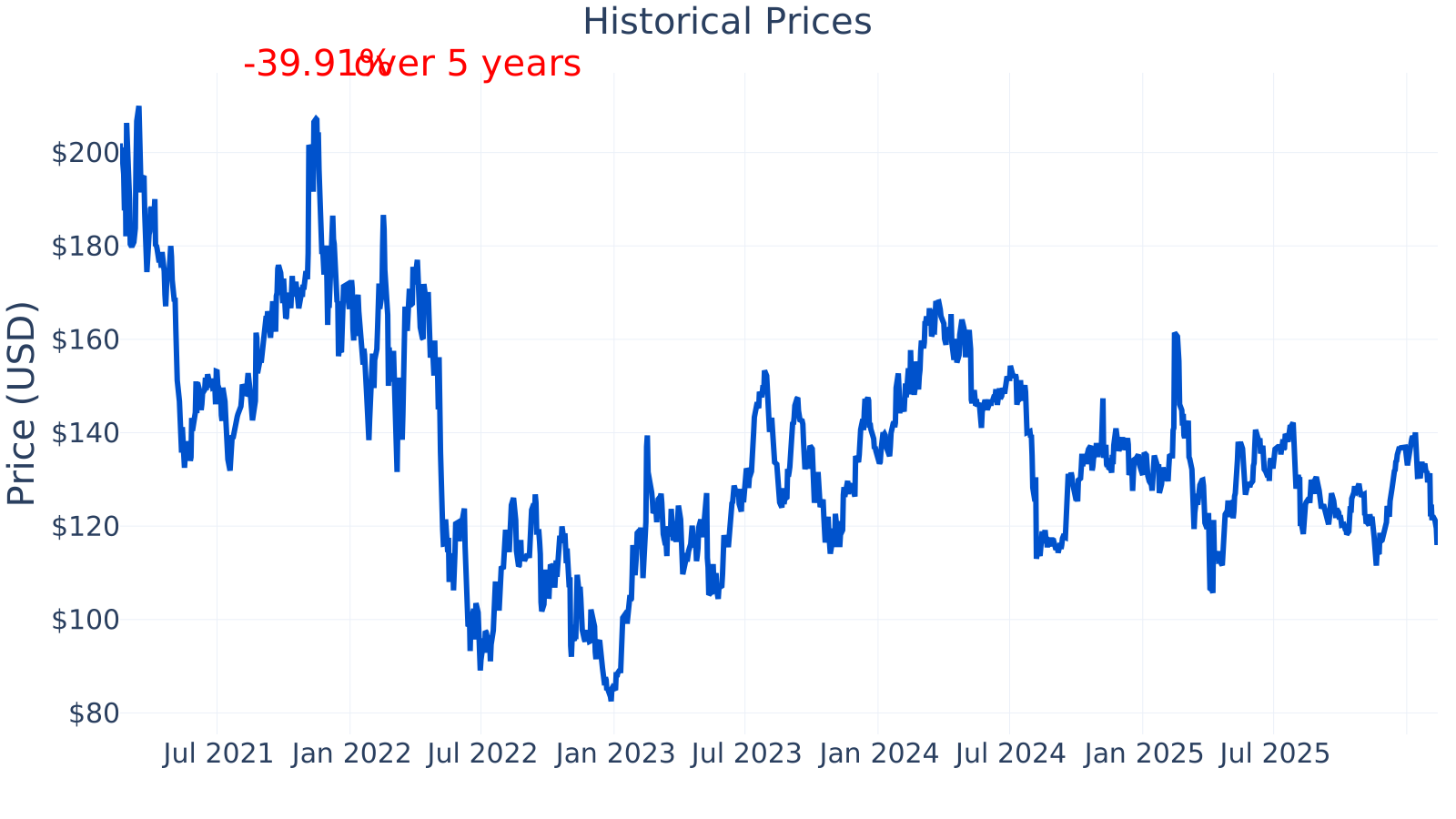
Airbnb’s market capitalization is about $72.8B, and the stock’s beta (~1.14) suggests somewhat higher volatility than the broader market. The company’s P/E ratio (~30.1) is above the industry median (~21.5), while its profit margin (~20.5%) is notably above the industry median (~10.4%). Year-over-year revenue growth (~12%) is roughly in line with the industry median (~12%). Balance-sheet leverage appears lower than many peers, with debt-to-equity ~26% versus an industry median near 96%. Trailing twelve-month free cash flow is about $4.62B, reflecting meaningful cash generation relative to many travel-related businesses.
Growth (medium)
Airbnb operates in the broad travel and lodging ecosystem, where demand is influenced by global travel patterns, consumer income, and the appeal of alternative accommodations. Over the long run, online travel booking and mobile-first trip planning have been durable trends, and Airbnb’s model benefits when travelers are comfortable booking stays directly through a platform with reviews and flexible inventory across many locations.
Revenue growth has normalized compared with the post-pandemic rebound period. Recent year-over-year growth rates have generally moved in the high single digits to low teens (for example, about 12% in the most recent period shown), which is consistent with a business that has become larger and is compounding from a higher base. For long-term context, what matters is whether Airbnb can keep expanding supply (hosts and listings), maintain demand, and defend its take rate (fees) while keeping customer acquisition costs under control.
Free cash flow has trended upward over time, rising from about $0.52B (TTM in 2021) to about $4.38B–$4.62B (TTM in 2025). For a platform business, sustained cash generation can be a practical indicator of operating efficiency: it can support reinvestment in product, trust and safety, and marketing, while also providing flexibility if travel demand weakens.
Potential growth catalysts described in company materials typically relate to expanding the usefulness of the platform (improving search and matching, strengthening trust, expanding supply in key markets, and growing awareness) and increasing attach rates for newer offerings such as Experiences. International expansion and deeper penetration in under-served geographies can also matter, since travel is inherently global and demand varies by region and season.
Risks (high)
Airbnb’s results are sensitive to travel demand and consumer spending. A global recession, geopolitical disruptions, public health events, or shifts in airline capacity and pricing can reduce travel volume and shorten booking windows, which can affect nights booked and revenue. Seasonality is also a factor in travel, and performance can vary materially by quarter.
Regulation is a core risk. Many cities and countries impose rules on short-term rentals (such as registration requirements, limits on nights, zoning restrictions, or tax rules). Changes in enforcement intensity or new restrictions can reduce available listings or raise compliance costs. Because rules differ widely by jurisdiction, the operational burden can be ongoing and complex.
From a balance-sheet perspective, Airbnb’s debt-to-equity (~26%) is lower than the industry median (near 96%), which can reduce financial risk compared with more highly levered travel peers. Even so, lower leverage does not eliminate business risk: demand swings and regulatory constraints can still affect cash flow.
Profitability has improved markedly versus earlier periods, with the latest profit margin around 20.5% (above the industry median near 9.6%). However, Airbnb’s margins can move meaningfully from year to year due to marketing intensity, product and trust investments, and other items that can affect reported net income.
Competition is significant. Airbnb competes with:
- Online travel agencies (for example, Booking Holdings and Expedia) that distribute hotels and alternative accommodations.
- Traditional hotels and hotel chains that compete on price, loyalty programs, and consistency.
- Property management companies and smaller rental platforms that aggregate vacation rentals.
Airbnb’s competitive advantages often cited in filings and business descriptions include its global brand recognition, two-sided marketplace scale (hosts and guests), and network effects from reviews and repeated usage. At the same time, travel search is highly competitive, and rivals can spend heavily on marketing and distribution. Another structural risk is “disintermediation” (hosts and guests attempting to transact off-platform), which marketplaces must actively prevent through product design, policies, and enforcement.
Valuation
On an earnings multiple basis, Airbnb’s latest P/E ratio (~30.1) is above the industry median (~21.5). Historically, Airbnb’s P/E has also moved across a wide range over time (as shown in the chart), reflecting both changes in profitability and shifts in market expectations. A higher-than-industry P/E often implies the market is assigning a premium for factors such as brand strength, platform economics, margin profile, balance-sheet positioning, and perceived durability of growth.
Whether that premium is justified depends on how the company performs on a few measurable fundamentals over time: maintaining healthy growth in nights booked and revenue, sustaining strong free cash flow, and preserving margins while navigating regulation and competition. The PEG ratio (~1.6) is one way some investors summarize “price relative to expected growth,” though it is only a rough indicator and depends heavily on growth assumptions that can change with the travel cycle.
Conclusion
Airbnb is a large-scale travel platform that earns service fees primarily from stays booked on its marketplace, with Experiences as a smaller line of business. Financially, recent metrics show a combination of meaningful profitability (profit margin around 20%), solid free cash flow generation (around $4.6B TTM), and lower leverage than many industry peers (debt-to-equity around 26%). Growth has moderated from earlier rebound levels to a more mature pace around the low teens, which places more emphasis on execution, product improvements, supply growth, and resilience through travel cycles.
The main uncertainties are external (travel demand shocks and local regulation) and competitive (intense competition across online travel and lodging). From a valuation perspective, the stock trades at a higher earnings multiple than the industry median, indicating that expectations for long-term performance are meaningfully embedded in the price.
Sources:
- SEC EDGAR — Airbnb, Inc. filings (Form 10-K and Form 10-Q)
- Airbnb, Inc. Investor Relations — Shareholder letters and quarterly results materials (press releases)
- Airbnb, Inc. — Public earnings call materials and transcripts (company-hosted, when available)
- Wikipedia — “Airbnb” (basic company background only)
This article is for informational purposes only and does not constitute financial advice. Some content is AI-generated. See Disclaimer


