Stock Analysis · Aeva Technologies Inc (AEVA)
Overview
Aeva Technologies Inc. (AEVA) develops sensing and perception technology used to help machines “see” and understand the world around them. The company is best known for its work on lidar (a type of sensor often discussed in automotive safety and automation), and it also targets other applications where accurate, real-time 3D information is useful, such as industrial automation and other machine-perception use cases. In practical terms, the company’s business model is centered on developing hardware and related software that can be designed into customer products over time.
At a high level, Aeva’s revenue is currently tied to early-stage commercialization activities (for example, development contracts, prototypes, and initial production programs), rather than large-scale, mature product shipments. Based on how companies at this stage typically report, revenue can come from a mix of engineering services and product-related sales, and it may be concentrated among a small number of customers.
In recent years, the financial picture has shown a large gap between revenue and operating costs. For example, annual revenue increased from about $9.1M (2024) to about $18.1M (2025), while annual operating expenses remained much higher (about $126.9M in 2025). Research and development (R&D) has been the largest recurring cost line item, which is consistent with a company still building and refining its core technology and preparing for broader production.
Revenue has been relatively small compared with total operating expenses across the period shown. R&D is the biggest cost component, and despite revenue improving into 2025, the company still reported sizable operating losses, indicating that scaling revenue (or reducing costs) remains the central financial challenge.
Key Figures
| Metric | Value | Industry ⓘ |
|---|---|---|
| Date | May 04, 2026 | |
| Context | ||
| Sector | Technology | |
| Industry | Software - Infrastructure | |
| Market Cap ⓘ | $1.04B | |
| Beta ⓘ | 2.20 | |
| Fundamental | ||
| P/E Ratio ⓘ | N/A | 29.58 |
| Profit Margin ⓘ | N/A | 6.71% |
| Revenue Growth ⓘ | 108.50% | 18.30% |
| Debt to Equity ⓘ | 774.83% | 24.92% |
| PEG ⓘ | N/A | |
| Free Cash Flow ⓘ | -$119.69M | |
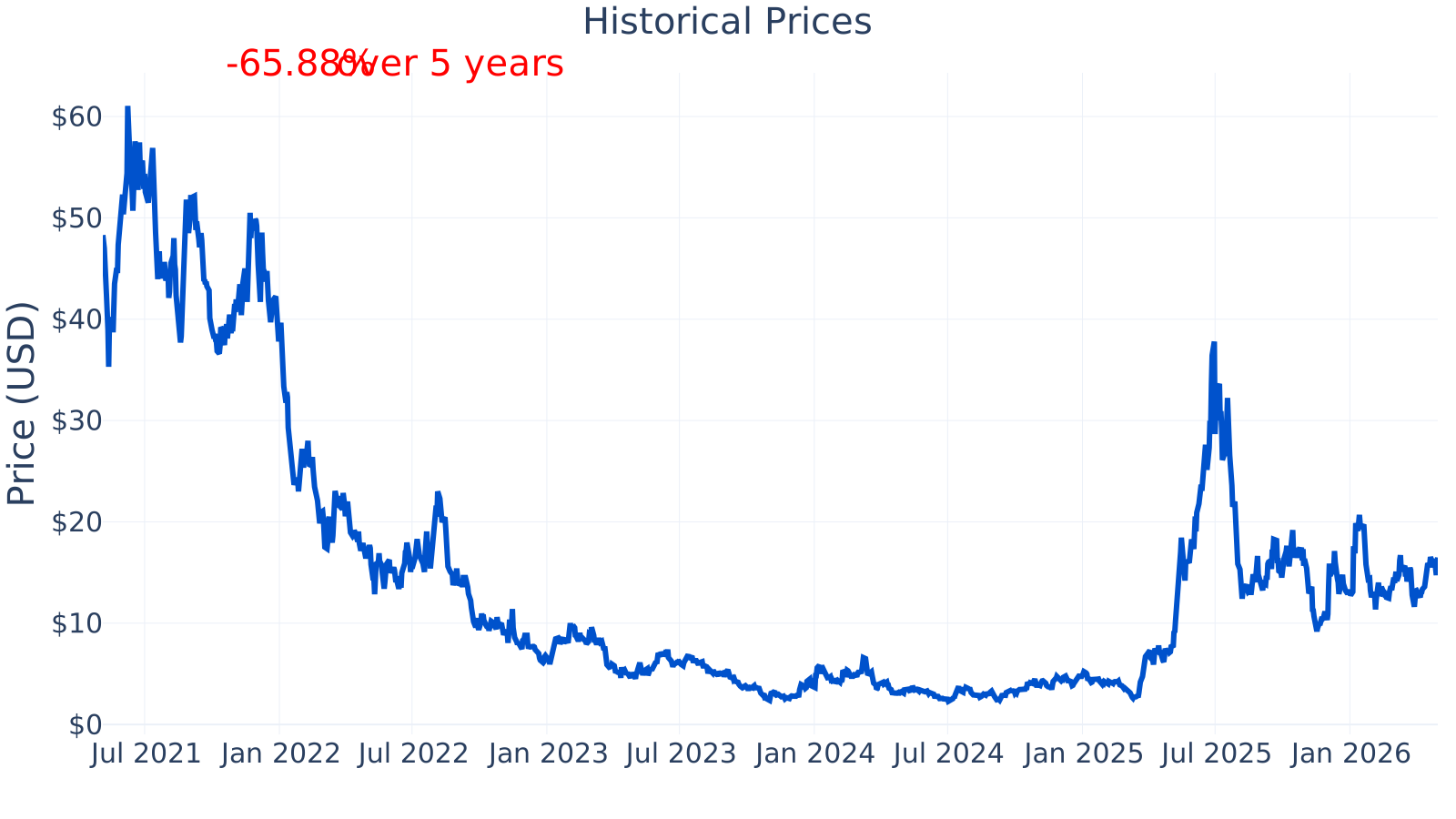
Aeva’s market capitalization is about $1.04B, and the stock has historically shown high volatility (beta around 2.20). Profitability remains negative (profit margin shown as 0% in the table, with the longer trend below indicating persistent losses). Year-over-year revenue growth is currently very high (about 108.5%), but it is coming off a small revenue base. Free cash flow over the trailing twelve months is negative (about -$119.7M), which means the business has been using cash rather than generating it. Debt-to-equity is shown as very elevated (about 774.8%), far above the industry median shown in the table, which is an important balance-sheet point to understand in context (and to verify against the company’s latest filings, including how equity is defined at that date).
Growth (Medium)
Aeva operates in a market connected to long-term trends: more automation in vehicles and industrial systems, and wider adoption of sensors and perception software to improve safety and machine decision-making. If these trends continue, they can support demand for sensing technologies over time. However, the timing and pace of adoption can be uneven, especially in automotive, where product cycles are long and supplier selection can take years.
The company’s strategy—investing heavily in R&D to reach product performance, cost, and manufacturability targets—fits an industry where technical validation and reliability standards can be decisive. A key growth question is whether development-stage engagements translate into scaled production programs with repeatable revenue.
Year-over-year revenue growth has been highly volatile, including periods of contraction and sharp rebounds. The latest reading (about 108.5% growth) is well above the industry median shown in the table (about 18.3%), but the earlier swings suggest revenue can be “lumpy,” which is common when revenue depends on project timing, customer milestones, and early production ramps.
Free cash flow has remained negative over the trailing twelve months across the period shown (roughly -$98M to -$127M, and about -$119.7M most recently). This pattern is typical for a company funding development and commercialization, but it also means execution depends on maintaining sufficient liquidity (cash resources and/or financing access) until the business can generate sustainable cash inflows.
Risks (High)
The biggest risk is commercialization: developing advanced sensing technology is only part of the challenge; the larger hurdle is reaching consistent, scaled production with acceptable unit economics. Aeva’s financial profile shows that operating costs remain far above revenue, and the business is still loss-making. If revenue growth does not translate into scale (or if cost reductions do not materialize), losses and cash usage could persist longer than expected.
Competitive pressure is another major factor. The lidar and perception ecosystem includes multiple well-funded competitors pursuing automotive and industrial design wins. In addition, some customers may develop parts of the stack internally or choose alternative sensor approaches. In this environment, competitive advantages typically come from a combination of sensor performance, cost, reliability, manufacturability, and the ability to meet demanding qualification requirements over long supply commitments. Public filings are usually the best place to evaluate how management describes differentiation, the status of customer programs, and progress toward production readiness.
Financial structure and funding risk can also matter for long-duration product cycles. Negative free cash flow can require additional capital over time, which may dilute shareholders or increase leverage, depending on how funding is raised.
Debt-to-equity stayed very low for several years and then jumped sharply in the most recent point shown (to about 774.8%), far above the industry median (around 24.5%). Such a spike can happen when debt increases, equity decreases, or accounting changes affect the denominator. Because this metric can move dramatically with changes in equity, it is important to corroborate it with the most recent balance sheet in SEC filings (including the mix of debt, cash, and equity).
Profit margins have been deeply negative throughout the period shown, improving from extremely negative levels (for example, around -3,500% in 2023) to less negative levels more recently (about -804% at the latest point). Even with improvement, the company remains far from profitability, while the industry median has moved into positive territory (about 6.7% at the latest point). This highlights that Aeva is still in an investment-heavy stage compared with more mature peers.
Key competitors typically include other lidar developers and sensing/perception suppliers targeting automotive and industrial markets. Relative positioning often depends on measurable performance, manufacturing scale readiness, cost targets, and the ability to secure long-term customer production contracts—areas that are usually addressed in company presentations and SEC disclosures rather than short-term financial results alone.
Valuation
Aeva is not currently valued in a traditional earnings-based way because it is loss-making; the P/E ratio shown for the company is effectively not meaningful in the period displayed. In these situations, market value tends to reflect expectations about future revenue scale, eventual margins, and the probability of reaching sustained production programs.
The industry median P/E ratio has been around the high-20s to low-30s in the period shown, while Aeva’s P/E is shown as 0 (not meaningful due to losses). This reinforces that comparing valuation to profitable peers using P/E is not informative here; more relevant context typically includes cash usage, balance sheet strength, revenue trajectory, and evidence of durable customer adoption.
With a market capitalization around $1.04B and negative free cash flow near -$119.7M (TTM), the valuation context depends heavily on whether revenue growth can continue and whether gross margin and operating leverage can improve meaningfully over time. The elevated volatility (beta ~2.20) also suggests the market’s expectations can shift quickly as new information emerges in filings and quarterly updates.
Conclusion
Aeva is an early-to-mid stage commercialization company focused on sensing technology, with a cost structure dominated by R&D and operating expenses that remain much larger than revenue. The growth profile shows sharp rebounds and strong recent year-over-year increases, but revenue has historically been uneven and still small relative to ongoing spending.
The long-term story depends on execution: converting development efforts into scaled production revenue, improving unit economics, and narrowing losses while maintaining enough financial flexibility to fund the path to scale. The risk profile is elevated due to persistent negative margins, ongoing cash burn, intense competition, and a recent sharp rise in debt-to-equity. For readers assessing the stock as a long-duration holding, the most decision-relevant facts to track over time are progress toward sustained production programs, revenue concentration, margin trajectory, cash runway, and balance-sheet changes as reported in SEC filings.
Sources:
- SEC EDGAR — Aeva Technologies, Inc. filings (Form 10-K, Form 10-Q, Form 8-K)
- Aeva Technologies, Inc. Investor Relations — Press Releases and Investor Presentations
- Wikipedia — “Aeva Technologies” (company background)
This article is for informational purposes only and does not constitute financial advice. Some content is AI-generated. See Disclaimer


