Stock Analysis · Advanced Micro Devices Inc (AMD)
Overview
Advanced Micro Devices, Inc. (AMD) designs semiconductors used to process information in a wide range of devices. In simple terms, AMD makes “brains” for computers and servers (CPUs), chips that speed up graphics and parallel computing (GPUs), and other related components and software used by large cloud companies, businesses, and consumers. AMD is a “fabless” chip company, meaning it designs products but relies on manufacturing partners to produce them.
In its filings, AMD reports revenue mainly through two business segments:
- Data Center: chips used in servers and cloud infrastructure (including CPUs and accelerators for heavy computing workloads).
- Client: processors used mainly in consumer and commercial PCs.
AMD also has meaningful exposure to gaming (console chips and PC graphics) and embedded markets (chips used in industrial, networking, and other specialized equipment), which the company has historically discussed as part of its broader product portfolio and end markets in its reporting and investor materials. The exact percentage split by segment and end market can change over time and is detailed in AMD’s annual and quarterly filings.
How its income has been evolving in recent years: total revenue increased from about $16.4B (2021) to about $34.6B (2025). Over the same period, AMD’s spending on research and development rose notably (about $2.8B in 2021 to about $8.1B in 2025), reflecting a strategy centered on continued product development and competition in high-performance chips.
Across 2021–2025, revenue rose significantly, while research and development spending also climbed sharply. Net income dipped in 2022–2023 versus 2021, then improved in 2024–2025, reaching about $4.3B in 2025.
Key Figures
| Metric | Value | Industry ⓘ |
|---|---|---|
| Date | Feb 07, 2026 | |
| Context | ||
| Sector | Technology | |
| Industry | Semiconductors | |
| Market Cap ⓘ | $339.84B | |
| Beta ⓘ | 1.95 | |
| Fundamental | ||
| P/E Ratio ⓘ | 79.86 | 45.89 |
| Profit Margin ⓘ | 12.52% | 9.42% |
| Revenue Growth ⓘ | 34.10% | 13.10% |
| Debt to Equity ⓘ | 7.10% | 25.62% |
| PEG ⓘ | 0.65 | |
| Free Cash Flow ⓘ | $6.74B | |
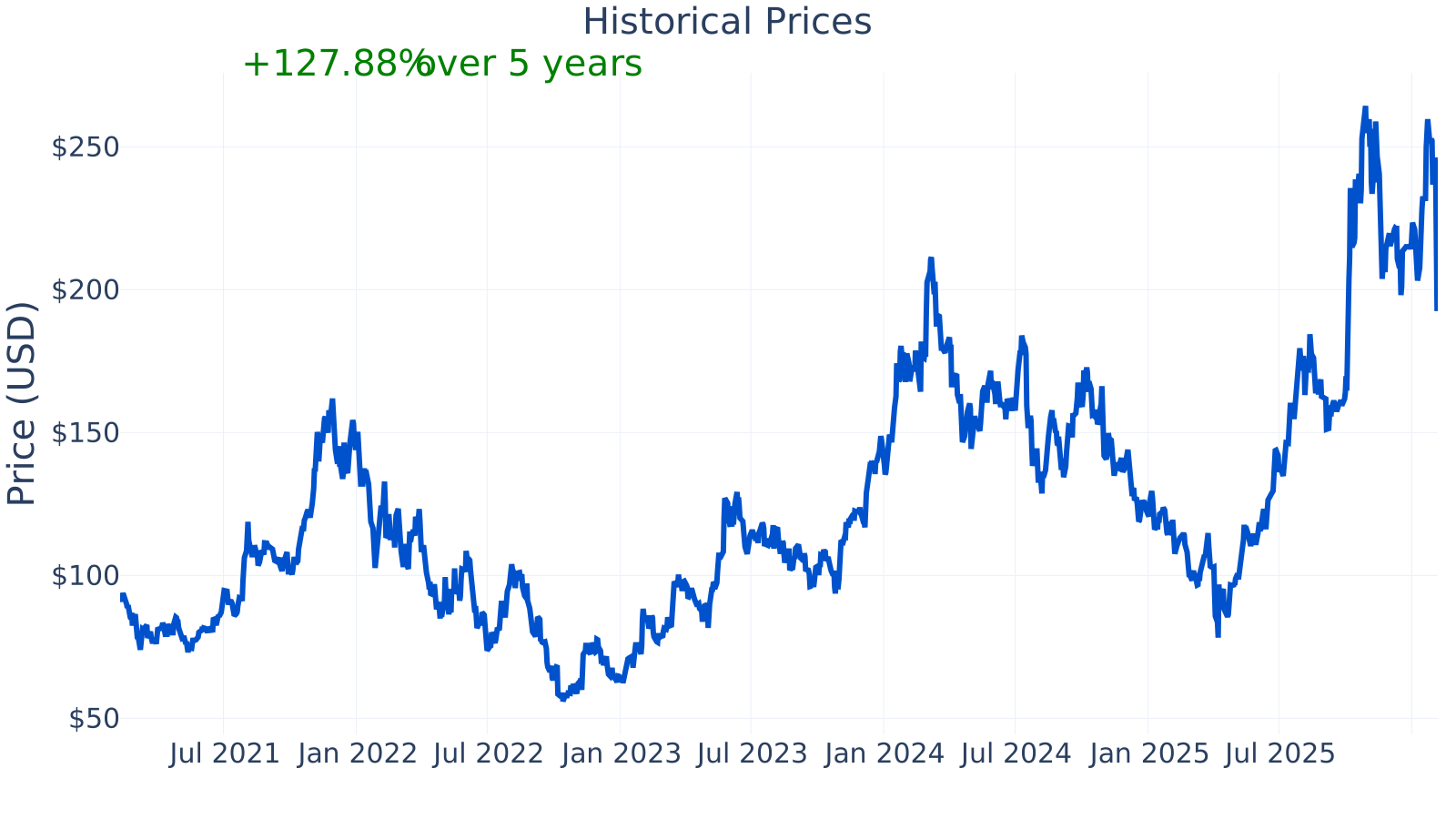
AMD’s market capitalization is about $339.8B. The stock’s beta (~1.95) indicates it has historically moved more than the broader market (higher volatility). The company’s profit margin is ~12.5% versus an industry median of ~9.4%. Recent year-over-year revenue growth is ~34.1%, above an industry median of ~13.1%. Leverage appears relatively low with debt-to-equity of ~7.1% versus an industry median of ~25.6%. Free cash flow over the trailing twelve months is about $6.74B.
Growth (High)
AMD operates in semiconductors, a sector tied to long-term demand for computing across cloud services, enterprise IT, consumer devices, and specialized applications. A major current driver across the industry is the build-out of advanced computing capacity, including workloads often grouped under “AI,” which typically require more powerful and more numerous chips in data centers.
AMD’s strategy is oriented around competing in higher-value parts of the market—particularly data center processors and accelerators—while maintaining a presence in PCs and other end markets. The company’s rising R&D spending over time aligns with the reality that semiconductor leadership is largely determined by sustained engineering investment, product cadence, and ecosystem support.
Revenue growth has been cyclical: very high growth in 2021–2022, a contraction in parts of 2023, followed by a clearer re-acceleration through 2024–2025. By the end of 2025, year-over-year growth is around 34%, which is meaningfully higher than the median level shown for the broader semiconductor peer set.
Free cash flow has also fluctuated over the period shown (from about $3.31B in 2022 down to about $1.17B in 2024, then back up to about $2.75B by 2025). This pattern is consistent with a business that experiences demand cycles and makes ongoing investments, while still producing substantial cash generation at scale.
Risks (High)
Semiconductors are cyclical. Demand can rise and fall with PC replacement cycles, enterprise spending, cloud capacity build-outs, and inventory adjustments across the supply chain. This cyclicality can affect revenue, margins, and cash flow even when long-term demand trends remain intact.
Competition is intense. AMD faces large, well-resourced rivals across its core markets, including Intel in CPUs, NVIDIA in data center accelerators and GPUs, and other semiconductor companies across embedded and specialized categories. Competitive outcomes depend on performance, power efficiency, total platform cost, software compatibility, and customers’ willingness to qualify and adopt alternatives. In some areas AMD is a strong challenger rather than the dominant leader, which can create both opportunity (share gains) and risk (pricing pressure and fast-moving product cycles).
AMD also depends on external manufacturing partners for chip production. This “fabless” model can be efficient, but it introduces supply chain and capacity risks (for example, constraints at manufacturing nodes used for leading-edge products), as well as execution risk around product launches tied to third-party manufacturing schedules.
Financial leverage appears relatively conservative: debt-to-equity is around 7%, below the industry median level shown (around 21%–36% across much of the displayed period). Lower leverage can reduce financial strain during down cycles, but it does not remove operational or competitive risks.
Profitability has varied materially. Net profit margin was very high in parts of 2021 (mid-20% range), fell sharply through 2022–2023 (briefly near break-even), and then recovered to about 12.5% by 2025, which is above the industry median shown. This history highlights that margins can move quickly in response to product mix, pricing, costs, and demand conditions.
Valuation
AMD’s valuation metrics reflect expectations for future growth and profitability. The latest P/E ratio is ~79.9, compared with an industry median of ~45.9, indicating that the market price embeds higher expectations than the typical peer.
Over the period shown, AMD’s P/E has swung widely, sometimes far above the industry median. This kind of variation often happens when earnings are temporarily depressed or rapidly changing, because the P/E ratio can rise sharply when the “E” (earnings) is small. As profitability recovered into 2025, the P/E remains elevated versus the peer median, suggesting the stock price is still discounting strong execution and continued growth.
Another way to contextualize valuation is the PEG ratio (~0.65), which relates the P/E to expected growth (with the important caveat that PEG depends heavily on growth estimates and the timeframe used). A lower PEG can indicate that the price is not rising as quickly as projected growth, but it is not a guarantee and can change quickly if growth or margins differ from expectations.
Conclusion
AMD is a large semiconductor designer with a product portfolio spanning PCs and data centers, and it has shown the ability to grow revenue substantially over multiple years while investing heavily in engineering. Recent metrics show faster-than-median industry revenue growth, profit margins that have recovered to above the peer median, and relatively low leverage.
At the same time, AMD operates in a cyclical industry with rapid product cycles and strong competitors. The company’s profitability has proven variable across cycles, and the valuation (as reflected by P/E relative to peers) suggests that the market is placing meaningful weight on continued growth and execution in higher-performance segments.
Sources:
- SEC EDGAR — Advanced Micro Devices, Inc. — Form 10-K (Annual Report)
- SEC EDGAR — Advanced Micro Devices, Inc. — Form 10-Q (Quarterly Report)
- AMD Investor Relations — Annual Report / 10-K materials
- Wikipedia — “Advanced Micro Devices”
This article is for informational purposes only and does not constitute financial advice. Some content is AI-generated. See Disclaimer


