Stock Analysis · Aehr Test Systems (AEHR)
Overview
Aehr Test Systems (AEHR) designs and sells equipment used to test and “burn in” semiconductors (computer chips). “Burn-in” is a stress test: chips are run under higher-than-normal heat and electrical load to help detect early failures before the chips end up inside products like cars, industrial systems, or data-center hardware. The company also sells the related hardware and services needed to run these test processes in production environments.
From a business-model perspective, Aehr is part of the semiconductor supply chain, but it is not a chipmaker. It provides tools that chipmakers and outsourced test providers can use to improve quality and reliability—especially important in markets where failures are costly (for example, automotive electronics).
Main sources of revenue are typically grouped into broad categories in company filings, such as:
- Test and burn-in systems (the larger “tool” sales)
- Contactors and related consumables (parts that interface with the device being tested and are replaced over time)
- Services and support (installation, maintenance, upgrades)
Percentages by category can vary meaningfully by year depending on the timing of large system orders versus recurring consumables; the exact mix should be taken from the latest annual report segment/product disclosures.
Over the last several fiscal years shown, total revenue increased from about $16.6M (FY2021) to $66.2M (FY2024), then moved down to about $59.0M (FY2025). Profitability also appears to have been volatile: the company generated positive operating income in FY2022–FY2024, then reported an operating loss in FY2025 as costs rose and revenue declined.
Key Figures
| Metric | Value | Industry ⓘ |
|---|---|---|
| Date | Apr 06, 2026 | |
| Context | ||
| Sector | Technology | |
| Industry | Semiconductor Equipment & Materials | |
| Market Cap ⓘ | $1.36B | |
| Beta ⓘ | 2.29 | |
| Fundamental | ||
| P/E Ratio ⓘ | N/A | 46.09 |
| Profit Margin ⓘ | -16.63% | 7.37% |
| Revenue Growth ⓘ | -26.50% | 8.10% |
| Debt to Equity ⓘ | 7.77% | 25.99% |
| PEG ⓘ | 0.90 | |
| Free Cash Flow ⓘ | -$11.91M | |
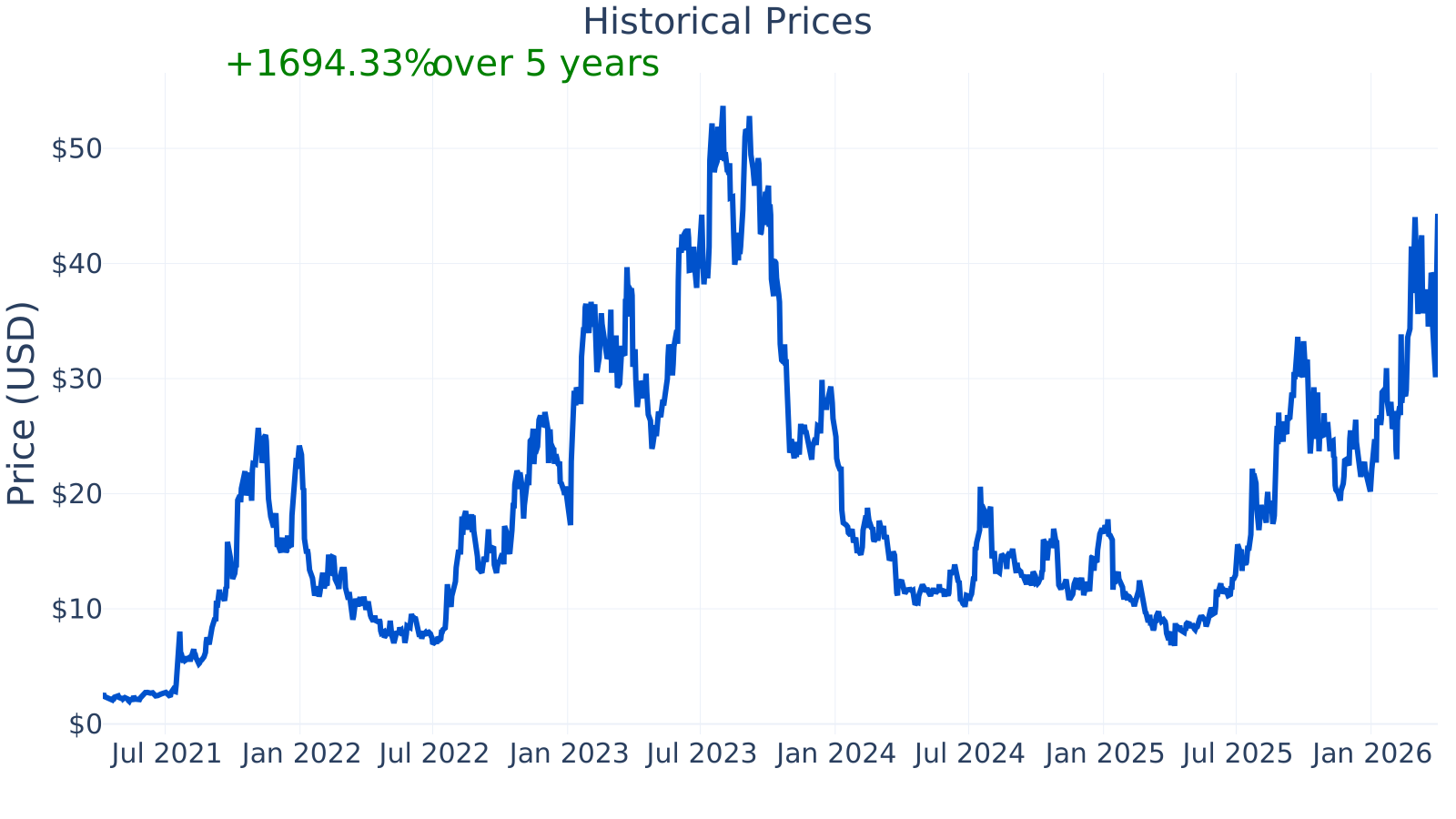
Aehr’s market capitalization is about $1.36B, and its beta (~2.29) indicates the stock has historically moved more than the overall market (higher volatility). Recent fundamentals show pressure: profit margin is about -16.6% versus an industry median near 7.4%, and year-over-year revenue growth is about -26.5% versus an industry median near 8.1%. Leverage looks modest with debt-to-equity around 7.8% (industry median ~26.0%). Trailing free cash flow is about -$11.9M, meaning cash generated after capital spending has been negative over the last twelve months.
Growth (medium)
Aehr operates in the semiconductor equipment ecosystem, where long-term demand is tied to rising chip content across many end markets. A major structural driver for test and reliability tools is that chips are increasingly used in safety- and uptime-sensitive applications (for example, vehicles, energy infrastructure, and industrial automation). In those settings, reliability screening can be more economically important than in low-cost consumer devices.
That said, this industry is known for cyclicality. Customers often place orders in waves aligned with capacity expansion cycles, and equipment vendors can see sharp changes in revenue depending on a few large programs. Aehr’s results reflect that pattern: after strong growth through FY2024, growth turned negative more recently.
The year-over-year revenue growth trend shows a transition from very high growth in earlier periods to negative growth in the most recent periods (for example, roughly -25% to -37% across several points shown, ending near -26.5%). This kind of swing can happen when customers digest prior tool purchases or delay new capacity adds.
Free cash flow turned from positive levels (roughly $1.8M to $4.5M across earlier points shown) to negative (about -$6.1M and then -$11.9M on the latest metric). For long-term business durability, a key question is whether this reflects temporary working-capital and investment needs during a downcycle, or whether profitability and cash generation are structurally weakening.
Potential catalysts (in a factual, non-predictive sense) typically come from: (1) broader semiconductor capital spending cycles improving, (2) design wins converting into volume production that requires additional test capacity, and (3) expansion of burn-in needs for newer device types and higher reliability requirements. The timing and magnitude of these factors can be uneven from year to year.
Risks (high)
Aehr’s main risks are closely tied to how semiconductor customers buy equipment. Revenue can be influenced by customer concentration, the timing of a small number of large orders, and rapid shifts in spending plans. This can create quarters (or even years) where reported results look very different from the prior period.
From a balance-sheet standpoint, leverage appears relatively conservative. Debt-to-equity declined materially from earlier elevated levels (for example, above 40% in 2021) and has been much lower in recent periods, ending around 7.8%, which is below the industry median (about 20%–26% depending on the date shown). Lower leverage can reduce financial risk during downturns, but it does not eliminate demand cyclicality.
Profitability has also been volatile. The profit margin was strongly positive for an extended stretch (peaking near 50% in some periods shown) but then turned negative and ended around -16.6%, while the industry median remained positive (around 7%–15% over the periods shown). This shift suggests that recent revenue softness and/or cost structure changes have had a meaningful impact on earnings.
Competitive positioning is another key risk area. Aehr participates in semiconductor test and burn-in equipment, where customers weigh equipment performance, cost-of-ownership, throughput, and long-term supplier reliability. Larger competitors may have broader product lines and deeper customer relationships, while smaller specialists may compete on niche performance or specific device types.
In terms of competitive advantages, Aehr’s potential strengths (as typically discussed in company materials and filings) tend to relate to specialized know-how in burn-in and production test workflows and its installed base that can drive recurring demand for interfaces/consumables and support. Whether that translates into durable leadership depends on the company’s ability to keep pace with changing chip packaging, new device architectures, and customer qualification requirements.
Main competitors are generally other semiconductor test and burn-in equipment providers, including large automated test equipment companies and other firms offering reliability and stress-test solutions. Competitive intensity can increase when semiconductor capital spending slows, as vendors compete harder for fewer projects.
Valuation
The price-to-earnings (P/E) history shown is uneven, including periods where the P/E is not meaningful (displayed as 0 on the chart) due to losses or extremely high values. When earnings were positive, the P/E ranged widely (for example, roughly from the low teens to above 80 at different points), while the industry median generally sat in a lower, steadier range (often around the teens to mid-40s on the dates shown).
In the current context, traditional P/E comparisons can be less informative because profitability is negative (profit margin ~-16.6%), so earnings-based valuation metrics may not reflect normalized performance. Investors who analyze valuation in such situations often focus more on balance-sheet strength, the durability of demand, the path back to sustainable margins, and whether revenue can re-accelerate—while recognizing that outcomes can vary across semiconductor cycles.
Conclusion
Aehr Test Systems is a specialized semiconductor equipment company focused on test and burn-in, a function that supports chip reliability in demanding applications. The company demonstrated a multi-year step-up in revenue through FY2024, but more recent results show a downturn: revenue growth is negative, profit margins have moved from strongly positive to negative, and trailing free cash flow has turned negative.
On the risk side, Aehr’s relatively low debt-to-equity suggests a more conservative leverage profile than many peers, which can matter in cyclical slowdowns. However, the business still appears exposed to uneven customer ordering patterns and the broader semiconductor capital spending cycle. The valuation picture is also harder to interpret using P/E ratios because recent profitability is negative, making earnings-based comparisons less stable.
Sources:
- SEC EDGAR — Aehr Test Systems, Inc. filings (Form 10-K, Form 10-Q, Form 8-K)
- Aehr Test Systems — Investor Relations materials and press releases (company-hosted)
- Wikipedia — “Aehr Test Systems” (basic company background)
This article is for informational purposes only and does not constitute financial advice. Some content is AI-generated. See Disclaimer


