Stock Analysis · Aehr Test Systems (AEHR)
Overview
Aehr Test Systems (AEHR) designs and sells equipment used to test semiconductors (computer chips). In simple terms, its products help chipmakers check whether chips work reliably—especially after chips have been packaged and are closer to being shipped. This kind of testing can be important for applications where failures are costly, such as automotive and industrial electronics.
The company operates in the semiconductor equipment space and focuses on systems and related components used for testing and “burn-in” (running chips under stress conditions to identify early failures). Aehr’s offering typically combines test systems with contact hardware (interfaces that connect the tester to the device being tested) and associated services.
Aehr’s revenue generally comes from selling test equipment, selling consumable or repeat-purchase hardware used with that equipment, and providing related services. In many semiconductor-equipment business models, results can be “lumpy,” meaning revenue may vary meaningfully depending on the timing of customer orders and project schedules.
Main revenue sources (typical company breakdown described in filings; exact percentages can vary by period and customer demand):
- Test and burn-in systems (capital equipment sold to customers)
- Contactors / interfaces and related hardware (often recurring with program ramps and replacements)
- Services, support, and other
Over the periods shown, revenue expanded sharply from 2021 to 2024, while operating expenses (R&D and SG&A) also increased. In 2025 (as shown), operating income and net income turned negative, illustrating how sensitive profitability can be to revenue volume and mix in a smaller semiconductor-equipment company.
Key Figures
| Metric | Value | Industry ⓘ |
|---|---|---|
| Date | Feb 23, 2026 | |
| Context | ||
| Sector | Technology | |
| Industry | Semiconductor Equipment & Materials | |
| Market Cap ⓘ | $1.03B | |
| Beta ⓘ | 2.31 | |
| Fundamental | ||
| P/E Ratio ⓘ | N/A | 49.76 |
| Profit Margin ⓘ | -16.63% | 7.37% |
| Revenue Growth ⓘ | -26.50% | 7.20% |
| Debt to Equity ⓘ | 7.77% | 20.49% |
| PEG ⓘ | 5.92 | |
| Free Cash Flow ⓘ | -$11.91M | |
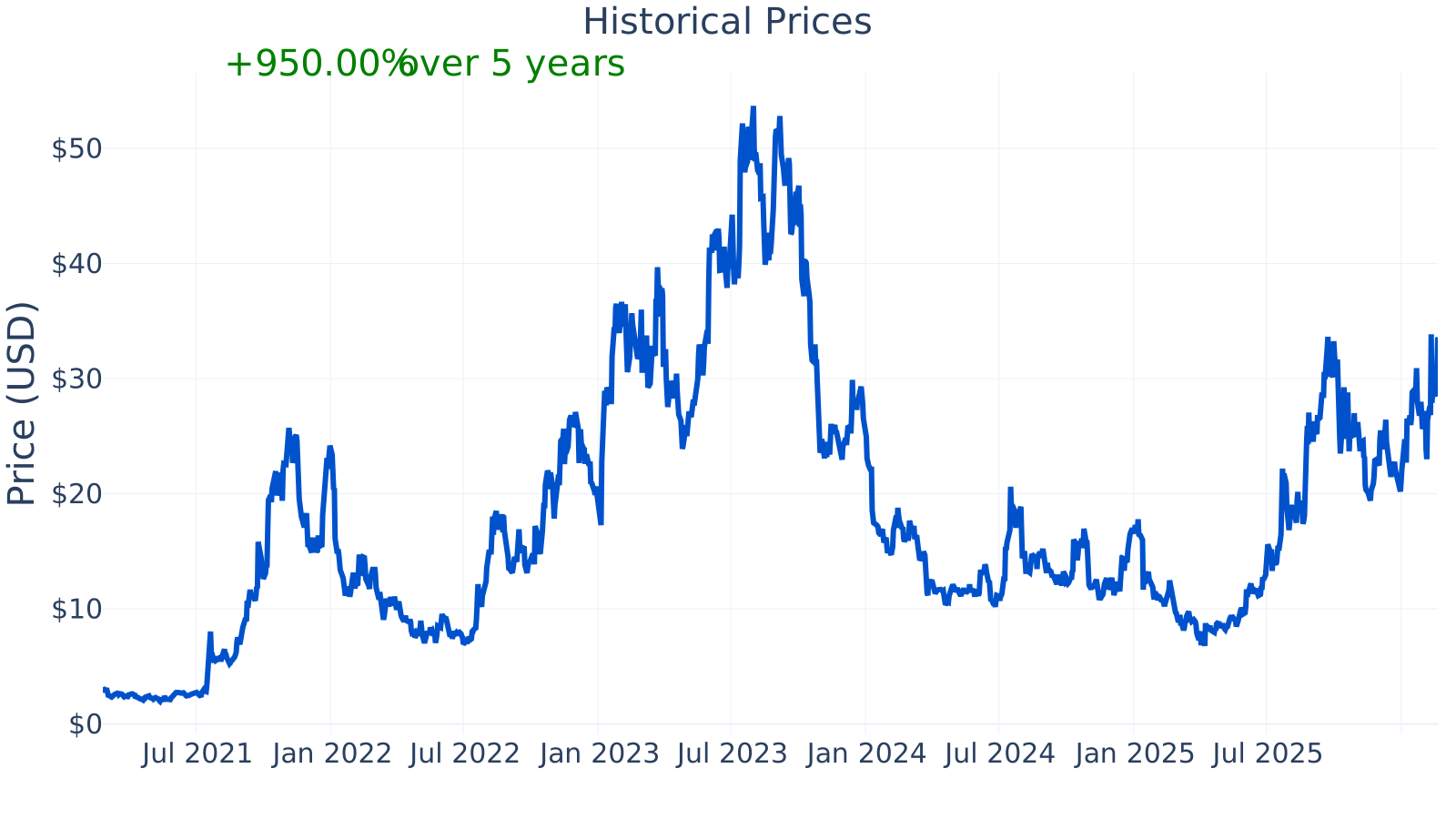
Aehr’s equity value is about $1.03B, and the stock has shown high volatility (beta ~2.31), which means it has historically moved more than the broader market. Recent fundamentals in the table point to a more challenging near-term picture versus the company’s stronger period in 2022–2024: profit margin is negative (~-16.6%) and year-over-year revenue growth is negative (~-26.5%), both weaker than the industry median. Leverage appears modest with debt-to-equity ~7.8%, below the industry median, while free cash flow over the trailing twelve months is negative (~-$11.9M). The PEG ratio (~5.92) suggests the market price may be embedding meaningful growth expectations relative to commonly used growth assumptions (PEG can be sensitive to the growth inputs used).
Growth (Medium)
Aehr participates in the semiconductor equipment industry, which is tied to long-term drivers such as increasing chip content in cars and industrial systems, ongoing growth in compute and data, and the need for reliability testing as chips become more complex. That said, semiconductor equipment demand is cyclical: customers often buy tools in waves, then pause as capacity is absorbed.
The company’s strategy centers on tools and hardware used for testing and screening devices—an area that can benefit when customers push for higher reliability and better yields (the share of good chips). If customers adopt new device types or testing approaches that require additional screening, that can increase demand for systems and the related interfaces that are used over time.
The revenue growth pattern shown is typical of a cyclical, project-driven supplier: very strong growth in 2021–2023, followed by a clear slowdown and then contraction into 2024–2025. For long-term context, this highlights that the company’s growth can be strong during adoption or expansion phases, but it may not be steady quarter-to-quarter or year-to-year.
Free cash flow improved from negative (2021) to positive (2022–2024), then moved back to negative in 2025. This swing can happen when revenue moderates but expenses and working capital needs do not fall as quickly, or when the company invests ahead of demand. A sustained return to positive free cash generation typically depends on stabilizing revenue and keeping operating costs aligned with sales volume.
Risks (High)
This article is for informational purposes only and does not constitute financial advice. Some content is AI-generated. See Disclaimer