Stock Analysis · Advance Auto Parts Inc (AAP)
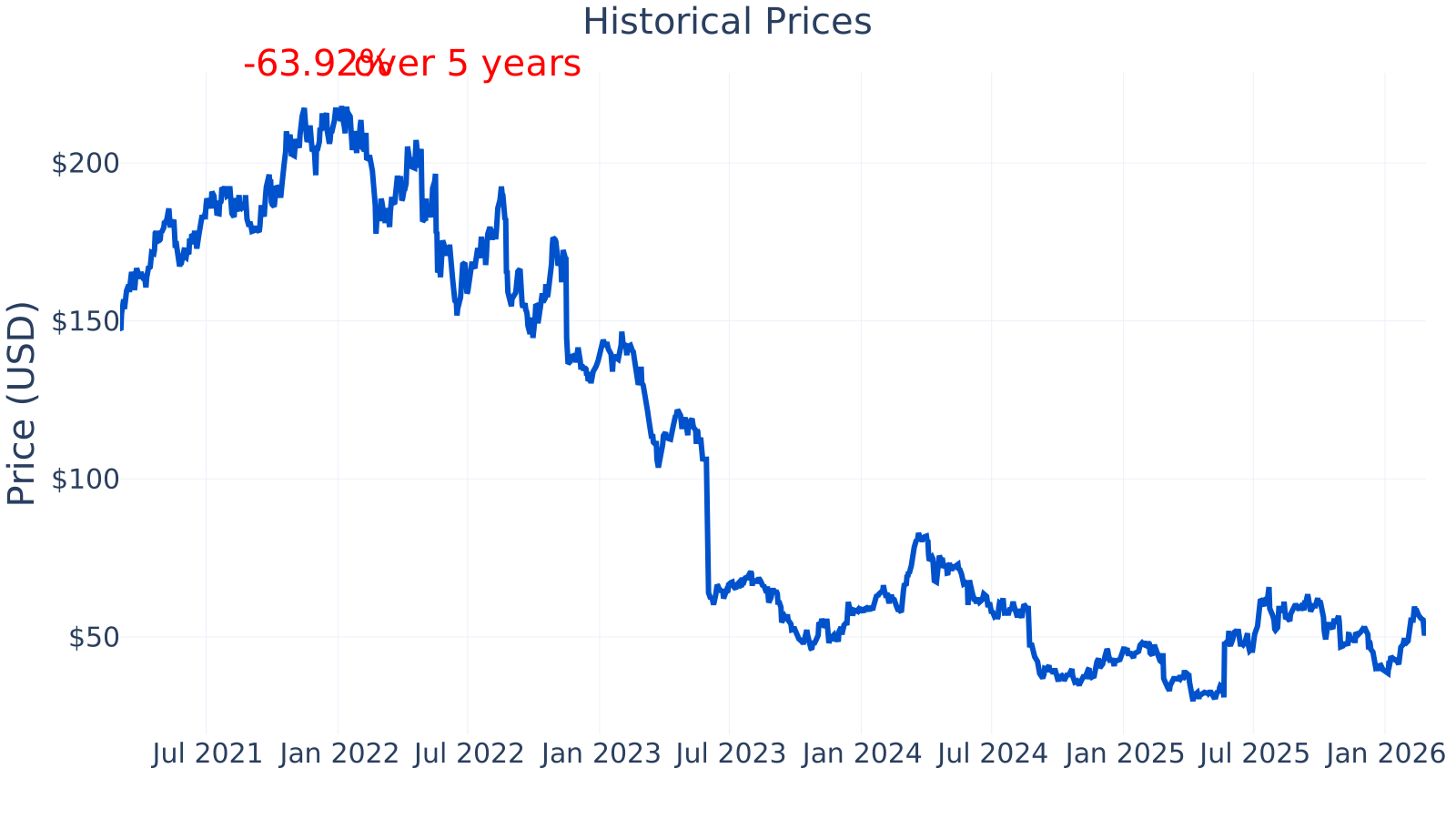
Overview
Advance Auto Parts, Inc. (AAP) is a retailer and distributor of aftermarket automotive parts, accessories, and maintenance items. In plain terms, it sells the replacement parts and tools used to repair and maintain vehicles after they have been sold by the original manufacturer. The company serves two main customer groups: (1) “do-it-yourself” consumers who work on their own cars and (2) professional installers/repair shops that buy parts frequently to service customer vehicles.
Its sales are primarily driven by routine vehicle needs (brakes, batteries, filters, fluids), wear-and-tear replacements, and repairs. Demand tends to be linked to how many vehicles are on the road, how old they are, and how many miles people drive. This is generally considered a “maintenance” category rather than a discretionary luxury purchase, although results can still swing based on execution, pricing, and competition.
Public filings typically describe the business around customer channels rather than breaking revenue into many product categories. At a high level, the main revenue sources are:
- Professional (repair shops / installers): recurring orders from garages and service providers
- Do-it-yourself (retail consumers): purchases made by individuals online and in stores
- Other items/services: smaller ancillary revenue streams disclosed in filings when applicable
The company’s recent income statement profile shows a business with substantial cost of goods sold and significant operating expenses (notably selling, general, and administrative costs). From 2021 to 2025, total revenue declined from about $11.0B (2021) to about $8.6B (2025), while profitability was volatile, including a large net loss in 2024.
Looking across the years shown, revenue trended down (about $11.0B in 2021 to about $8.6B in 2025). Operating income moved from solidly positive in 2021–2022 to near break-even in 2023, deeply negative in 2024, and back to positive in 2025. Interest expense also rose meaningfully by 2025, which can matter more when operating profits are under pressure.
Key Figures
| Metric | Value | Industry ⓘ |
|---|---|---|
| Date | Mar 02, 2026 | |
| Context | ||
| Sector | Consumer Cyclical | |
| Industry | Auto Parts | |
| Market Cap ⓘ | $3.20B | |
| Beta ⓘ | 1.17 | |
| Fundamental | ||
| P/E Ratio ⓘ | 47.05 | 24.70 |
| Profit Margin ⓘ | 0.51% | 3.56% |
| Revenue Growth ⓘ | -1.20% | 4.90% |
| Debt to Equity ⓘ | 339.90% | 76.35% |
| PEG ⓘ | 1.44 | |
| Free Cash Flow ⓘ | -$298.00M | |
Advance Auto Parts has a market capitalization of about $3.2B and a beta of ~1.17, which indicates the stock has tended to move somewhat more than the overall market. The company’s P/E ratio is ~47.1, above the industry median of about 24.7, while profit margin is ~0.5% versus an industry median near 3.6%. Year-over-year revenue growth is slightly negative at about -1.2% (industry median about +4.9%). Leverage is high with debt-to-equity of ~340% compared with an industry median near 76%. Free cash flow over the trailing twelve months is negative (~-$298M), meaning cash generated after capital spending has recently been insufficient to cover investments and other cash needs without relying on cash balances or financing.
Growth (Low)
The aftermarket auto parts industry is generally supported by long-term factors such as an aging vehicle fleet and ongoing maintenance needs. Even as new vehicle technologies evolve, vehicles still require many maintenance items (though the mix can change over time). In that sense, the broader category is often viewed as relatively steady compared with more cyclical consumer segments.
However, company-specific growth is not only about the industry; it also depends heavily on execution (in-stock levels, distribution speed to professional customers, pricing, promotions, and customer service). The revenue trend shown here suggests that Advance Auto Parts has been facing headwinds: year-over-year revenue growth turned negative in multiple quarters, and the latest reading is around -1.2%, below the industry median.
The year-over-year revenue growth line shows a shift from positive growth in 2021–2022 to repeated declines from late 2023 through 2025. For a retail/distribution business, sustained negative growth can reflect competitive pressure, lost share, store productivity issues, weaker demand in certain channels, or deliberate changes to pricing and assortment; filings and calls typically provide the operational context behind those movements.
Cash generation is another practical “growth enabler” because it helps fund inventory, distribution improvements, and store investments without adding debt. Here, free cash flow has been volatile and recently negative.
The free cash flow pattern moved from strongly positive in 2021 to much lower in 2022, around break-even/negative in 2023, positive again in 2024, and negative in 2025. This variability can limit flexibility, especially when paired with higher leverage, and it can make multi-year improvement plans harder to execute without careful cost control and working-capital discipline.
Potential catalysts in this type of business typically come from operational improvements: better product availability, faster delivery to professional customers, improved merchandising, and tighter expense control. Any measurable stabilization in sales trends and a sustained return to healthy cash generation would usually be considered important signals for a long-term business turnaround narrative.
Risks (High)
A key risk for Advance Auto Parts is that recent profitability has been weak and inconsistent. Profit margin fell sharply from mid-single-digit levels in 2021 to near zero or negative in several periods thereafter, before returning to a small positive value most recently. Thin margins provide less cushion against pricing pressure, wage inflation, supply chain friction, or higher shrink and returns.
The profit margin trend shows a steep deterioration from roughly 5–6% in 2021 toward near-zero and negative territory through much of 2024–2025, while the industry median stayed positive in the mid-single digits for most of the period. Even with a recent improvement to about 0.5%, profitability remains well below the industry median (about 3.4%), which highlights execution risk and the importance of sustained cost and pricing discipline.
Leverage is another major risk factor. Debt can be useful when a business is stable and cash generative, but it becomes more constraining when earnings and cash flow are under pressure. Advance Auto Parts’ latest debt-to-equity level is substantially higher than the industry median, and the longer-term trend shows a meaningful increase over time.
Debt-to-equity rose from roughly 88% in early 2021 to about 340% by the end of 2025, far above the industry median (roughly 76%). This suggests a more leveraged balance sheet than many peers, which can amplify outcomes—helpful if operations improve, but more challenging if margins and cash flow remain weak.
Competitive intensity is structurally high in auto parts retailing and distribution. Large, scaled competitors can compete on store footprint, supply chain speed, loyalty programs, and professional delivery networks. In addition, online retailers and marketplace sellers can pressure prices on certain product lines. Because many auto parts are somewhat standardized, competitive advantages often come from logistics execution, availability, and service levels rather than from unique products.
In terms of positioning, Advance Auto Parts competes with other national auto parts retailers and distributors serving both DIY and professional channels. Key risks versus competitors include losing share in the professional segment (where frequent delivery and fill rates matter), and margin compression if pricing is used to defend volume. The company’s recent weaker margin profile versus the industry median suggests it has less room for error while it works through operational changes.
Valuation
Valuation is often summarized using multiples like the price-to-earnings (P/E) ratio, but P/E can be difficult to interpret when earnings are unusually low or volatile. That context matters here given the sharp swings in operating income and net income across 2023–2025.
The latest P/E is about 47.1 versus an industry median near 24.7. Historically in the period shown, the company’s P/E was often in the teens to low 20s before later becoming less stable (including periods where it is not meaningfully shown, which typically happens when earnings are negative or extremely small). A higher-than-industry P/E can sometimes reflect expectations of a profit recovery, but when profit margins and free cash flow are under pressure, it can also indicate that the “E” (earnings) is temporarily depressed and may not represent a steady earning level.
Given the combination of low margins, negative recent free cash flow, and elevated leverage, valuation discussions for AAP tend to be closely tied to whether operations stabilize and profitability normalizes. Without a clearer multi-period track record of improved margins and cash generation, single-number valuation measures can be less informative than they appear.
Conclusion
Advance Auto Parts operates in a large, essential vehicle-maintenance category with recurring demand, serving both retail consumers and professional repair customers. That industry backdrop can be supportive over long periods, but recent company performance shown here points to meaningful execution challenges: declining revenue across multiple periods, profit margins well below the industry median, negative free cash flow in the most recent trailing period, and a materially higher debt load than many industry peers.
From a long-term perspective, the central question is less about whether drivers will need replacement parts (they will) and more about whether Advance Auto Parts can consistently translate that demand into durable profitability and cash generation while managing leverage. The recent trends indicate that operational improvements and financial stabilization would be the main determinants of how the long-term fundamentals develop from here.
Sources:
- SEC EDGAR — Advance Auto Parts, Inc. filings (Form 10-K, Form 10-Q, Form 8-K)
- Advance Auto Parts Investor Relations — Annual Report materials and investor presentations (company-hosted)
- Advance Auto Parts Investor Relations — Earnings call transcripts / prepared remarks (company-hosted public releases)
- Wikipedia — “Advance Auto Parts” (basic company background)
This article is for informational purposes only and does not constitute financial advice. Some content is AI-generated. See Disclaimer


