Stock Analysis · Acushnet Holdings Corp (GOLF)
Overview
Acushnet Holdings Corp is a golf-focused consumer products company. It designs, manufactures, and sells golf equipment and related products, best known through the Titleist and FootJoy brands. In practical terms, the business earns money when golfers (and retailers, golf shops, and clubs) purchase its golf balls, clubs, gloves, shoes, and apparel.
Revenue is primarily driven by a mix of “hard goods” (notably golf balls and clubs) and “soft goods” (footwear, gloves, and apparel). Based on how the company reports its operations in its annual filings, the main revenue streams are typically organized around these segments:
- Titleist golf equipment (especially golf balls and golf clubs)
- FootJoy (golf shoes, gloves, and apparel)
- Other golf-related products and distributed brands (smaller portion)
Across recent years, the company’s overall revenue has been in the roughly $2.1B–$2.5B range annually, with profitability supported by gross profit that has generally remained above the cost of making and sourcing products, while selling and administrative spending is a major operating cost line.
From 2021 to 2024, total revenue rose from about $2.15B to about $2.46B. Over the same span, operating income increased (about $255M to $304M), while interest expense also climbed (about $6.7M to $54.7M), which is consistent with a business that has taken on more debt and/or faced higher interest rates.
Key Figures
| Metric | Value | Industry ⓘ |
|---|---|---|
| Date | Feb 08, 2026 | |
| Context | ||
| Sector | Consumer Cyclical | |
| Industry | Leisure | |
| Market Cap ⓘ | $5.96B | |
| Beta ⓘ | 0.89 | |
| Fundamental | ||
| P/E Ratio ⓘ | 27.52 | 27.52 |
| Profit Margin ⓘ | 8.80% | 7.90% |
| Revenue Growth ⓘ | 6.00% | 6.00% |
| Debt to Equity ⓘ | 105.80% | 33.08% |
| PEG ⓘ | 3.66 | |
| Free Cash Flow ⓘ | $110.14M | |
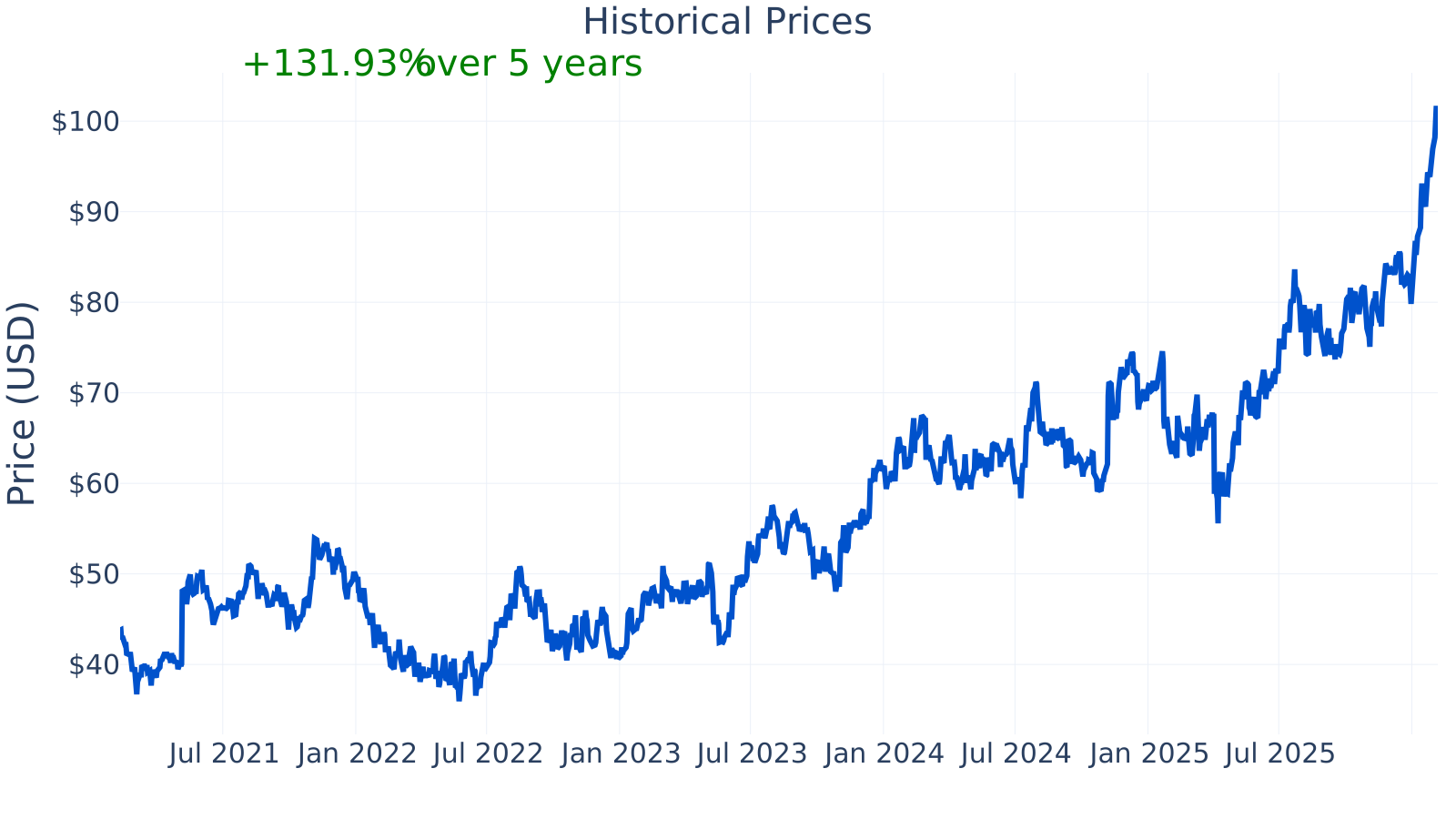
Acushnet’s market capitalization is about $6.0B, and the stock’s beta (~0.89) suggests it has historically moved somewhat less than the overall market. The latest P/E ratio (~27.5) is in line with the median for its listed industry peer group shown here. Profitability is slightly above that peer median with a net profit margin of ~8.8% versus an industry median of ~7.9%. Recent year-over-year revenue growth is ~6%, also around the peer median.
Two balance-sheet and cash items stand out. First, debt-to-equity is ~106%, notably higher than the shown industry median of ~33%, implying heavier reliance on borrowing than many peers. Second, free cash flow over the last twelve months is about $110M, indicating the business has been generating cash after operating needs and capital spending, though this measure has fluctuated meaningfully in recent years.
Growth (Medium)
Acushnet operates in the golf industry, which tends to be mature overall but can still grow through participation trends, premium product innovation, and international expansion. Demand is also influenced by consumer discretionary spending (people typically spend more on equipment and apparel when they feel financially comfortable) and by replacement cycles (golf balls and gloves are replenished frequently, clubs less often). This creates a business profile that can grow, but not always in a straight line year to year.
A core part of Acushnet’s growth strategy is brand-led premium positioning: using well-known names in golf to support steady demand, pricing power, and retailer shelf space. Another key lever is product cadence—regular new launches in clubs, ball models, footwear, and apparel—aimed at keeping products relevant and maintaining a premium mix. When executed well, this approach can support margins as much as (or more than) pure volume growth.
The year-over-year revenue growth pattern has been uneven. After very high growth in parts of 2021 (from a low comparison period), growth cooled to mid-single digits through much of 2022, turned negative in at least one quarter in late 2023, and has hovered around low single digits to mid-single digits across several more recent quarters. That pattern is consistent with a business exposed to consumer cycles and retailer inventory adjustments.
Free cash flow has also been volatile: it was strongly positive in 2021, lower in 2022, negative around 2023, then rebounded in 2024 and remained positive into 2025. For a consumer products company, this variability often reflects changes in working capital (inventory and receivables), timing of product builds, and the pace of investment—factors that matter for long-term durability because cash generation helps fund operations, debt service, and shareholder returns.
Risks (Medium-High)
This article is for informational purposes only and does not constitute financial advice. Some content is AI-generated. See Disclaimer


