Stock Analysis · Academy Sports Outdoors Inc (ASO)
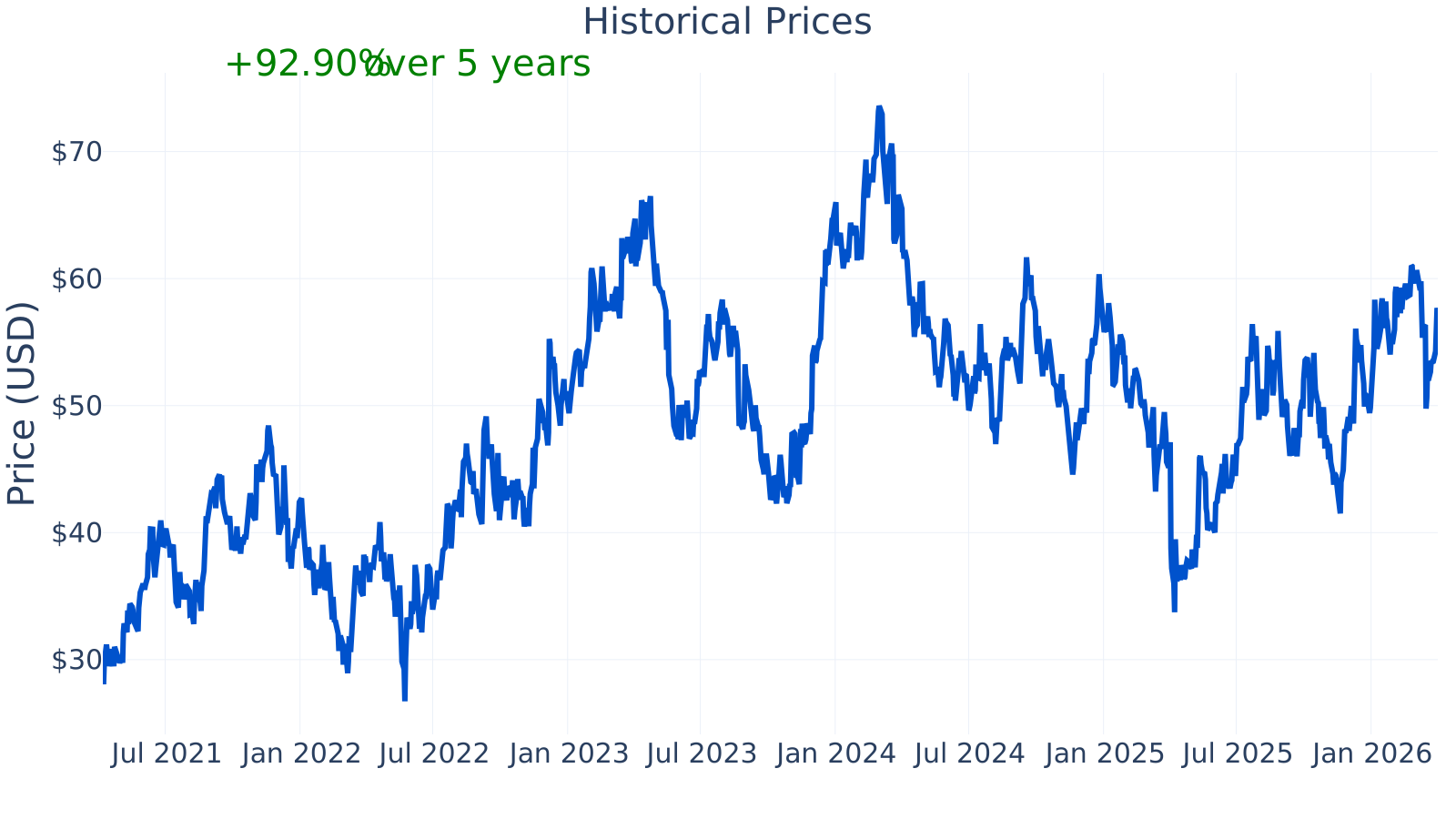
Overview
Academy Sports + Outdoors, Inc. is a U.S. sporting goods and outdoor recreation retailer. It sells products such as athletic apparel and footwear, sports and fitness equipment, and outdoor items (including hunting, fishing, and camping gear). The company operates primarily through a chain of physical stores, supported by an e-commerce channel that extends its reach beyond store markets.
From a business-model perspective, Academy’s revenue is mainly driven by selling branded and private-label merchandise to everyday consumers. Demand tends to be influenced by consumer spending, seasonal sports calendars, and outdoor recreation trends.
Based on how Academy describes its business in its SEC filings, the main revenue categories are typically discussed as merchandise groups rather than separate “business lines.” Exact percentage splits can vary by year and are not always disclosed as fixed shares. The largest revenue drivers are generally:
- Apparel and footwear (sportswear, casual wear, athletic shoes)
- Outdoor (hunting, fishing, camping, and related equipment)
- Sports and recreation (team sports, fitness, and general sporting goods)
Academy’s financial profile is shaped by retail fundamentals: buying inventory at the right cost, managing promotions and markdowns, controlling store operating expenses, and keeping a close watch on working capital (inventory and payables).
Across the periods shown, total revenue moved from about $6.77B (FY2022) down to $5.93B (FY2025), then back up to about $6.05B (FY2026). Over the same span, selling, general and administrative expenses rose (from about $1.29B in FY2022 to about $1.59B in FY2026), while operating income and net income declined versus earlier peaks—illustrating how changes in sales volume, product mix, and expense levels can meaningfully affect profitability in retail.
Key Figures
| Metric | Value | Industry ⓘ |
|---|---|---|
| Date | Apr 06, 2026 | |
| Context | ||
| Sector | Consumer Cyclical | |
| Industry | Specialty Retail | |
| Market Cap ⓘ | $3.82B | |
| Beta ⓘ | 1.22 | |
| Fundamental | ||
| P/E Ratio ⓘ | 10.35 | 20.59 |
| Profit Margin ⓘ | 6.22% | 4.93% |
| Revenue Growth ⓘ | 2.50% | 3.70% |
| Debt to Equity ⓘ | 65.01% | 92.65% |
| PEG ⓘ | 0.66 | |
| Free Cash Flow ⓘ | $221.97M | |
Academy’s market capitalization is about $3.82B, placing it in the mid-cap range. The stock’s beta of ~1.22 suggests it has historically moved somewhat more than the overall market. On profitability, the company’s profit margin is ~6.22%, above the specialty retail median shown (~4.93%). Growth is more muted in the latest snapshot: year-over-year revenue growth is ~2.5% versus an industry median near 3.7%. Balance-sheet leverage appears lower than the industry median, with debt-to-equity ~65% compared with ~93% for the peer median listed. Trailing twelve-month free cash flow is about $222M, indicating the business has recently generated cash after operating needs and capital spending, though this can vary significantly in retail depending on inventory cycles.
Growth (Medium)
Academy operates in the sporting goods and outdoor retail space, which is generally tied to long-term participation in sports, fitness, and outdoor recreation, but also strongly influenced by consumer confidence and discretionary spending. This is not typically a “straight-line” growth industry: results can look strong in some years and slow in others depending on product cycles, promotions, and broader economic conditions.
A practical way to think about Academy’s growth strategy (as described in company filings) is a combination of: (1) improving performance in existing stores through merchandising and execution, (2) adding new stores in selected markets, and (3) growing digital sales as a complement to physical locations. For long-term fundamentals, the key question is whether the company can maintain healthy merchandise margins while funding store growth and managing inventory well.
The year-over-year revenue pattern shown is uneven: strong positive growth in parts of 2021 and early 2022, followed by several quarters of decline, and then a return to modest growth more recently (around ~2%–3% in the latest points shown). This kind of volatility is common in retail and often reflects changing demand, comparisons against strong prior periods, and the level of promotional activity needed to drive traffic.
Free cash flow has trended down from earlier highs (about $1.09B in 2021) to roughly $222M in the latest trailing period. Even when a retailer remains profitable, free cash flow can compress when inventory needs rise, when margins normalize, or when investments increase. For long-term monitoring, consistency and resilience of cash generation through different demand environments tends to matter as much as any single-year number.
Risks (Medium-High)
Academy’s main risks are typical of a consumer-facing retailer. Demand can weaken quickly when households pull back on discretionary purchases. Competition is also intense across both physical retail and e-commerce, and pricing pressure can increase when peers promote heavily or when product categories become oversupplied. Because Academy sells many seasonal and trend-sensitive items, inventory planning and markdown risk are ongoing operational challenges.
In competitive positioning, Academy operates in a crowded field that includes large-format sporting goods retailers and broadline retailers with sporting/outdoor departments, as well as brand-direct e-commerce. The company’s potential advantages—based on how it describes itself in filings—tend to come from value-oriented positioning, localized assortments, private-label offerings, and scale benefits in purchasing and distribution. However, it is not the only well-known player in the category, and sustained differentiation can be difficult when products are similar and consumers compare prices easily.
Balance-sheet risk is often discussed through leverage, because higher debt can reduce flexibility during weaker retail cycles.
The debt-to-equity ratio declined materially versus the early part of the chart (from well above 100% in 2021 to about 65% most recently), and it sits below the industry median line shown. This suggests less reliance on debt than many peers in the comparison set, which can be helpful in a downturn. Still, the ratio has moved around over time, so it is not a “set and forget” metric.
Profitability is another key retail risk area, because small changes in gross margin or operating costs can meaningfully affect net income.
Net profit margin has stepped down from peaks near ~9%–10% in 2022–2023 to about ~6.2% recently. Even after the decline, the company remains above the industry median shown in the chart, but the direction highlights a real risk: if promotions increase further or operating costs rise faster than sales, profits can compress quickly.
Valuation
The price-to-earnings (P/E) ratio shown for Academy is around 10.35 most recently, while the listed specialty retail median is about 20.59. Historically in the chart, Academy’s P/E has often been below the peer median. A lower P/E can reflect market expectations for slower growth, more cyclical earnings, higher uncertainty about future margins, or simply a more conservative valuation applied to the company.
Interpreting valuation alongside fundamentals: Academy’s recent profile shows modest revenue growth, profit margins that are still above the peer median but trending lower, and positive (though reduced) free cash flow. In that context, a lower-than-median earnings multiple is consistent with a business that the market may view as mature and sensitive to consumer cycles, while still capable of generating earnings and cash when operations are steady.
Conclusion
Academy Sports + Outdoors is a consumer cyclical retailer whose results depend heavily on execution (inventory, promotions, and expense control) and the willingness of consumers to spend on discretionary categories like sports and outdoor recreation. The company has recently shown profitability above the peer median and lower leverage than the peer median, while revenue growth has been uneven and margins have normalized downward from earlier highs.
From a long-term perspective, the main points to keep in view are whether Academy can sustain stable margins through competitive cycles, keep generating cash after inventory and store investments, and grow in a disciplined way without eroding returns. The valuation metrics shown indicate the stock has typically traded at a lower earnings multiple than the industry median, which aligns with the company’s cyclical retail exposure and the recent moderation in growth and cash generation.
Sources:
- U.S. Securities and Exchange Commission (SEC) EDGAR — Academy Sports + Outdoors, Inc. filings (Form 10-K, Form 10-Q)
- Academy Sports + Outdoors, Inc. — Investor Relations materials (annual report/filings and investor presentations, where available)
- Wikipedia — “Academy Sports + Outdoors” (basic company background)
This article is for informational purposes only and does not constitute financial advice. Some content is AI-generated. See Disclaimer


