Stock Analysis · Abercrombie & Fitch Company (ANF)
Overview
Abercrombie & Fitch Company is a specialty apparel retailer that designs, sources, markets, and sells clothing and accessories. The company operates through a mix of physical stores and digital channels (its websites and apps), and it focuses on two main brands: Abercrombie and Hollister. In simple terms, the business earns money by selling apparel to customers, managing inventory efficiently, and keeping brand demand strong enough to support healthy pricing.
Revenue is primarily generated from selling products to consumers, with sales typically described by brand and by sales channel (stores vs. digital) in company filings. A common way to think about the revenue “mix” for a retailer like ANF is:
- Product sales (apparel and accessories) across the two brands (Abercrombie and Hollister)
- Direct-to-consumer (digital) sales through e-commerce
- Store-based sales through company-operated retail locations
The company’s recent financial profile shows that revenue has increased meaningfully over the last few fiscal years, while profitability has improved compared with the weaker period around fiscal 2023 (as shown in the operating and net income lines below).
Across the most recent fiscal years shown, total revenue rose from about $3.7B (FY2023) to about $5.3B (FY2026), while net income increased from near break-even in FY2023 to roughly $507M in FY2026. That combination suggests the company was not only selling more, but also converting a larger portion of sales into profit than it did a few years earlier.
Key Figures
| Metric | Value | Industry ⓘ |
|---|---|---|
| Date | Mar 09, 2026 | |
| Context | ||
| Sector | Consumer Cyclical | |
| Industry | Apparel Retail | |
| Market Cap ⓘ | $4.00B | |
| Beta ⓘ | 1.11 | |
| Fundamental | ||
| P/E Ratio ⓘ | 8.18 | 14.87 |
| Profit Margin ⓘ | 9.63% | 8.32% |
| Revenue Growth ⓘ | 5.40% | 8.90% |
| Debt to Equity ⓘ | 83.20% | 92.83% |
| PEG ⓘ | 3.62 | |
| Free Cash Flow ⓘ | $378.37M | |
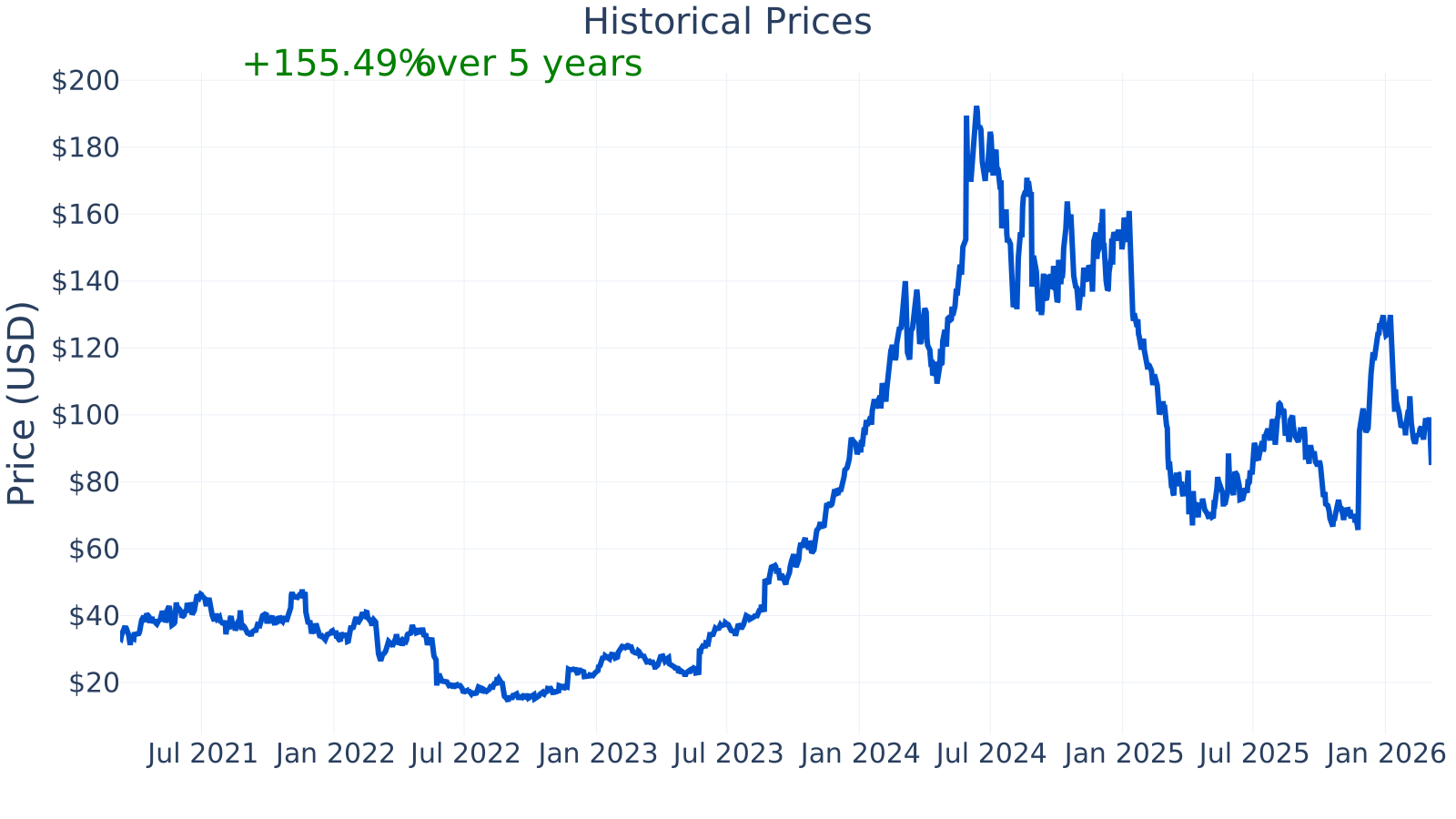
At the latest point shown, Abercrombie & Fitch Company has a market capitalization of about $4.0B and a beta of about 1.11 (a measure often used to describe how volatile the stock has been relative to the broader market). The current P/E ratio is ~8.18, below the industry median shown (~14.87). Profit margin is about 9.63% versus an industry median near 8.32%. Year-over-year revenue growth is about 5.4% versus an industry median near 8.9%. Debt-to-equity is about 83% compared with an industry median near 93%. Trailing twelve-month free cash flow is about $378M.
Growth (Medium)
Apparel retail is generally considered a mature, highly competitive part of consumer spending rather than a “high-growth” industry. Demand is influenced by fashion cycles, consumer confidence, and discretionary income. That said, individual brands can still grow meaningfully for extended periods if they improve product relevance, execute well on merchandising and inventory discipline, and build strong digital experiences.
The year-over-year revenue growth trend shows a sharp recovery after weaker periods, with especially strong growth through parts of FY2024, and then a moderation to mid-single-digit growth more recently (about 5.4% at the latest point shown). This pattern is common in retail: growth can surge during a successful product cycle and then normalize as comparisons get tougher.
Free cash flow (cash generated after operating needs and capital spending) swung from negative around FY2023 (about -$167M) to strongly positive in FY2024 and FY2025 (about $495M and $527M), and remained positive in FY2026 (about $378M). For long-term business durability, sustained positive free cash flow can matter because it gives a company flexibility to reinvest, reduce debt, or withstand downturns without relying as heavily on outside financing.
Potential growth catalysts for an apparel retailer like ANF typically include better product acceptance, improved inventory management (fewer markdowns), continued gains in digital conversion and customer retention, and expansion in categories or regions where the brands resonate. The main point is that growth is likely to be driven more by company execution and brand strength than by industry tailwinds.
Risks (High)
Retail apparel carries meaningful risk because results can change quickly when consumer demand shifts. If fashion trends move away from the company’s assortments, or if the company buys too much inventory in the wrong styles, it may need to discount heavily—often pressuring margins and cash flow. Costs can also be volatile: sourcing, freight, and wage pressures can reduce profitability, especially if price increases are difficult to pass through to customers.
Competition is intense. Abercrombie and Hollister compete for consumer attention and spending with a wide range of retailers and brands across similar price points and demographics, including large specialty apparel chains, fast-fashion players, athletic and lifestyle brands, and department stores. In this environment, competitive advantages are usually “soft” rather than structural: brand strength, fit and quality perception, speed of product development, marketing effectiveness, and an efficient store-and-digital operating model. The company is a well-known brand owner, but the category does not typically have a single permanent leader, and market share can shift over time.
The debt-to-equity ratio has generally trended down from higher levels earlier in the period shown (often above 100%) to about 83% most recently, which is also below the industry median shown (about 93%). Even with improvement, leverage still matters in retail because downturns can put pressure on earnings and cash flow at the same time that lease commitments and other fixed costs remain.
Profit margin improved substantially from very low levels around FY2023 (near break-even) to around 9–11% through much of FY2024–FY2026, landing at about 9.63% most recently. While that is above the industry median shown, retail margins can be cyclical; a key risk is that the current margin level may not hold if promotions increase or costs rise.
Valuation
The P/E ratio shown has moved significantly over time, which is often what happens when earnings swing up and down in a cyclical business. Most recently, the P/E is about 8.18, below the industry median shown (about 14.87). A lower P/E can indicate the market is assigning a more cautious outlook to the company’s future earnings, or it can reflect that current earnings are elevated relative to the stock price.
Whether the current valuation is “high” or “low” depends heavily on how sustainable the recent improvement is. If revenue growth remains modest (mid-single digits recently) and profit margins normalize downward in a tougher demand environment, valuation metrics can change quickly. On the other hand, if the company sustains higher margins and continues generating meaningful free cash flow, the current earnings multiple may look different in context. In apparel retail, the durability of brand momentum and margin discipline tends to be the central valuation question.
Conclusion
Abercrombie & Fitch Company operates a well-known set of apparel brands and generates revenue primarily from direct product sales through stores and digital channels. Recent years show a clear improvement in scale (revenue rising to about $5.3B) and profitability (net income around $507M at the latest fiscal year shown), alongside sustained positive free cash flow after a weaker period.
At the same time, the business remains exposed to the typical apparel retail risks: shifting fashion demand, promotional cycles, and cost volatility. Competitive pressure is structurally high, and financial performance can change quickly when the product cycle turns. The current valuation picture, including a P/E below the industry median shown, is best interpreted alongside the key uncertainty: how durable the current margin and cash-generation levels are across a full retail cycle.
Sources:
- U.S. Securities and Exchange Commission (SEC EDGAR) — Abercrombie & Fitch Company filings (Form 10-K, Form 10-Q)
- Abercrombie & Fitch Co. Investor Relations — Annual Report / Form 10-K materials and investor presentations (company-hosted)
- Wikipedia — “Abercrombie & Fitch” (basic company background)
This article is for informational purposes only and does not constitute financial advice. Some content is AI-generated. See Disclaimer


