Stock Analysis · AXT Inc (AXTI)
Overview
AXT, Inc. (AXTI) is a materials company in the semiconductor supply chain. It makes specialized “substrates,” which are the foundation wafers used by other manufacturers to build certain kinds of electronic and photonic components. These substrates are typically used in compound semiconductors (materials such as gallium arsenide and indium phosphide), which are common in applications like high-speed communications, radio-frequency electronics, and some optical and sensing technologies.
In practical terms, AXT operates upstream from many well-known chip brands: it does not usually sell finished chips to consumers. Instead, it sells high-purity substrate materials to device makers and other industrial customers. Revenue therefore depends heavily on demand cycles in communications, data infrastructure, and other end markets that rely on these specialized semiconductors.
Based on the information available here, a detailed revenue split by end market or product line (with percentages) is not provided. In general, revenue is driven by sales of compound semiconductor substrates and related materials/services, as described in the company’s SEC filings.
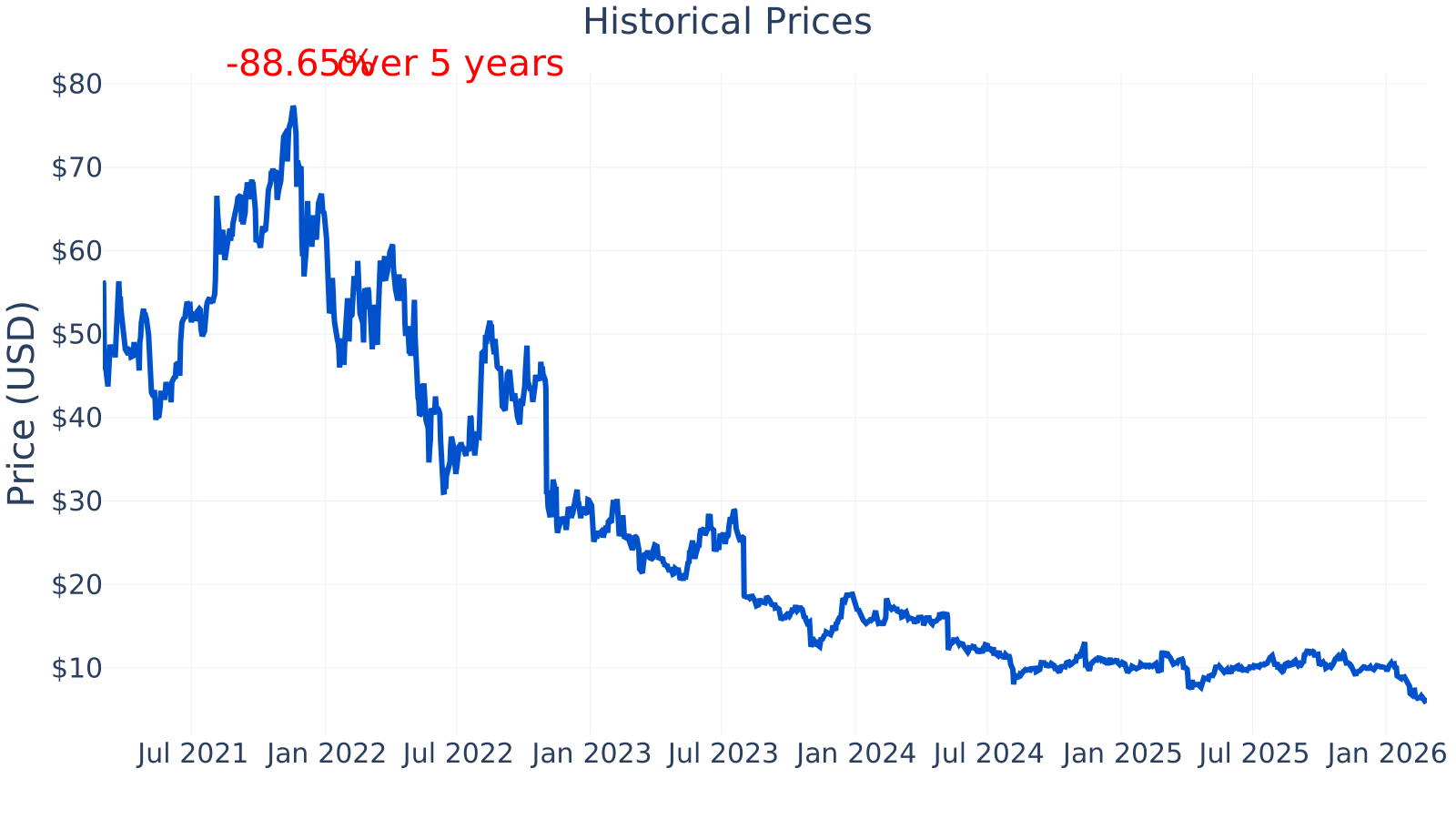
The revenue and profit flow over the last several years shows a business that was profitable in 2021 and 2022, followed by a sharp drop in revenue in 2023 and a shift to net losses that continued through 2025. Gross profit also narrowed significantly versus the earlier period, which typically signals lower volumes, less favorable product mix, and/or pricing and cost pressures.
Key Figures
| Metric | Value | Industry ⓘ |
|---|---|---|
| Date | Feb 23, 2026 | |
| Context | ||
| Sector | Technology | |
| Industry | Semiconductor Equipment & Materials | |
| Market Cap ⓘ | $1.64B | |
| Beta ⓘ | 1.93 | |
| Fundamental | ||
| P/E Ratio ⓘ | N/A | 49.76 |
| Profit Margin ⓘ | -24.07% | 7.37% |
| Revenue Growth ⓘ | -8.20% | 7.20% |
| Debt to Equity ⓘ | 24.03% | 20.49% |
| PEG ⓘ | 3.77 | |
| Free Cash Flow ⓘ | -$18.93M | |
AXT’s market capitalization is about $1.64B, and the stock’s beta of 1.93 suggests it has tended to move much more than the broader market. Recent profitability is negative (profit margin about -24.1% versus an industry median around +7.4%), and year-over-year revenue growth is also negative (about -8.2% versus an industry median around +7.2%). Debt relative to equity is about 24.0%, which is somewhat above the industry median near 20.5%. Free cash flow over the trailing twelve months is negative (about -$18.9M), indicating the company has recently been using more cash than it generates from operations after capital spending.
Growth (Medium)
AXT participates in the broader semiconductor ecosystem, an industry with long-term demand drivers tied to connectivity, data transmission, and increasingly complex electronic systems. Within that ecosystem, compound semiconductors are often discussed as important for high-frequency and high-speed applications, because they can offer performance advantages in areas where traditional silicon can be less efficient.
That said, the company’s recent operating results suggest it has been moving through a difficult part of the cycle. A business can be in a promising industry and still experience multi-year swings if customers reduce orders, delay expansions, or rebalance inventories.
The revenue growth pattern has been volatile: strong positive growth in 2021 and early 2022, followed by steep declines through much of 2023, a rebound across several quarters in 2024, and then renewed weakness in 2025, ending the period at about -8.2% year-over-year. For long-term context, this kind of “up/down” profile often indicates sensitivity to customer spending cycles rather than steady, linear expansion.
Free cash flow has stayed negative over the period shown, but the magnitude of cash outflow has improved from roughly -$34.1M (TTM as of 2022-03-31) to roughly -$8.5M (TTM as of 2025-03-31). A shrinking cash burn can be an important operational signal, but it is not the same as consistent cash generation.
Potential catalysts for future growth typically come from customer demand returning (for example, restocking or new product ramps) and from the company improving yields, cost structure, or product mix. Whether those factors translate into sustained improvement is usually visible through multiple quarters of revenue stability and margin recovery.
Risks (High)
This article is for informational purposes only and does not constitute financial advice. Some content is AI-generated. See Disclaimer