Stock Analysis · Ast Spacemobile Inc (ASTS)
Overview
AST SpaceMobile, Inc. (ASTS) is building a satellite network designed to connect directly to everyday mobile phones for voice, text, and data when users are outside normal cellular coverage. The basic idea is to extend mobile connectivity to remote or underserved areas (and to provide resilience during outages) by combining satellites in orbit with partnerships from wireless carriers on the ground.
Today, the company is still in a build-out and testing phase rather than a mature “steady revenue” telecom business. That matters for long-term readers because financial results can look unusual: spending tends to come before meaningful, recurring service revenue.
Based on its filings, AST SpaceMobile’s revenue has historically been relatively limited and not yet representative of the long-term business model. When disclosed, revenue has generally been tied to early-stage activities such as engineering work, reimbursements, or other arrangements connected to building and validating the system, rather than broad consumer service at scale.
Main revenue sources (from largest to smallest) are not consistently disclosed as stable “segments” in the same way as mature telecom companies, because the business is still transitioning toward commercial service. In general terms, reported revenue has been associated with items such as:
- Partner-related revenue linked to development, testing, and early commercialization arrangements (percentage not consistently disclosed in a stable breakdown)
- Other early-stage or non-recurring revenue items associated with building and validating the network (percentage not consistently disclosed)
Across the years shown, operating costs have been large compared with revenue, which is typical for a company investing heavily before full commercial rollout. Research and development and other operating expenses remain significant, while net income has stayed negative, reflecting a business still funding deployment and scale-up.
Key Figures
| Metric | Value | Industry ⓘ |
|---|---|---|
| Date | Mar 31, 2026 | |
| Context | ||
| Sector | Technology | |
| Industry | Communication Equipment | |
| Market Cap ⓘ | $28.20B | |
| Beta ⓘ | 2.87 | |
| Fundamental | ||
| P/E Ratio ⓘ | N/A | 43.82 |
| Profit Margin ⓘ | N/A | 3.27% |
| Revenue Growth ⓘ | 2731.30% | 16.60% |
| Debt to Equity ⓘ | 121.62% | 78.48% |
| PEG ⓘ | N/A | |
| Free Cash Flow ⓘ | -$1.14B | |
AST SpaceMobile’s market capitalization is about $28.2B, and the stock has shown high volatility (beta about 2.87), meaning it has tended to move much more than the broader market. Profitability is not yet established: profit margin is shown as 0% in the latest snapshot, and historically it has been deeply negative at times. Revenue growth is highly variable and can look extreme in certain periods (the latest YoY figure shown is about 2,731%), which is common when a small revenue base changes rapidly. Financial leverage is meaningful: debt-to-equity is about 122%, above the industry median shown (~78%). Free cash flow over the trailing twelve months is negative (about -$1.14B), consistent with heavy investment spending.
Growth (Very High)
AST SpaceMobile operates at the intersection of satellite communications and traditional mobile connectivity. The long-term growth logic is straightforward: global demand for reliable connectivity continues to rise, and coverage gaps still exist even in developed markets (rural areas, oceans, disaster situations). If AST SpaceMobile can provide direct-to-device service that works with standard phones and integrates with carrier partners, that could expand the addressable market beyond traditional satellite phones and specialized equipment.
The company’s strategy also aims to fit into existing mobile industry economics by working with mobile network operators rather than replacing them. In that model, carriers can potentially extend coverage without building towers everywhere, while AST SpaceMobile gains distribution through established telecom brands and customer bases.
The revenue growth pattern shown is uneven, with some periods of very large year-over-year increases. For early-stage companies, this often reflects timing of contracts or milestones rather than smooth demand trends. As a result, revenue growth alone may not indicate that a recurring, scalable service has arrived; it mainly signals that reported revenue can change sharply as the company progresses through development and early commercialization stages.
Free cash flow is negative across the periods shown and has become more negative over time (from about -$203M to about -$362M on a trailing twelve-month basis in the values shown). For a space and network build-out, this is not surprising: satellites, launches, ground systems, and engineering require large upfront spending. The key long-term question is whether those cash outflows translate into a network capable of producing recurring service revenue at scale.
Potential catalysts (in neutral terms) typically relate to operational execution: successful satellite deployments, demonstrations of reliable service, and the start and expansion of commercial agreements that produce recurring revenue. For a business like this, progress tends to come in step-changes rather than small weekly improvements.
Risks (Very High)
The main risks are concentrated in execution, financing, and competition. Space-based networks require complex engineering, reliable launches, and sustained capital. Any delays, technical setbacks, or higher-than-expected costs can push out timelines and increase cash needs. The company’s negative cash flow profile means funding strategy (raising capital, managing debt, or structuring partner financing) remains a central issue.
Debt-to-equity has risen materially over time and is about 122% in the latest figure shown, higher than the industry median displayed (~78%). This suggests the capital structure has become more leveraged compared with many peers in the same broad industry group. Higher leverage can amplify outcomes: it can help fund growth, but it can also reduce flexibility if business milestones take longer than expected.
Profit margins have been far below the industry median for an extended period, including extremely negative readings in several quarters. Even with improvement in the most recent point shown (still negative), the overall pattern indicates the business is not yet operating at a self-funding scale. For long-term outcomes, the transition from “build and test” to “operate and monetize” is the critical step; until then, losses can persist.
Competitive positioning is difficult to summarize with a single label because the market is still forming. AST SpaceMobile’s intended advantage is direct-to-device connectivity with standard phones, which—if delivered reliably—could reduce friction for adoption versus solutions that require specialized user equipment. However, the company is not the only participant pursuing satellite-enabled mobile connectivity. Competing approaches include other satellite operators and constellations, as well as direct-to-device initiatives supported by large incumbents. In practice, competitors with larger balance sheets, existing satellite fleets, or established telecom relationships may be able to move faster, fund more capacity, or withstand setbacks more easily.
In addition to engineering and competitive risk, regulatory and spectrum coordination are important for satellite communications businesses. Approvals, interference management, and cross-border operating requirements can influence both timeline and achievable coverage.
Valuation
Traditional valuation tools are difficult to apply cleanly because the company is not consistently profitable. That is visible in the P/E chart: when earnings are negative (or otherwise not meaningful), the P/E ratio is not informative in the usual way.
In the periods shown, AST SpaceMobile’s P/E ratio is effectively not meaningful (displayed as 0), while the industry median shown sits in a more typical positive range (often roughly around the 20–40+ area, depending on the date). In other words, the market is not valuing the company primarily on current earnings power. Instead, valuation is more closely tied to expectations about future commercialization, scale, and the ability to convert large upfront investment into recurring cash-generating service.
With a market capitalization around $28.2B and free cash flow shown as negative, the implied expectations embedded in the stock price can be significant. If operational milestones arrive later than expected, or if the business model scales more slowly, valuation can compress even without dramatic changes to the underlying technology. Conversely, if the company demonstrates repeatable service performance and a credible path to sustained revenue, market perception can change rapidly. This “outcome dispersion” is a defining feature of early-stage infrastructure and space-based communications companies.
Conclusion
AST SpaceMobile is building a direct-to-device satellite connectivity network intended to extend standard mobile service beyond the reach of traditional cell towers. The long-term opportunity is tied to rising global connectivity needs and the possibility of integrating satellite coverage into mainstream mobile offerings through carrier partnerships.
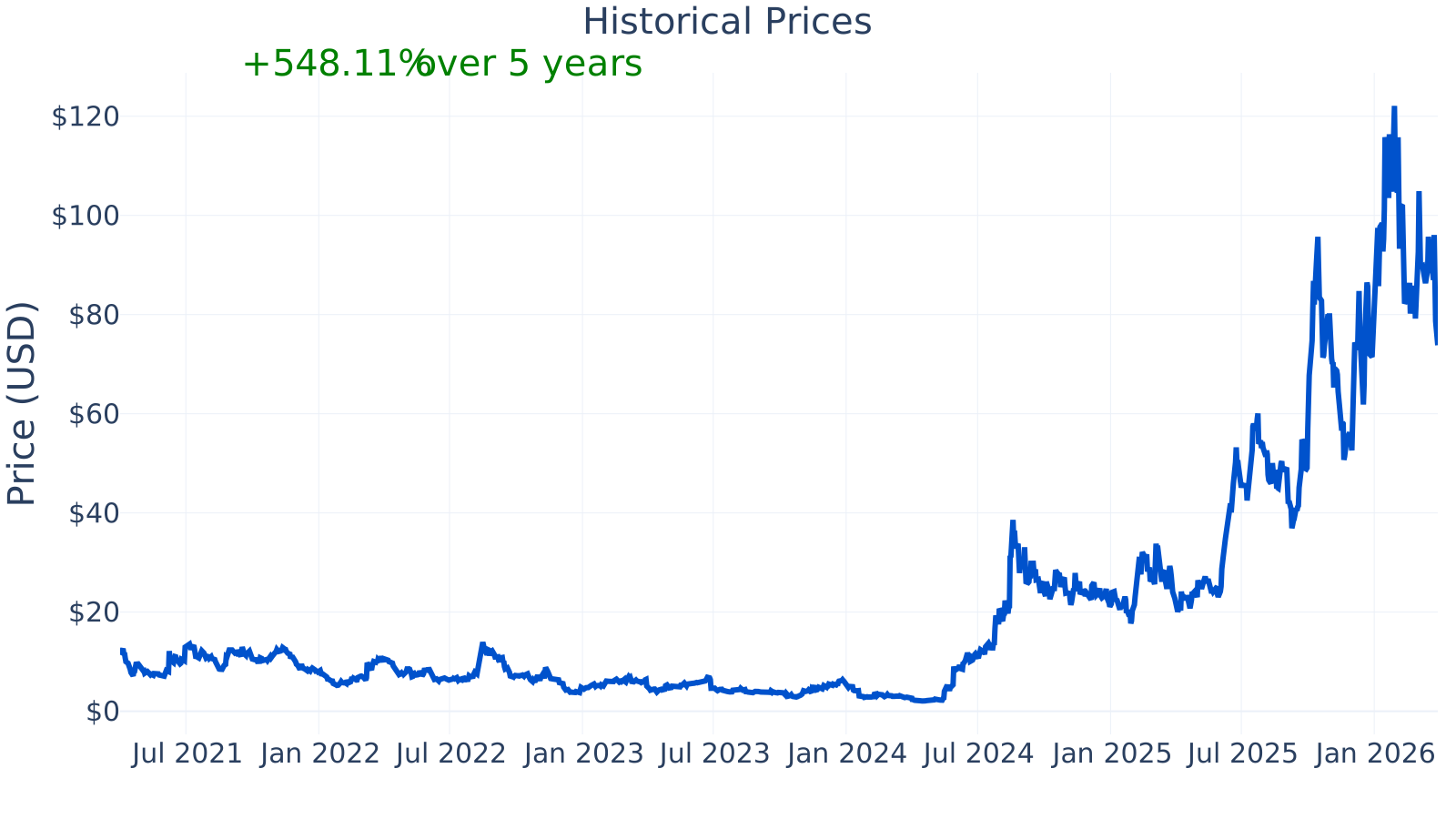
At the same time, the financial profile reflects a company still in an investment-heavy phase: negative free cash flow, historically very weak profit margins, and a debt-to-equity level that has moved higher than the industry median shown. The stock’s historical price path and high beta highlight that market expectations can shift quickly as milestones are met—or delayed.
Overall, the long-term investment profile is best described as highly dependent on execution and funding outcomes, with potential for large differences between scenarios. The most decision-relevant facts to monitor over time are progress toward scalable commercial service, the stability and repeatability of revenue generation (versus milestone-driven variability), and whether cash usage and leverage remain manageable as the network expands.
Sources:
- SEC EDGAR — AST SpaceMobile, Inc. Form 10-K (Annual Report)
- SEC EDGAR — AST SpaceMobile, Inc. Form 10-Q (Quarterly Reports)
- SEC EDGAR — AST SpaceMobile, Inc. Form 8-K (Current Reports)
- AST SpaceMobile Investor Relations — Press Releases and Shareholder Materials
- Wikipedia — “AST SpaceMobile” (company overview and basic history)
This article is for informational purposes only and does not constitute financial advice. Some content is AI-generated. See Disclaimer


