Stock Analysis · Acm Research Inc (ACMR)
Overview
ACM Research, Inc. (ACMR) designs and sells specialized equipment used by semiconductor manufacturers (“chipmakers”) to clean, plate, and prepare silicon wafers during the chip production process. In simple terms, its machines help remove tiny contaminants and build certain thin layers on wafers, steps that are necessary to improve yields (how many usable chips come out of a batch) and to support more advanced chip designs.
The company generates revenue primarily from selling semiconductor manufacturing tools and related services/spare parts. In its filings, ACM Research describes its offering around advanced wafer cleaning and other wafer process tools, with revenue typically tied to customer orders and factory investment cycles.
Main sources of revenue are generally described as:
- Tool/equipment sales (the largest component in typical semiconductor equipment models; exact percentage varies by period and is detailed in company filings)
- Services and spare parts (support, maintenance, and recurring aftermarket items; typically smaller than equipment sales)
From an overall profit-and-cost perspective, the company’s scale has increased significantly over the past several years, with revenue rising from about $260M (2021) to about $901M (2025). Over that same period, operating expenses (notably R&D) also increased, indicating continued investment in new products and capabilities.
One notable pattern over 2021–2025 is that revenue expanded quickly (about $260M to about $901M), while spending on research and development also rose materially (about $34M to about $145M). Net income increased overall (about $38M to about $94M), but with fluctuations, reflecting a business that is scaling while continuing to invest.
Key Figures
| Metric | Value | Industry ⓘ |
|---|---|---|
| Date | May 05, 2026 | |
| Context | ||
| Sector | Technology | |
| Industry | Semiconductor Equipment & Materials | |
| Market Cap ⓘ | $3.39B | |
| Beta ⓘ | 1.82 | |
| Fundamental | ||
| P/E Ratio ⓘ | 37.95 | 48.78 |
| Profit Margin ⓘ | 10.44% | 8.18% |
| Revenue Growth ⓘ | 9.40% | 11.50% |
| Debt to Equity ⓘ | 20.69% | 26.74% |
| PEG ⓘ | N/A | |
| Free Cash Flow ⓘ | -$68.55M | |
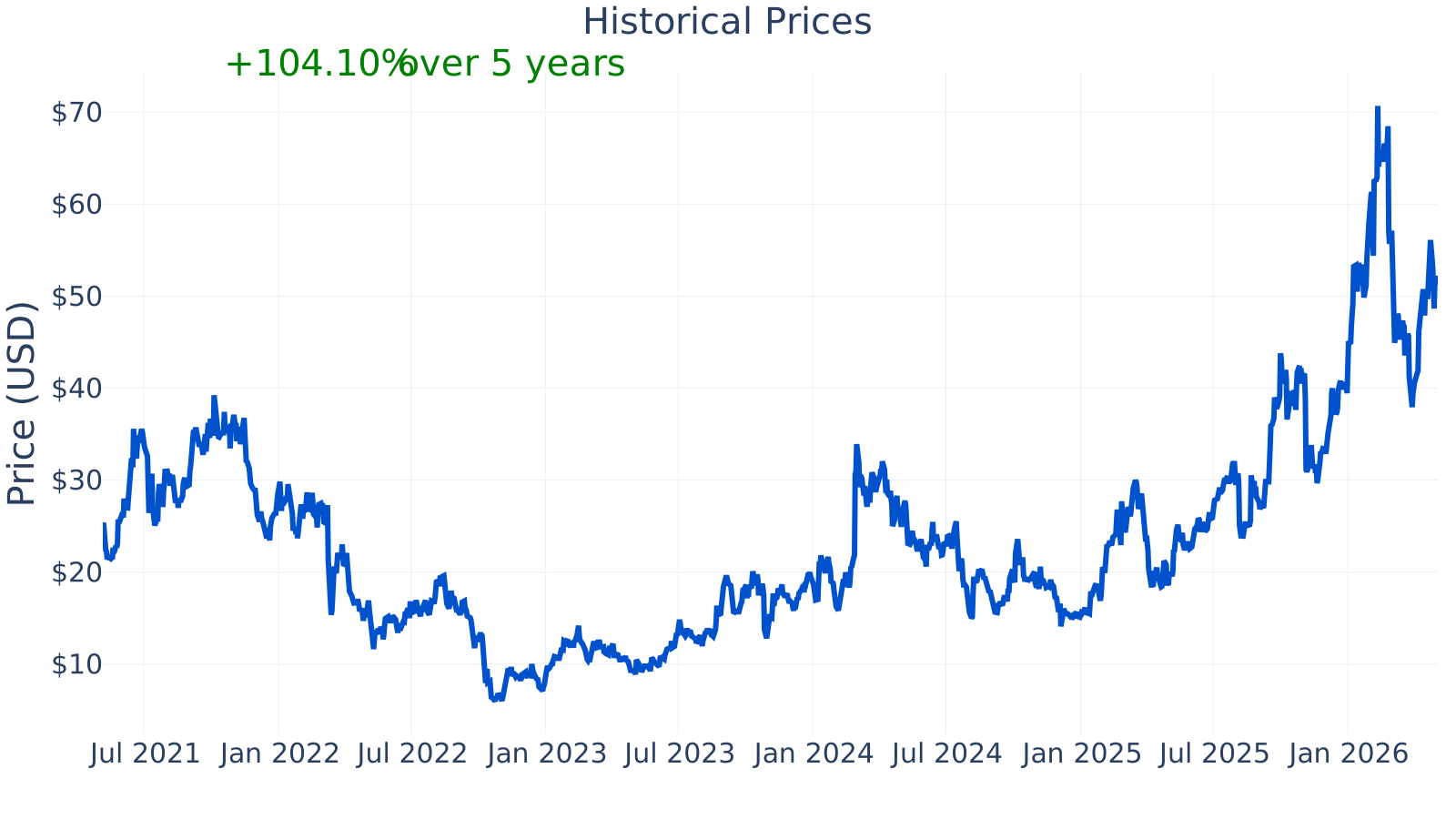
ACM Research’s market capitalization is about $3.39B. The stock’s beta of ~1.82 indicates that it has historically moved more than the broader market (higher volatility). On profitability, the company shows a profit margin of ~10.44%, above the industry median shown here (~8.18%). Growth is positive but currently below the industry median on this measure: year-over-year revenue growth of ~9.4% versus an industry median of ~11.5%. Balance-sheet leverage appears moderate with debt-to-equity of ~20.7%, below the industry median (~26.7%). Free cash flow over the trailing twelve months is -$68.5M, meaning cash generated after operating needs and capital spending has been negative recently.
Growth (Medium)
ACM Research operates in the semiconductor equipment industry, which is shaped by long-term demand for chips used in computing, memory, smartphones, data centers, industrial automation, and emerging workloads. A key feature of this industry is that it can grow over time but tends to be cyclical: chipmakers often increase spending in waves, then slow down when inventories build or end-demand softens.
Strategically, ACM Research’s focus on process steps like wafer cleaning and related processes can fit well with long-term trends toward more complex manufacturing. As chips get denser and manufacturing tolerances tighten, contamination control and process precision become more important, supporting ongoing demand for high-performance tools—though the timing of orders can still vary significantly by year.
Revenue growth has been volatile across quarters. Several periods show very high year-over-year growth (including triple-digit growth in some quarters), while more recent quarters show slower but still positive growth (around 6%–32% in 2025 quarters, ending at about 9.4% in the most recent point shown). This variability is consistent with a customer-capex-driven industry where shipments and tool acceptance can shift between quarters.
Free cash flow has also swung meaningfully: it was negative in 2022–2024, turned positive by 2025 (about $90M at one point shown), and is currently negative on a trailing basis (about -$68.5M in the latest metrics table). For a company selling large systems, free cash flow can be influenced by working capital (inventory and receivables), customer payment timing, and investment levels, so consistency over multiple periods is often an important observation for long-term fundamentals.
Risks (High)
A central risk for ACM Research is industry cyclicality. Semiconductor equipment demand depends heavily on when major chipmakers decide to expand capacity or upgrade process technology. That can lead to sharp changes in revenue growth, utilization of manufacturing capacity, and operating margins.
Another key risk is customer concentration and competitive pressure, which are common in semiconductor equipment: a relatively small number of large manufacturers account for a substantial portion of global spending. When large customers pause spending, suppliers can feel the impact quickly. In addition, equipment vendors must keep pace with demanding process requirements; falling behind on technology, reliability, or cost of ownership can affect adoption.
Competitive dynamics are also a meaningful factor. The semiconductor equipment space includes large, established players across process steps. Depending on the specific tool category (for example, wet cleaning and related processes), competition can come from major diversified equipment suppliers as well as specialized toolmakers. Relative positioning tends to depend on process performance, cost, service footprint, and demonstrated results in high-volume manufacturing. In many segments, industry leaders benefit from scale, deep customer relationships, and extensive installed bases, which can be challenging advantages to overcome.
Financial leverage appears moderate in the period shown, ending at about 20.7% debt-to-equity. The trend over time shows debt-to-equity rising from very low levels in 2021–2022 to higher levels in 2024–2025, which can be normal as a company funds growth, but it still introduces greater sensitivity to operating performance and interest costs than a near-debt-free structure.
Profit margins have fluctuated. The most recent profit margin shown is about 10.44%. Earlier periods reached the mid-teens, and the path includes dips and recoveries. While the latest figure is above the industry median shown (~8.18%), the variability highlights exposure to mix shifts (which tools are shipping), pricing/competition, and operating-cost absorption (how efficiently fixed costs are spread over revenue).
Valuation
One common way to describe valuation is the price-to-earnings (P/E) ratio, which compares the stock price to the company’s earnings. ACM Research’s current P/E is about 37.95, compared with an industry median of about 48.78 in the same grouping shown in the key figures. This places the company below the median on this metric, though P/E ratios can vary widely across semiconductor equipment firms due to differences in growth expectations, margins, cyclicality exposure, and accounting impacts.
Historically, the P/E ratio shown has moved substantially over time, including periods in the teens as well as much higher levels, and it recently increased to around 51 at the latest point on the chart (while the current “latest metrics” P/E is ~38, reflecting that P/E can shift with both price movements and changes in trailing earnings). For context, valuation interpretation often depends on whether earnings are near a cyclical peak or trough, and whether recent profit levels and cash generation look repeatable through different parts of the semiconductor spending cycle.
Conclusion
ACM Research is a semiconductor equipment supplier focused on wafer processing steps that are essential to chip manufacturing. The company has expanded materially in scale over the last several years, with revenue rising from roughly $260M (2021) to roughly $901M (2025), alongside continued increases in R&D investment. Profitability has been positive, with a recent profit margin around 10%, and leverage appears moderate at about 21% debt-to-equity.
At the same time, the business sits in a cyclical industry where quarterly growth rates and cash generation can swing meaningfully. Recent trailing free cash flow is negative, which places additional attention on working-capital discipline and the sustainability of earnings through a full cycle. Valuation metrics such as the P/E ratio suggest the stock trades below the median of its listed industry peer group on this single measure, but the wide historical range of P/E levels and the industry’s cyclicality mean valuation is sensitive to expectations about future earnings stability, growth durability, and competitive positioning.
Sources:
- SEC EDGAR — ACM Research, Inc. filings (Form 10-K, Form 10-Q)
- ACM Research, Inc. — Investor Relations materials and press releases (company website)
- Wikipedia — “ACM Research” (basic company background)
This article is for informational purposes only and does not constitute financial advice. Some content is AI-generated. See Disclaimer