Stock Analysis · Elastic NV (ESTC)
Overview
Elastic N.V. is a software company best known for “Elastic,” a platform used to search, analyze, and protect large volumes of digital information. In simple terms, its tools help organizations find the right information quickly (search), understand what is happening across their systems (observability/monitoring), and improve security by detecting threats and unusual behavior (security). Elastic’s products are commonly deployed in cloud environments and are used by a wide range of customers, from technology companies to governments and large enterprises.
Elastic mainly earns money by selling subscriptions to its software and related services. Its model is largely recurring: customers typically pay over time to keep using the platform and to access additional capabilities, support, and enterprise features. The company also offers a free “open” version of some of its technology, which can drive adoption and later lead to paid subscriptions when organizations need more advanced functionality or support.
Main sources of revenue (typical structure disclosed in company filings):
- Subscription revenue (the large majority of total revenue; generally the dominant component in Elastic’s reporting)
- Professional services and other revenue (a smaller portion; implementation, training, and advisory-type services)
Business scale and cost structure (high level): Elastic has grown revenue over the last several years, while spending heavily on research and development and on go-to-market functions (sales and marketing). This is common for software companies focused on product expansion and customer acquisition, but it also means reported profitability can fluctuate depending on spending levels and accounting items.
Revenue expanded from about $608 million (FY2021) to about $1.48 billion (FY2025). Over the same period, research and development and selling/general/administrative costs also increased, which helps explain why operating profit has been close to break-even rather than consistently positive.
Key Figures
| Metric | Value | Industry ⓘ |
|---|---|---|
| Date | Mar 02, 2026 | |
| Context | ||
| Sector | Technology | |
| Industry | Software - Application | |
| Market Cap ⓘ | $5.53B | |
| Beta ⓘ | 0.95 | |
| Fundamental | ||
| P/E Ratio ⓘ | N/A | 25.64 |
| Profit Margin ⓘ | -5.04% | 7.25% |
| Revenue Growth ⓘ | 17.70% | 16.65% |
| Debt to Equity ⓘ | 2.66% | 24.64% |
| PEG ⓘ | 4.17 | |
| Free Cash Flow ⓘ | $256.85M | |
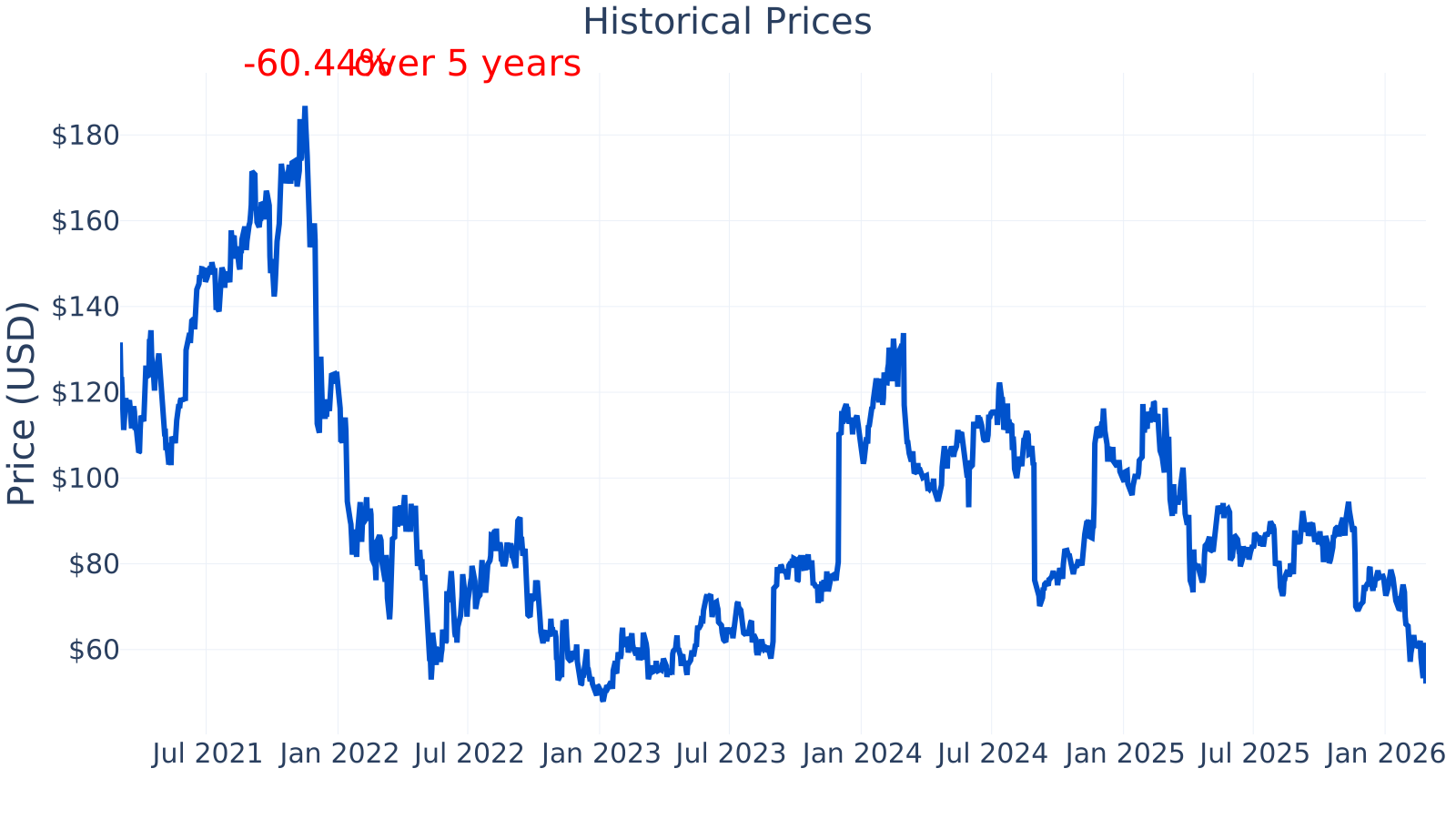
Elastic’s market capitalization is about $5.53 billion, and the stock’s beta of ~0.95 suggests price swings that have been roughly in line with the broader market. The company shows year-over-year revenue growth of ~17.7%, slightly above the stated industry median (~16.7%). Profitability is currently negative with a profit margin of about -5.0% versus an industry median of about +7.2%, highlighting that Elastic’s earnings profile differs from many profitable software peers. Balance-sheet leverage appears low on the latest reading, with debt-to-equity around 2.7% compared with an industry median near 24.6%. Free cash flow over the trailing twelve months is about $257 million, indicating meaningful cash generation even while accounting earnings remain uneven.
Growth (Medium)
Elastic operates in markets that are closely tied to long-term digital trends: cloud computing, the rapid growth of machine-generated data (logs, events, traces), and the need for security monitoring. As organizations run more systems in the cloud and rely more on software-driven operations, the volume of data that needs to be searched and analyzed tends to rise. This environment generally supports demand for tools that can index large amounts of information and make it usable for engineers, security teams, and business users.
A key part of Elastic’s growth strategy is selling a single technology foundation across multiple use cases—search, observability, and security. When this works, it can expand the relationship with existing customers (for example, a customer starting with logging/monitoring and later adding threat detection). Another growth lever is cloud adoption: offering the product as a managed service can make deployment easier and may broaden the customer base, though cloud delivery can also change margins and cost dynamics.
Year-over-year revenue growth has slowed from very high rates (above 40% in FY2021) to the mid-to-high teens more recently, with the latest point around 17.7%. This pattern often reflects a company maturing from an earlier rapid expansion phase into a more scaled phase where growth depends more on larger enterprise rollouts and ongoing expansion within the installed base.
Free cash flow improved significantly over time, rising from near break-even levels in early periods to roughly $257 million on a trailing twelve-month basis. For long-term business durability, this matters because it can indicate that the company is funding operations with internally generated cash rather than relying mainly on external financing.
Risks (High)
Elastic faces meaningful competitive and execution risks. In software markets, customers can switch vendors over time, especially when alternatives are integrated into broader platforms they already use. Elastic also operates in categories where product quality and performance are critical; outages, security vulnerabilities, or a perception that the platform is hard to manage could slow adoption or increase churn.
Competition is intense across Elastic’s main use cases:
- Search: alternatives include open-source and commercial search technologies, as well as cloud provider services that bundle search capabilities.
- Observability: large platform vendors and specialist monitoring companies compete for budgets related to logs, metrics, and traces.
- Security analytics (SIEM and related): competition includes both large security platforms and specialized vendors.
Elastic’s competitive advantages typically center on its broad “stack” (one data layer supporting multiple use cases), a large user community, and the ability to scale search and analysis across many data types. However, it is not a risk-free “winner-takes-all” market. Large technology ecosystems can influence buying decisions, and customers sometimes prefer an end-to-end suite from a single major vendor.
Debt-to-equity moved dramatically over time, ending at a very low level of about 2.7% on the latest reading (below the industry median near 25.4%). The earlier elevated readings and the sharp decline suggest the capital structure has changed materially, and readers typically verify the drivers in the most recent filings (for example, changes in equity, debt balances, or accounting classifications). Lower leverage can reduce financial risk, but it does not remove competitive or execution risk.
Profit margin improved from deeply negative levels (around -20% to -26% in earlier periods) to briefly positive territory in parts of FY2024, but it is currently about -5.0%, below the industry median (about +7.4%). This highlights that profitability is still in progress and can be affected by operating expenses, revenue mix, and non-operating items such as taxes.
Valuation
For valuation, one commonly cited metric is the price-to-earnings (P/E) ratio, but it can be difficult to interpret when earnings are low or volatile. Elastic’s P/E has appeared only intermittently on the chart (and is absent in many periods), which typically happens when earnings are negative or extremely small relative to the share price. When it is visible, it has been much higher than the industry median in those same dates—reflecting that reported earnings have not been a stable anchor for valuation.
In the periods where it is shown, Elastic’s P/E ratio ranged roughly from the 130s to above 200, while the industry median shown alongside it was much lower (roughly ~50–62 in those snapshots). This gap often indicates that the market is valuing the company more on revenue growth and potential operating leverage than on current net income. The PEG ratio around 4.17 also signals that, under this methodology, the valuation may look elevated relative to the company’s expected growth rate, though PEG depends heavily on forecasting assumptions and can vary widely.
Conclusion
Elastic is a scaled software company focused on search, observability, and security—areas supported by long-term trends in cloud adoption and the expanding volume of digital activity. The business has demonstrated sustained revenue growth and a notable improvement in free cash flow generation, which can be an important sign of operating discipline as the company grows.
At the same time, the company operates in highly competitive markets and has not delivered consistently positive profit margins on a sustained basis, with profitability shifting over time. Valuation signals based on earnings can be hard to interpret due to uneven net income, and when P/E is measurable it has been well above the industry median in the observed periods. Overall, the long-term story depends heavily on Elastic’s ability to maintain growth, deepen adoption across use cases, and translate scale into more consistent profitability while competing against both specialists and large platform providers.
Sources:
- U.S. SEC EDGAR — Elastic N.V. filings (Form 10-K, 10-Q, 8-K)
- Elastic N.V. Investor Relations — Annual Report / Form 10-K materials and shareholder communications
- Elastic N.V. Investor Relations — Earnings call materials and company-hosted transcripts (when available)
- Wikipedia — “Elastic N.V.” (basic company background only)
This article is for informational purposes only and does not constitute financial advice. Some content is AI-generated. See Disclaimer


