Stock Analysis · NXP Semiconductors NV (NXPI)
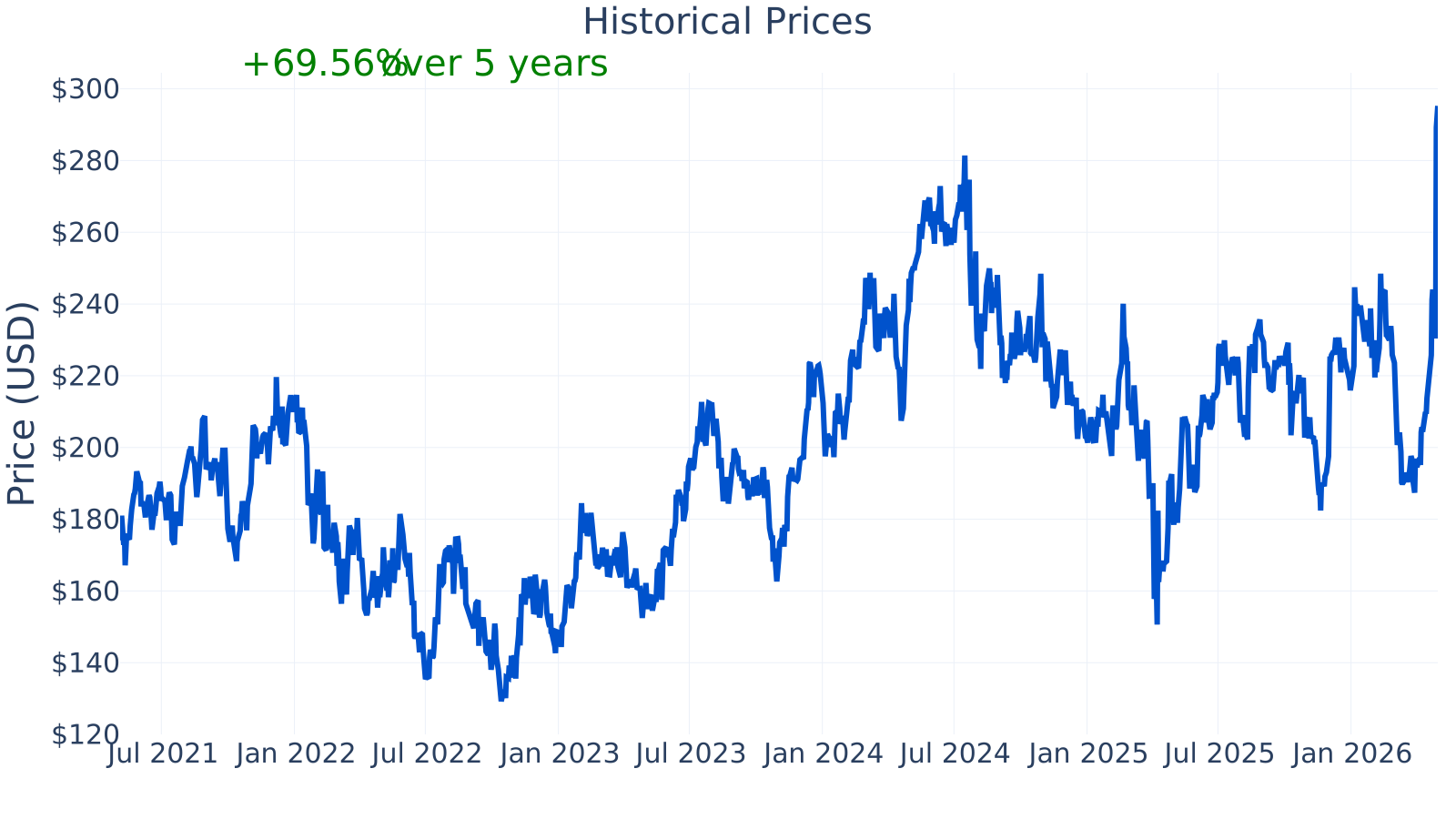
Overview
NXP Semiconductors N.V. (NXPI) designs and sells semiconductors (computer chips) that help electronic devices sense, connect, process data, and operate securely. Instead of focusing mainly on consumer gadgets, NXP is heavily tied to “real-world” electronics such as cars, factories, and connected infrastructure. Its products commonly appear in areas like automotive electronics (vehicle networking, radar, power and battery-management-related functions), industrial automation, and secure identification or payments.
From a revenue standpoint, NXP is organized around end markets (what the chip is used for). In its reporting, the main sources are typically:
- Automotive (largest)
- Industrial & IoT
- Mobile
- Communication Infrastructure & Other (smallest)
Percentages vary by year and cycle; for exact segment shares, NXP’s latest annual report (Form 10-K) provides the current breakdown.
NXP’s recent multi-year financial pattern shows a business that invested heavily in research and development while generating substantial gross profit. Over 2021–2025, total revenue peaked around 2022–2023 and then declined into 2024–2025, alongside lower operating income and net income—consistent with cyclical demand in parts of the semiconductor market.
Across 2021 to 2025, revenue moved from about $11.1B (2021) up to roughly $13.2B (2022–2023) and then down to about $12.3B (2025). Research and development spending stayed high (roughly $1.9B–$2.4B range each year), reflecting ongoing investment in new chip designs and platforms. Net income also eased from about $2.8B (2022–2023) to about $2.0B (2025).
Key Figures
| Metric | Value | Industry ⓘ |
|---|---|---|
| Date | May 04, 2026 | |
| Context | ||
| Sector | Technology | |
| Industry | Semiconductors | |
| Market Cap ⓘ | $74.54B | |
| Beta ⓘ | 1.47 | |
| Fundamental | ||
| P/E Ratio ⓘ | 28.25 | 53.51 |
| Profit Margin ⓘ | 21.03% | 6.16% |
| Revenue Growth ⓘ | 12.20% | 19.70% |
| Debt to Equity ⓘ | 107.29% | 20.71% |
| PEG ⓘ | 0.75 | |
| Free Cash Flow ⓘ | $2.96B | |
NXP’s market capitalization is about $74.5B and the stock’s beta (~1.47) indicates it has tended to move more than the broader market. The company’s P/E ratio is ~28.3, below the industry median shown (~53.5), while its profit margin is ~21.0%, well above the industry median shown (~6.2%). Recent year-over-year revenue growth is ~12.2%, which is below the industry median shown (~19.7%). The debt-to-equity ratio is ~107%, materially higher than the industry median shown (~21%), and trailing twelve-month free cash flow is about $3.0B. The PEG ratio (~0.75) suggests the P/E is lower relative to the growth rate assumptions embedded in that metric, though PEG depends heavily on forward growth estimates and can shift quickly in cyclical industries.
Growth (Medium)
NXP operates in markets shaped by long-running trends: vehicles are adding far more electronics content per car, factories are adding automation and sensors, and many systems are becoming connected and security-conscious. These themes can support long-duration demand for chips that manage power, connect devices, process signals, and authenticate users or machines.
A key part of NXP’s strategy is its concentration on automotive and industrial applications, which often have longer product cycles and more stringent qualification requirements than fast-turn consumer electronics. In practice, that can translate into stickier customer relationships once a chip is designed into a vehicle platform or an industrial system. Another strategic angle is the continued emphasis on embedded processing, connectivity, and security, which are often combined in modern electronic systems.
The year-over-year revenue growth pattern shows the cyclical nature of the business. Growth was very strong in 2021–2022 (often above 20%), cooled to roughly flat to negative through much of 2023–2025, and then turned positive again most recently (about +12.2%). This “ups and downs” behavior is common in semiconductors due to inventory cycles and changing end-market demand.
Free cash flow (cash generated after operating needs and capital spending) also moved with the cycle: it rose from about $2.13B (2022) to about $3.77B (2024), dipped to about $1.76B (2025), and then rebounded to about $2.96B (2026). For a long-term view, this metric matters because it is a practical source of funding for debt reduction, dividends, and share repurchases (depending on the company’s capital allocation decisions disclosed in filings).
Risks (Medium-High)
NXP’s main risks are typical for a large chipmaker but still important for long-term owners to understand. First, semiconductors are cyclical: demand can swing due to customer inventory corrections, slower end markets (especially autos or industrial), and broader economic conditions. Second, NXP depends on a complex global supply chain, including outsourced manufacturing partners; disruptions, capacity constraints, or quality issues can affect shipments and costs. Third, the company is exposed to geopolitical and trade constraints that can alter where products are sold or manufactured, and what technology can be shared across borders.
Competition is intense across NXP’s end markets. In automotive and industrial semiconductors, competitors often include large diversified chip companies and specialist analog/power and microcontroller suppliers. Depending on the specific product category, commonly cited peer groups in company and sector disclosures can include firms such as Infineon Technologies, Texas Instruments, STMicroelectronics, Renesas Electronics, onsemi, Analog Devices, and Microchip Technology. Positioning differs by niche: NXP is widely associated with automotive-grade processing/connectivity and secure identification technologies, but it competes product-by-product, and customers may dual-source.
A potential competitive advantage for NXP is the combination of deep automotive qualification experience, long product lifetimes, and a portfolio that spans processing, networking, and security. These factors can increase switching costs once designed into a platform. However, leadership is not universal across all semiconductor categories, and pricing/market share can shift with technology transitions.
NXP’s debt-to-equity ratio has been consistently higher than the industry median shown. The most recent value is about 107% versus an industry median near 15%–36% over the periods shown. While debt can be manageable when cash flows are strong, higher leverage can reduce flexibility during downturns or periods of rising interest rates.
Profit margin has generally been strong versus the industry median shown. Most recently it is about 21.0%, compared with an industry median around 7.2%. The time series shows NXP maintaining a relatively elevated margin profile even through periods when industry profitability appears compressed, though NXP’s margins also dipped during parts of 2025 before rebounding.
Valuation
Valuation is often discussed using the price-to-earnings (P/E) ratio, which compares the stock price to the company’s earnings. NXP’s latest P/E is about 28.3, while the industry median shown is higher (about 53.5). A lower-than-industry P/E can reflect differences in growth expectations, perceived cyclicality, financial leverage, or business mix.
Historically (over the dates shown), NXP’s P/E ratio moved from much higher levels in 2021 down into the teens during 2022–2023 and then climbed back toward the high 20s most recently. Over much of 2023–2026 in the chart, NXP’s P/E also appears below the industry median, which can be consistent with the market assigning a more conservative multiple due to cyclicality or balance-sheet considerations. Interpreting whether today’s multiple is “high” or “low” depends heavily on whether earnings are near a cyclical peak or trough, and on how durable the company’s margins and cash flows prove to be through the next downcycle.
Conclusion
NXP is a large semiconductor company with a clear emphasis on automotive and industrial markets, areas supported by long-term trends such as increased electronics content in vehicles, connectivity, and the need for secure and reliable embedded computing. The company has demonstrated comparatively strong profitability versus the industry median shown and has produced meaningful free cash flow over time, though both revenue growth and cash generation have fluctuated with the semiconductor cycle.
The main trade-offs visible from the fundamentals are the combination of solid margin performance and cyclical revenue patterns, alongside a higher debt load than the industry median shown. From a valuation perspective, the stock’s P/E is below the industry median shown, but the interpretation remains closely tied to where earnings are in the cycle and how resilient end-market demand is over the next several years.
Sources:
- SEC EDGAR — NXP Semiconductors N.V. Form 10-K (Annual Report)
- SEC EDGAR — NXP Semiconductors N.V. Form 10-Q (Quarterly Reports)
- NXP Semiconductors — Investor Relations materials (company-hosted filings and presentations)
- Wikipedia — “NXP Semiconductors” (basic company background)
This article is for informational purposes only and does not constitute financial advice. Some content is AI-generated. See Disclaimer


