Stock Analysis · NXP Semiconductors NV (NXPI)
Overview
NXP Semiconductors N.V. designs and sells semiconductors (chips) that help other products sense, connect, compute, and stay secure. In practice, NXP’s chips are commonly used in cars (for example, vehicle networking, safety systems, infotainment, and power/energy control), as well as in industrial equipment and connected devices. The company positions itself as a supplier of “embedded” solutions, meaning its components are built into larger systems that typically stay in use for many years (such as vehicle platforms and factory automation equipment).
From a revenue perspective, NXP reports its business by end market. In its annual reporting, the largest portion is typically the Automotive segment, followed by Industrial & IoT, then Mobile, and Communication Infrastructure & Other. The exact percentages vary year to year based on semiconductor cycles and customer demand, but the mix has been consistently anchored by automotive and industrial uses.
As a high-level ordering from largest to smallest (based on the company’s reporting structure and typical mix):
- Automotive (largest)
- Industrial & IoT
- Mobile
- Communication Infrastructure & Other (smallest)
At the business-model level, NXP invests heavily in research and development to win long design cycles (especially in automotive), then aims to scale those designs across many units once customers move into volume production.
Over the last several years, revenue rose into 2022–2023 and then declined in 2024–2025, while the company kept a sizable research and development budget (a little over $2 billion per year in the period shown). Net income also eased from the 2022–2023 level to 2024–2025, illustrating how earnings can move with semiconductor demand cycles even when long-term markets remain intact.
Key Figures
| Metric | Value | Industry ⓘ |
|---|---|---|
| Date | Feb 07, 2026 | |
| Context | ||
| Sector | Technology | |
| Industry | Semiconductors | |
| Market Cap ⓘ | $56.55B | |
| Beta ⓘ | 1.46 | |
| Fundamental | ||
| P/E Ratio ⓘ | 28.25 | 45.89 |
| Profit Margin ⓘ | 16.47% | 9.42% |
| Revenue Growth ⓘ | 7.20% | 13.10% |
| Debt to Equity ⓘ | 121.54% | 25.62% |
| PEG ⓘ | 0.70 | |
| Free Cash Flow ⓘ | $2.65B | |
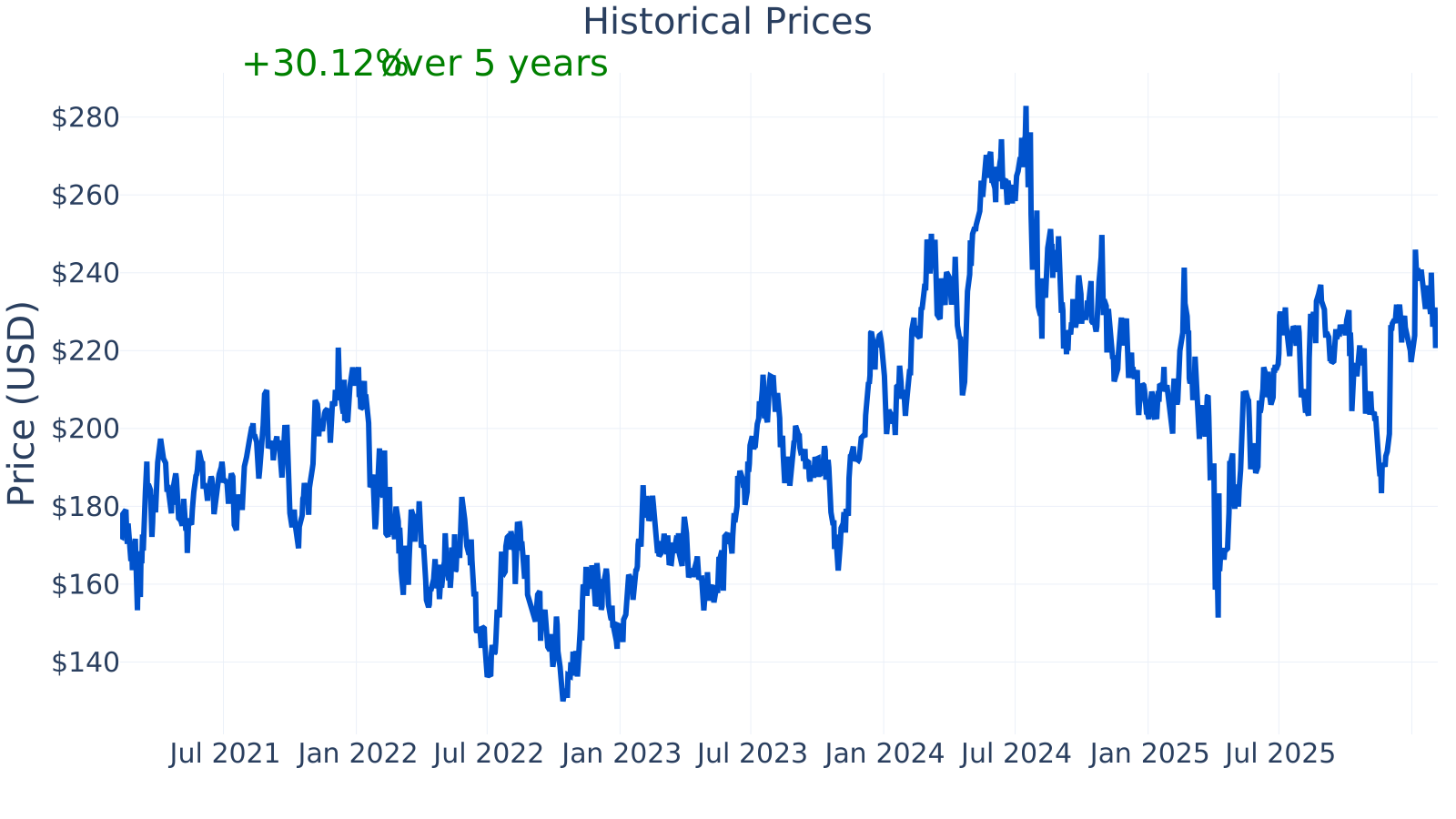
NXP’s market capitalization is about $56.6B, and its beta of ~1.46 suggests the stock has tended to move more than the broader market. The company’s P/E ratio is ~28.3, which is below the semiconductor industry median (~45.9) in the peer set shown. Profitability stands out: NXP’s profit margin is ~16.5% versus an industry median near 9.4%. Recent top-line momentum is more moderate: year-over-year revenue growth is ~7.2%, below the industry median (~13.1%). Leverage is higher than many peers: debt-to-equity is ~122% versus an industry median around 26%. Free cash flow over the trailing twelve months is about $2.65B, indicating the business has continued to generate cash after operating needs and capital spending.
Growth (Medium)
NXP participates in several long-duration trends that can support demand over time, even though the semiconductor industry is cyclical quarter to quarter. The most important structural driver is the growing semiconductor content per vehicle: modern cars require more chips for safety features, advanced driver assistance, connectivity, electrification, and in-vehicle networking. Industrial automation and connected “edge” devices (equipment that collects data and makes decisions locally) can also expand chip demand, particularly for reliable embedded computing and secure connectivity.
NXP’s strategy is oriented toward markets with longer product life cycles—especially automotive and industrial—where design wins can produce revenue for many years once a platform is adopted. In these segments, switching suppliers can be costly for customers due to qualification requirements, safety standards, and system-level integration, which can support more durable relationships once NXP’s components are designed in.
The year-over-year revenue growth pattern shows the cyclical nature of semiconductors: very strong growth in 2021–2022, then a period of flat-to-negative comparisons through much of 2023–2025, followed by a return to positive growth (about 7%) in the most recent point shown. For long-term business assessment, this is often interpreted as demand normalization after a strong cycle rather than a straight-line trend.
Free cash flow increased into 2024 (peaking around $3.77B in the series shown) and then fell to about $1.76B by early 2025 before recovering to around $2.65B on a trailing basis. This matters because consistent cash generation can help fund research and development, capital needs, and shareholder returns, but the swings also highlight sensitivity to industry and end-market conditions.
Potential catalysts (in a neutral, descriptive sense) include broader auto production stabilization, rising electronic content per vehicle, and recoveries in industrial demand. Company-specific catalysts often come from major new platform wins that ramp into volume production over multiple years, although the timing can be difficult to forecast from public information alone.
Risks (Medium-High)
This article is for informational purposes only and does not constitute financial advice. Some content is AI-generated. See Disclaimer