Stock Analysis · Ardagh Metal Packaging SA (AMBP)
Overview
Ardagh Metal Packaging SA (AMBP) manufactures aluminum beverage cans (and related can ends) primarily for large drink producers. In simple terms, it sells the packaging that holds beer, soft drinks, energy drinks, sparkling water, and other ready-to-drink beverages.
AMBP’s business model tends to be built around high-volume, long-running customer relationships. Demand is influenced by beverage consumption trends, customers’ packaging choices (aluminum cans vs. other formats), and the company’s ability to run its plants efficiently while managing input costs such as aluminum and energy.
From a revenue standpoint, the company is largely tied to beverage-can demand in its operating regions (as described in its filings). Public filings typically describe revenue primarily by sales of aluminum beverage cans and ends, with additional geographic detail rather than many different product lines.
Across the years shown, total revenue rises from about $4.1B (2021) to about $5.5B (2025), while profitability is heavily influenced by costs and financing. A notable feature is that interest expense grows (roughly $126M in 2021 to about $209M in 2025), which can materially affect net results even when operating income improves.
Key Figures
| Metric | Value | Industry ⓘ |
|---|---|---|
| Date | Apr 27, 2026 | |
| Context | ||
| Sector | Consumer Cyclical | |
| Industry | Packaging & Containers | |
| Market Cap ⓘ | $2.40B | |
| Beta ⓘ | 0.63 | |
| Fundamental | ||
| P/E Ratio ⓘ | N/A | 17.22 |
| Profit Margin ⓘ | 0.19% | 5.97% |
| Revenue Growth ⓘ | 18.60% | 2.10% |
| Debt to Equity ⓘ | -641.83% | 133.74% |
| PEG ⓘ | N/A | |
| Free Cash Flow ⓘ | $209.00M | |
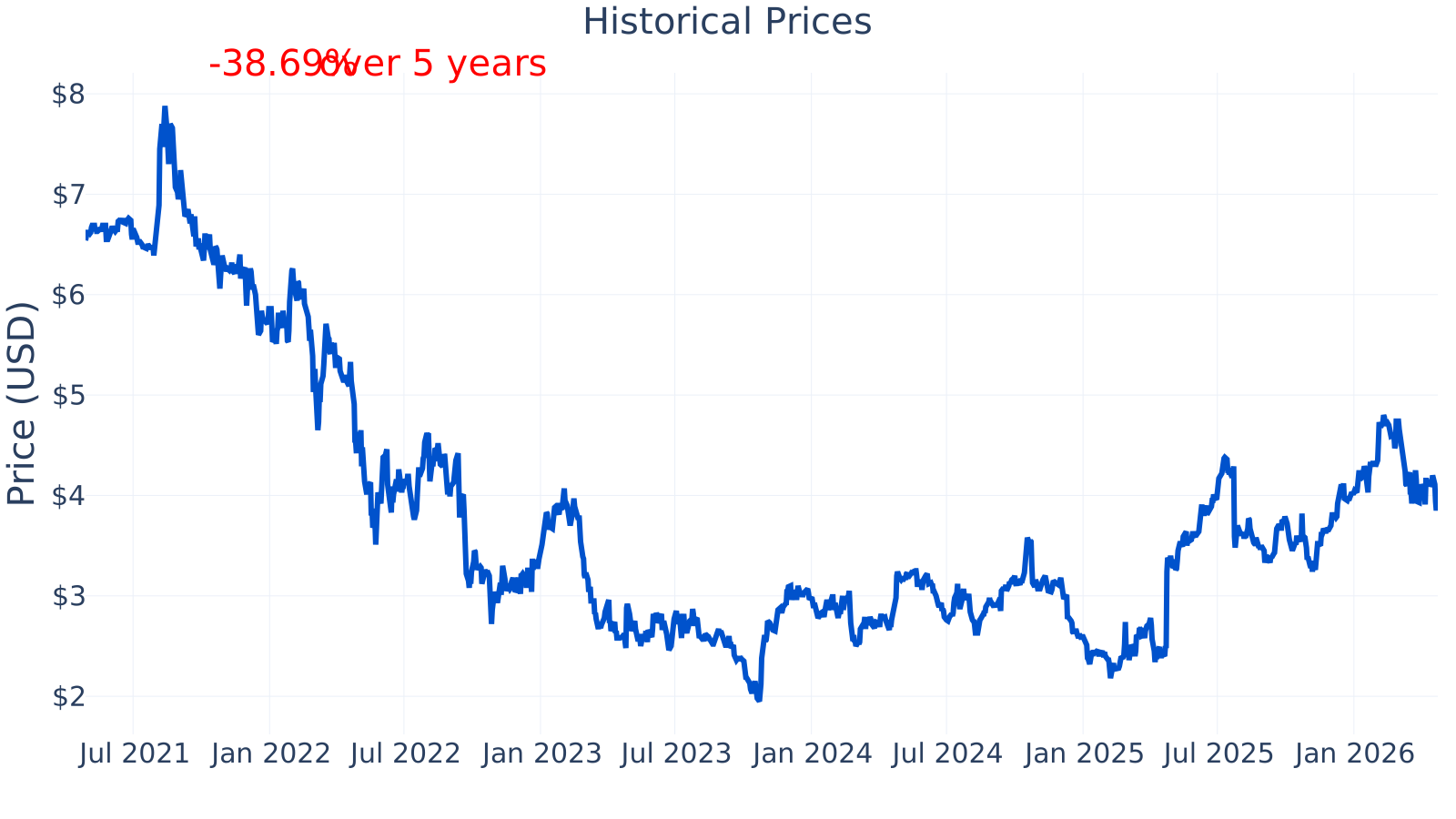
AMBP’s market capitalization is about $2.4B, and the stock’s beta (~0.63) suggests it has historically moved less than the broader market on average (though this can change). Recent profit margin is ~0.19%, which is far below the industry median shown (~5.97%), meaning a small change in costs, pricing, or volumes can have an outsized effect on net income. On the other hand, the most recent year-over-year revenue growth is ~18.6% versus an industry median near 2.1%, indicating stronger recent top-line momentum than the typical peer in the same industry set. Trailing twelve-month free cash flow is about $209M, which is a meaningful positive compared with earlier periods that were negative.
Growth (Medium)
Metal beverage packaging is often discussed in company materials as a category supported by long-term themes such as recyclability, brand preference for cans in certain beverage segments, and convenience. However, it is not a “hypergrowth” market; it is more commonly shaped by steady consumption patterns, regional capacity additions, and periodic shifts between packaging formats.
AMBP’s growth outlook is therefore closely tied to (1) can volume demand from beverage producers, (2) the company’s ability to secure contracts and run plants at high utilization, and (3) execution on operational efficiency. A practical “catalyst” in this type of business is often a combination of improved capacity utilization, more favorable contract economics, and stabilizing input costs—because small margin changes can materially affect earnings.
The year-over-year revenue growth trend shows a period of strong growth in 2021–2022, a softer patch around parts of 2023–2024, and then a re-acceleration into 2025–2026, reaching about 18.6% most recently. This is notably above the industry median shown in the table (~2.1%), but it is still important to interpret revenue growth alongside profitability (since higher sales do not automatically translate into higher earnings).
Free cash flow has improved materially over time, moving from negative levels in 2021–2023 to positive territory by 2024 and remaining positive most recently (about $209M TTM). For a manufacturing business, this can matter because positive free cash flow can help support debt servicing, maintenance and expansion investments, and overall financial flexibility.
Risks (High)
The main risk area is that AMBP operates a capital-intensive manufacturing model with meaningful exposure to input costs (aluminum, energy) and operational execution. Even when revenue grows, profitability can remain pressured if costs rise faster than pricing or if plants run below optimal utilization.
Profit margins have been volatile and, more recently, extremely thin. The latest profit margin is about 0.19%, compared with an industry median near 6.45% in the most recent point shown on the chart. This gap highlights how sensitive AMBP’s net results can be to interest costs, depreciation, taxes, and one-time items—especially in a business where operating improvements may not fully show up at the bottom line.
Leverage is another key risk signal. The debt-to-equity ratio shown is unusual (including negative values and very large swings). In practice, this often happens when equity becomes very small or negative due to accumulated losses, accounting effects, or balance-sheet structure—making the ratio less intuitive than in a typical company. Regardless of the ratio’s sign, the broader point for long-term analysis is that AMBP has had meaningful financing costs (interest expense rising across the years shown in the overview), and higher leverage can reduce flexibility during weaker demand periods.
On competitive positioning, aluminum beverage cans are generally a scale business: large players tend to compete on plant footprint, reliability, cost efficiency, and long-term customer relationships. Competitive advantages usually come from manufacturing scale, geographic proximity to customers, and execution (scrap rates, uptime, logistics, procurement). AMBP is a significant participant in this space, but it operates alongside other large, well-established packaging companies.
Main competitors typically include other global beverage-can manufacturers (large integrated packaging groups and dedicated can producers). In competitive terms, AMBP’s placement depends on region and customer mix; the more difficult challenge visible in the metrics is not demand alone, but achieving and sustaining profitability closer to industry norms while managing financing costs.
Valuation
Valuation for AMBP can be harder to interpret using traditional earnings-based measures when net income is near break-even and margins are very thin. In such cases, the price-to-earnings (P/E) ratio may swing sharply or become temporarily less informative.
The P/E series shown is highly volatile, with some periods where it is not meaningful (displayed as 0 on the chart). When it does appear, AMBP’s P/E has at times been far above the industry median (which stays roughly in the mid-teens to around 20 in the period shown). This pattern is consistent with a company whose earnings are small relative to its market value or fluctuate significantly from period to period. As a result, investors often look at additional lenses—such as cash flow trends and operating performance—to contextualize valuation, especially for capital-intensive businesses.
Given the combination of (1) improving revenue growth, (2) positive recent free cash flow, and (3) very low net margin plus meaningful interest burden, the market’s pricing context often reflects a trade-off between operational improvement potential and financial/earnings fragility. Whether the price is “expensive” or “cheap” cannot be concluded from P/E alone here because earnings have not been consistently strong enough to make the ratio stable.
Conclusion
Ardagh Metal Packaging SA is a focused manufacturer of aluminum beverage cans, a category that can benefit from long-term packaging trends but is also shaped by industrial realities like utilization, input costs, and financing structure. The company has shown strong recent revenue growth and a shift to positive free cash flow, both of which can be important indicators of improving operating momentum.
At the same time, the most recent profitability remains very thin versus industry norms, and interest expense is a meaningful drag—factors that can amplify downside sensitivity if conditions weaken. In plain terms: AMBP’s long-term profile is strongly linked to whether it can convert scale and revenue into durable, industry-like margins while maintaining adequate balance-sheet flexibility.
Sources:
- SEC EDGAR — Ardagh Metal Packaging S.A. filings (Annual Report on Form 20-F, Quarterly Reports, and other filed exhibits as applicable)
- Ardagh Metal Packaging — Investor Relations materials and press releases (company-hosted)
- Wikipedia — “Ardagh Metal Packaging” (basic company background)
This article is for informational purposes only and does not constitute financial advice. Some content is AI-generated. See Disclaimer