Stock Analysis · Millicom International Cellular SA (TIGO)
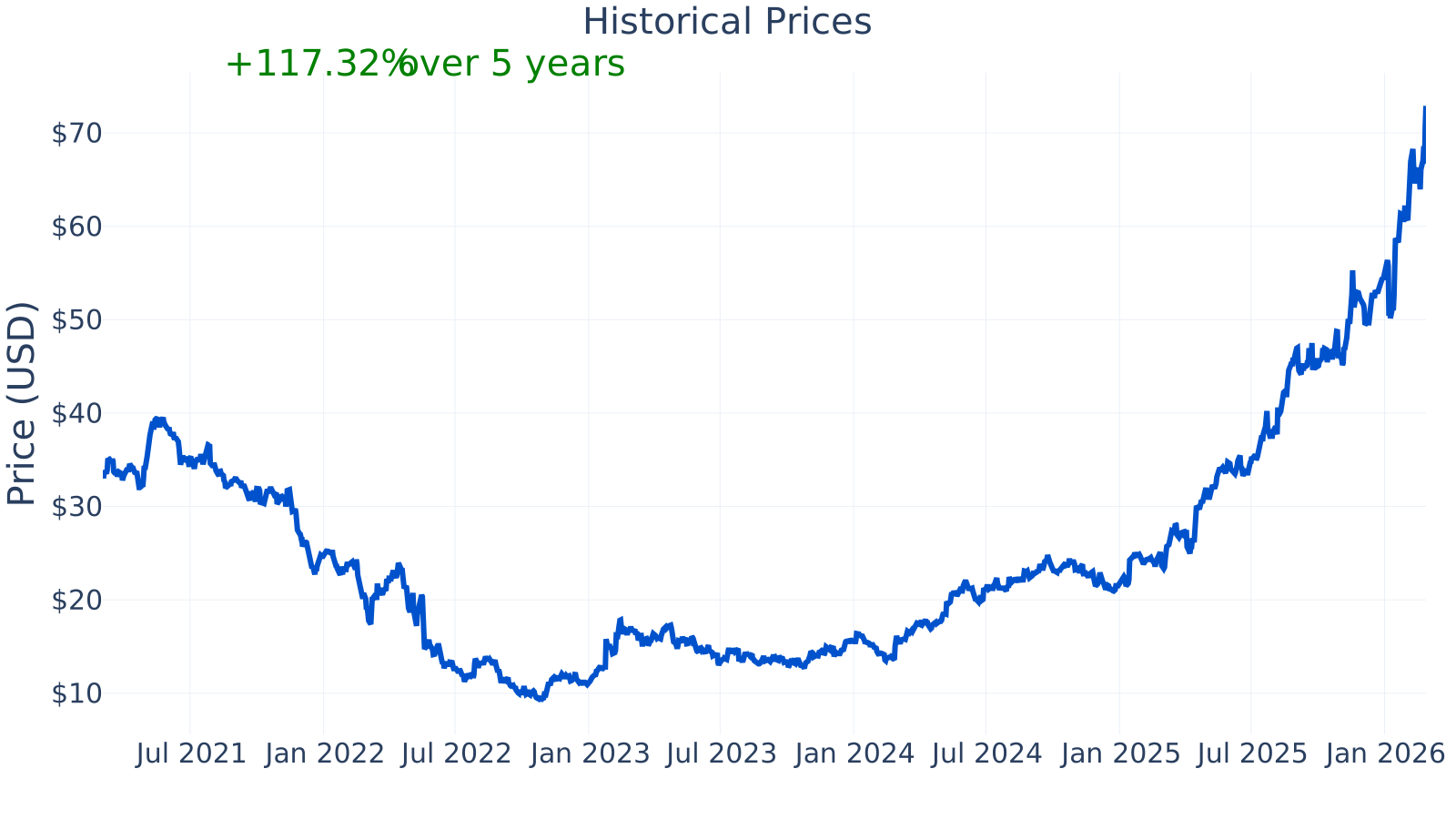
Overview
Millicom International Cellular SA (TIGO) is a telecommunications and digital-services company focused on Latin America. It provides mobile services (voice, text, and data), fixed broadband internet for homes and businesses, and related connectivity services. In several of its markets, Millicom also operates cable and fiber networks and sells bundled offers that combine home internet with mobile plans.
In addition to connectivity, Millicom has developed digital services that can sit on top of telecom networks, such as mobile financial services (often referred to as “mobile money” in filings) and other value-added offerings. These services aim to increase customer engagement and diversify the business beyond traditional telecom access.
Across telecom companies, revenue typically comes mainly from service subscriptions and usage (mobile and fixed), with a smaller portion from equipment sales (for example, handsets) and other services. Exact percentages vary by year and by country and are usually detailed by the company in its annual report segment disclosures.
Over the 2021–2025 period shown, total revenue rises from about $4.3B (2021) to about $5.8B (2024–2025). Profitability appears to fluctuate meaningfully: net income moves from about $590M (2021) to about $57M (2022), turns negative in 2023, then improves to about $253M (2024) and about $1.3B (2025). The pattern suggests results can be influenced by factors beyond day-to-day operations (for example, financing costs, taxes, and one-time items), which is common in telecom businesses operating across multiple countries and currencies.
Key Figures
| Metric | Value | Industry ⓘ |
|---|---|---|
| Date | Mar 02, 2026 | |
| Context | ||
| Sector | Communication Services | |
| Industry | Telecom Services | |
| Market Cap ⓘ | $12.18B | |
| Beta ⓘ | 0.93 | |
| Fundamental | ||
| P/E Ratio ⓘ | 11.18 | 16.24 |
| Profit Margin ⓘ | 22.62% | 6.34% |
| Revenue Growth ⓘ | 15.70% | 2.05% |
| Debt to Equity ⓘ | 260.19% | 119.24% |
| PEG ⓘ | 0.63 | |
| Free Cash Flow ⓘ | $1.17B | |
Millicom’s market capitalization is about $12.2B, placing it among the larger listed telecom operators focused on Latin America. The beta is about 0.93, which indicates the stock has historically moved somewhat similarly to the broader market (though beta can change over time and does not capture company-specific risks).
On profitability, the latest profit margin shown is about 22.6%, well above the industry median shown (about 6.3%). However, the historical profit margin series indicates that profitability has not been stable in recent years, including periods around breakeven or negative margins, before improving sharply most recently.
Growth (as measured here by year-over-year revenue growth) is about 15.7%, above the industry median shown (about 2.1%). Leverage is elevated: debt-to-equity is about 260%, compared with an industry median around 119%, which can matter in a capital-intensive industry where interest expense is a recurring cost.
Growth (Medium)
Telecom demand is generally supported by long-term trends: rising mobile data consumption, migration to faster broadband (including fiber where available), and the growing importance of reliable connectivity for commerce, education, and entertainment. In many Latin American markets, there is also an ongoing shift from legacy networks to higher-capacity infrastructure, which can support higher speeds and more data usage over time.
Millicom’s strategy (as described in company reporting) typically centers on expanding and upgrading network coverage and capacity, increasing adoption of higher-value plans, and selling converged bundles (mobile + home broadband). Bundling can reduce customer churn (customers leaving for another provider) and can increase revenue per household when customers take multiple services from the same provider. Digital services such as mobile financial services may also provide additional growth avenues, depending on adoption and regulatory conditions in each market.
The year-over-year revenue growth trend is uneven. There are periods of very strong growth (notably in 2022), followed by slower or negative comparisons in parts of 2023–2025, and then a rebound to positive growth at the end of 2025 (about 15.7%). This pattern suggests that growth can be cyclical and influenced by pricing, currency movement, competitive intensity, and macroeconomic conditions in the countries where Millicom operates.
Free cash flow (cash generated after operating costs and capital spending) increases substantially over the period shown—from roughly $127M (2021) to about $1.10B (2025). For a telecom operator, sustained free cash flow can be important because the business requires ongoing network investment while also needing to service debt and meet spectrum/license obligations where applicable.
Risks (High)
Telecom is capital-intensive and heavily regulated, and Millicom operates across multiple jurisdictions. That creates several layers of risk: regulatory changes (licenses, spectrum terms, consumer rules), competitive pricing pressure, and country-specific macroeconomic volatility (including inflation and currency swings). Because many costs, financing, or equipment purchases can be tied to hard currencies while revenues are often earned in local currencies, exchange-rate moves can affect reported results and leverage metrics.
Debt levels appear high versus the industry median throughout the period shown. The latest debt-to-equity is about 260% (compared with an industry median around 119%). While leverage is common in telecom due to stable subscription-like revenue, higher leverage can increase sensitivity to interest rates, refinancing conditions, and temporary downturns in operating performance.
Profit margin has been volatile, moving from negative territory in parts of 2021, to modestly positive, dipping around breakeven/negative again in 2023, then rising sharply through 2025 to about 22.6% (above the industry median shown of about 5.1%). This volatility can reflect a mix of operating performance and non-operating items (such as financing costs, taxes, and one-time gains or charges). For long-term analysis, it can be important to distinguish recurring operating profitability from temporary effects.
Competitive positioning depends on the specific country and service (mobile vs. fixed). In most markets, Millicom typically faces competition from large regional and global telecom groups and strong local operators. Common competitors in Latin American telecom markets include América Móvil (Claro), Telefónica (Movistar), and Liberty Latin America, along with various local fixed broadband and mobile providers. Competitive advantage in telecom often comes from network quality and coverage, spectrum holdings, brand strength, distribution, and the ability to bundle services. Millicom’s fixed network footprint (including cable/fiber assets where present) can support bundling, but the company still faces aggressive promotions and price competition typical of the sector.
Valuation
The latest P/E ratio shown is about 11.2 versus an industry median around 16.2. A lower P/E can indicate the market is assigning a more cautious outlook (for example, due to country risk, leverage, or earnings volatility), or it can reflect that recent earnings have increased faster than the share price.
The historical P/E series varies widely, including periods where the ratio spikes (often a sign that earnings were temporarily very low) and later declines to single digits by late 2025 in the series shown. This aligns with the idea that earnings have been volatile, which can make simple valuation comparisons less reliable unless paired with a closer look at how sustainable profits and cash flows are across an economic cycle.
Conclusion
Millicom is a Latin America-focused telecom operator providing essential connectivity services, with additional digital offerings that may deepen customer relationships. The business operates in a structurally relevant industry where demand for data and broadband tends to grow over time, and recent free cash flow shown improves meaningfully, which is a notable point for a capital-intensive company.
At the same time, the risk profile appears elevated. The leverage level stands above the industry median, and profitability has been unstable over several years before improving sharply most recently. Country, currency, regulatory, and competitive dynamics can materially influence results from year to year.
Based on the metrics shown, the company trades at a lower P/E than the industry median at the latest point, while also showing stronger recent margin and revenue growth than the median. Whether that valuation relationship persists tends to depend on the durability of earnings and free cash flow, and on how effectively the company manages debt and navigates market-by-market competition and regulation.
Sources:
- SEC EDGAR — Millicom International Cellular S.A. filings (Annual Report / Form 20-F and other submitted reports)
- Millicom Investor Relations — Annual reports, results materials, and press releases
- Wikipedia — “Millicom” (basic company background information)
This article is for informational purposes only and does not constitute financial advice. Some content is AI-generated. See Disclaimer


