Stock Analysis · Millicom International Cellular SA (TIGO)
Overview
Millicom International Cellular S.A. (often known by the brand “Tigo”) is a telecommunications company focused on Latin America. It provides mobile services (voice, messaging, and data), fixed broadband internet for homes and businesses, pay TV in some markets, and related digital services. In many of its countries, Millicom operates networks that connect customers through mobile towers and fixed infrastructure (such as fiber and cable), then sells service plans on top of that connectivity.
At a high level, Millicom’s business is built around recurring subscription-like revenue: customers pay monthly (or prepaid) for connectivity, and the company invests continuously to maintain and expand its networks.
Based on Millicom’s reporting categories, revenue typically comes from a mix of the following activities (exact percentages vary by year and country):
- Mobile services (mobile data, voice, messaging, and related fees)
- Home broadband / fixed internet (including fiber or cable internet access)
- Business services (connectivity and solutions for companies, sometimes including cloud/IT-related connectivity services)
- Other digital services (market-dependent offerings such as value-added services and platforms)
Over time, the company’s results can be strongly influenced by currency moves and economic conditions in its countries, since the business is largely based in emerging markets while financial reporting and debt are often tied to major currencies.
Across the last few years shown, revenue increased overall (from about $4.26B in 2021 to about $5.80B in 2024). Profitability also shows how financing costs matter in this type of business: interest expense remains a large line item (hundreds of millions per year), which can meaningfully affect bottom-line results even when operating profit is positive.
Key Figures
| Metric | Value | Industry ⓘ |
|---|---|---|
| Date | Feb 07, 2026 | |
| Context | ||
| Sector | Communication Services | |
| Industry | Telecom Services | |
| Market Cap ⓘ | $11.19B | |
| Beta ⓘ | 0.93 | |
| Fundamental | ||
| P/E Ratio ⓘ | 10.27 | 15.18 |
| Profit Margin ⓘ | 19.59% | 6.18% |
| Revenue Growth ⓘ | -0.80% | 2.10% |
| Debt to Equity ⓘ | 252.53% | 113.97% |
| PEG ⓘ | 0.56 | |
| Free Cash Flow ⓘ | $1.17B | |
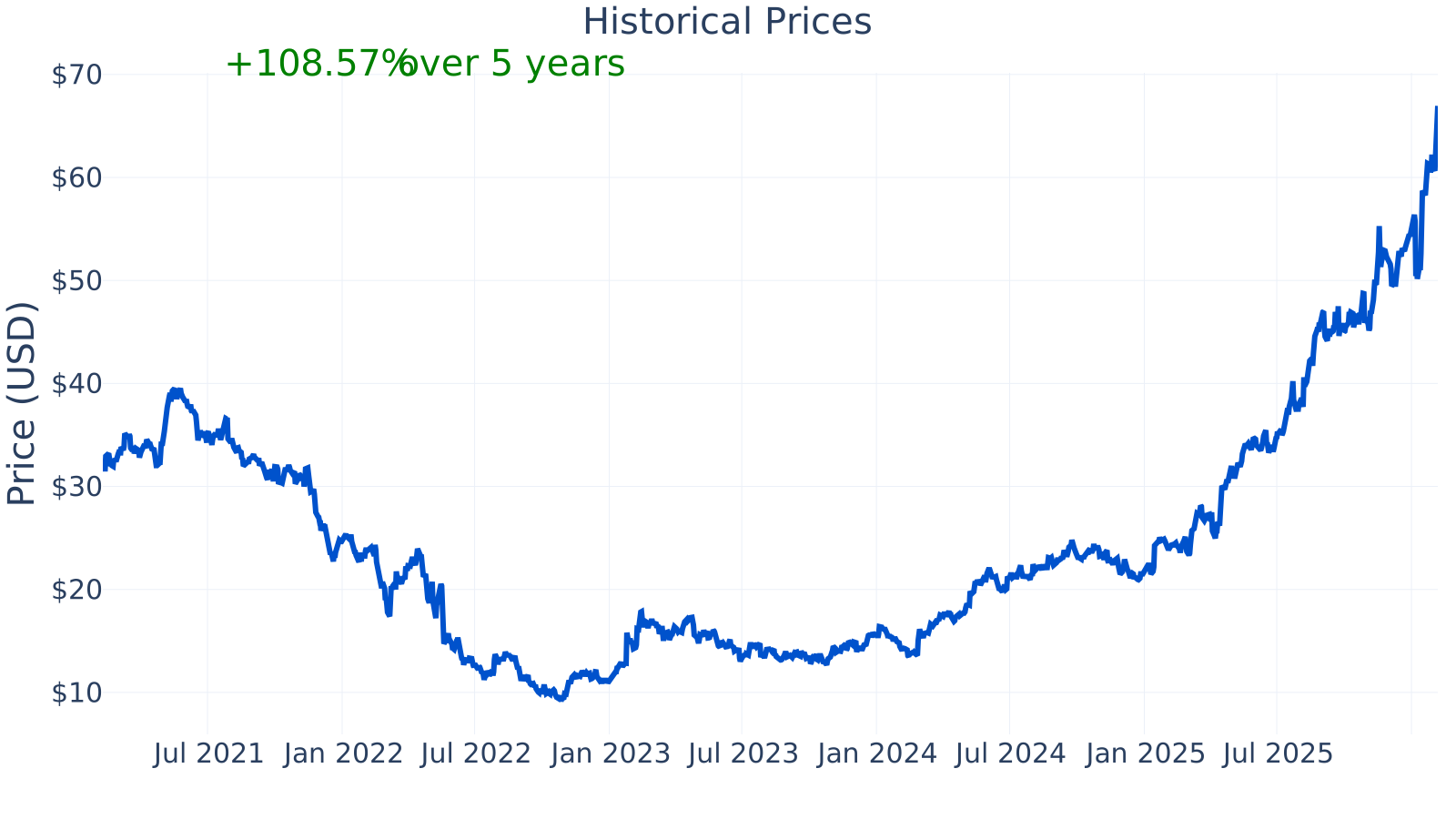
Millicom’s market capitalization is about $11.2B, placing it among the larger publicly listed telecom operators focused on Latin America. The stock’s beta of ~0.93 suggests price moves that have been somewhat close to the overall market on average (though single stocks can still be volatile, especially in emerging-market exposure). The latest P/E ratio is ~10.3, below the industry median (~15.2), while the profit margin is ~19.6%, well above the industry median (~6.2%). Recent year-over-year revenue growth is about -0.8% versus an industry median around +2.1%, highlighting that the latest period reflects weaker top-line momentum than the typical peer. Leverage is notable: debt-to-equity is ~253% compared with an industry median near 114%. Finally, trailing twelve-month free cash flow is about $1.17B, which is significant in absolute terms for funding network investment and meeting financial obligations.
Growth (Medium)
Telecom is usually a “steady demand” industry: people and businesses rely on connectivity in everyday life. In Millicom’s regions, long-run demand is supported by continued data consumption growth (video, social, work tools), migration from older networks to faster technologies, and the expansion of fixed broadband (especially fiber) where households move toward higher-speed plans.
That said, telecom growth is often more incremental than explosive. Companies compete on coverage, speed, customer service, and pricing, and they must invest heavily in networks. For Millicom, future growth tends to depend on (1) increasing data usage per customer, (2) expanding higher-value fixed broadband access, and (3) maintaining pricing discipline in competitive markets.
The pattern shown indicates revenue growth was very strong in parts of 2022 (several quarters well above 30% year over year), then moderated considerably and turned slightly negative more recently (around -0.8% in the latest reading). This kind of swing can happen when exchange rates move, inflation and pricing adjust, and comparisons become tougher after unusually strong periods.
Free cash flow increased materially over the period displayed (from roughly $127M in 2021 to about $1.10B by 2025). For a network operator, sustained free cash flow is important because it helps fund ongoing capital spending, spectrum-related needs (where applicable), and debt servicing. A potential catalyst for the business model is the continued conversion of customers to higher-value data and home broadband plans—if competitive intensity stays manageable and network quality remains strong.
Risks (High)
This article is for informational purposes only and does not constitute financial advice. Some content is AI-generated. See Disclaimer


