Stock Analysis · Penguin Solutions Inc (PENG)
Overview
Penguin Solutions Inc (PENG) operates in the technology sector, within information technology services. In practical terms, the company provides technology solutions and services that help customers run and support their computing needs (for example, equipment and related services used in data-heavy workloads). Its business model is generally tied to customer technology spending cycles, which can rise or fall depending on broader IT budgets and infrastructure investment.
Public filings typically break revenue into a small number of operating categories (the exact labels can vary by reporting period). Because detailed, reliable segment percentages are not included in the provided financial inputs here, the revenue mix below is described at a high level rather than as precise percentages:
- Technology solutions and systems (customer deployments that may include hardware, integration, and related deliverables)
- Services and support (ongoing support, maintenance, and professional services tied to customer environments)
The company’s recent income structure shows that a large share of revenue is consumed by direct costs, with profitability depending heavily on operating discipline (selling/administrative costs and R&D) and financing costs (interest expense).
Across the periods shown, revenue has moved meaningfully up and down (roughly from about $1.06B in FY2021 to $1.37B in FY2025), while operating income has also fluctuated—negative in some years and positive in others. Interest expense appears notably lower in FY2025 than in earlier periods shown, which can reduce pressure on net results when operating profit is modest.
Key Figures
| Metric | Value | Industry ⓘ |
|---|---|---|
| Date | Feb 08, 2026 | |
| Context | ||
| Sector | Technology | |
| Industry | Information Technology Services | |
| Market Cap ⓘ | $987.08M | |
| Beta ⓘ | 2.20 | |
| Fundamental | ||
| P/E Ratio ⓘ | 85.36 | 21.42 |
| Profit Margin ⓘ | 1.86% | 4.91% |
| Revenue Growth ⓘ | 0.60% | 6.15% |
| Debt to Equity ⓘ | 88.40% | 54.49% |
| PEG ⓘ | N/A | |
| Free Cash Flow ⓘ | $122.21M | |
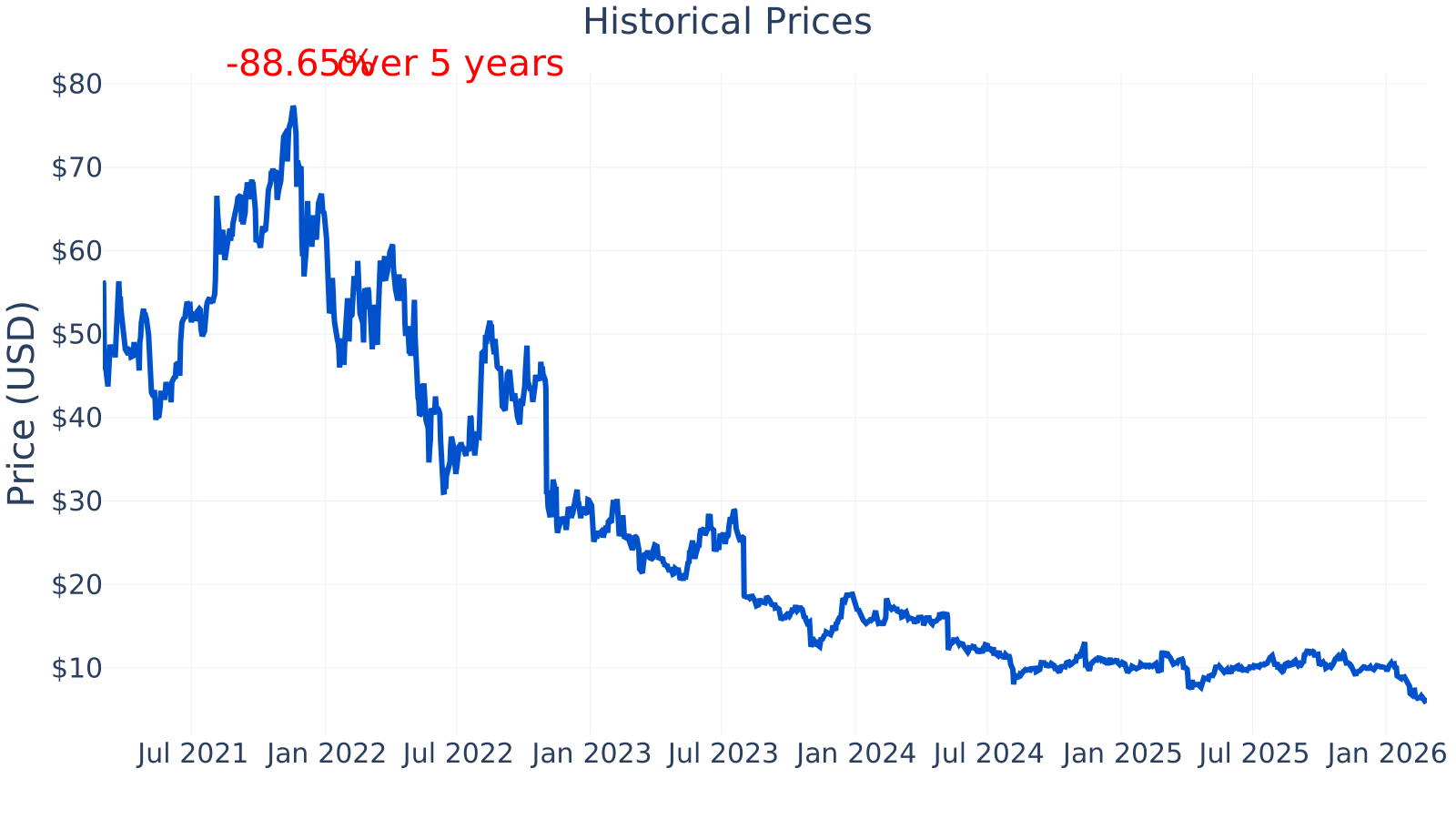
At the latest point shown, Penguin Solutions has a market capitalization of about $987M. The stock’s beta of ~2.20 indicates it has historically been much more volatile than the overall market. Profitability and growth look modest on the most recent snapshot: profit margin ~1.86% (vs. industry median ~4.91%) and year-over-year revenue growth ~0.60% (vs. industry median ~6.15%). Leverage is higher than the industry median, with debt-to-equity ~88% (industry median ~54%). Despite thin margins, the company shows positive trailing twelve-month free cash flow of ~$122M, which can matter for resilience and reinvestment capacity.
Growth (Medium)
Penguin Solutions operates in areas linked to ongoing demand for computing infrastructure and IT services. Over the long run, organizations tend to expand data processing needs (cloud usage, enterprise systems, and data-intensive workloads). That said, this is also an industry where spending can be cyclical: customers may delay projects in weaker budget environments and accelerate them when conditions improve.
The revenue growth pattern shown is uneven. After very strong year-over-year growth in 2021 (above 50% in several points), growth slowed sharply and turned negative through much of 2022–2024, before improving and returning to positive territory in late 2024 and 2025. The most recent value shown is close to flat (~0.6%), which suggests the near-term run rate is not currently expanding quickly.
Free cash flow has remained positive across the time points shown and rose materially in the latest period (roughly $36.7M in 2021 to about $138.1M in early 2025, with the latest TTM shown at ~$122.2M). In plain terms, the business has recently generated cash after operating needs and capital spending, which can support balance sheet flexibility and internal investment. A potential catalyst over time would be sustained revenue stabilization combined with improved operating efficiency, since small changes in costs can have a noticeable impact when margins are thin.
Risks (High)
This article is for informational purposes only and does not constitute financial advice. Some content is AI-generated. See Disclaimer