Stock Analysis · Ichor Holdings Ltd (ICHR)
Overview
Ichor Holdings Ltd (ICHR) supplies subsystems and specialized components used in semiconductor manufacturing equipment. In simple terms, it helps the companies that build chipmaking tools by providing parts that manage and control process gases and chemicals, as well as other engineered assemblies needed inside advanced fabrication equipment.
The company’s revenue is primarily generated by selling these subsystems and components to semiconductor equipment manufacturers (often called “OEMs”), along with related services such as integration and support. In its filings, Ichor generally describes revenue at a high level (rather than publishing a detailed, percentage-based split by product line), and its results can be strongly influenced by changes in capital spending cycles in the semiconductor industry and by the purchasing patterns of its largest customers.
From a “where the money goes” perspective, recent years show that the cost to produce what Ichor sells (materials, manufacturing, and related costs) represents the largest outflow, leaving a smaller gross profit to cover operating expenses (like R&D and overhead) and interest costs.
Across 2021–2025, total revenue moved from about $1.10B (2021) up to about $1.28B (2022), then down to about $811M (2023) before recovering to about $947.7M (2025). Over the same period, gross profit narrowed (about $177.5M in 2021 versus about $87.8M in 2025), which helps explain why net income turned negative after 2022.
Key Figures
| Metric | Value | Industry ⓘ |
|---|---|---|
| Date | May 08, 2026 | |
| Context | ||
| Sector | Technology | |
| Industry | Semiconductor Equipment & Materials | |
| Market Cap ⓘ | $2.48B | |
| Beta ⓘ | 1.88 | |
| Fundamental | ||
| P/E Ratio ⓘ | N/A | 48.78 |
| Profit Margin ⓘ | -5.28% | 8.18% |
| Revenue Growth ⓘ | 4.70% | 11.50% |
| Debt to Equity ⓘ | 6.42% | 23.11% |
| PEG ⓘ | 0.80 | |
| Free Cash Flow ⓘ | $137.00K | |
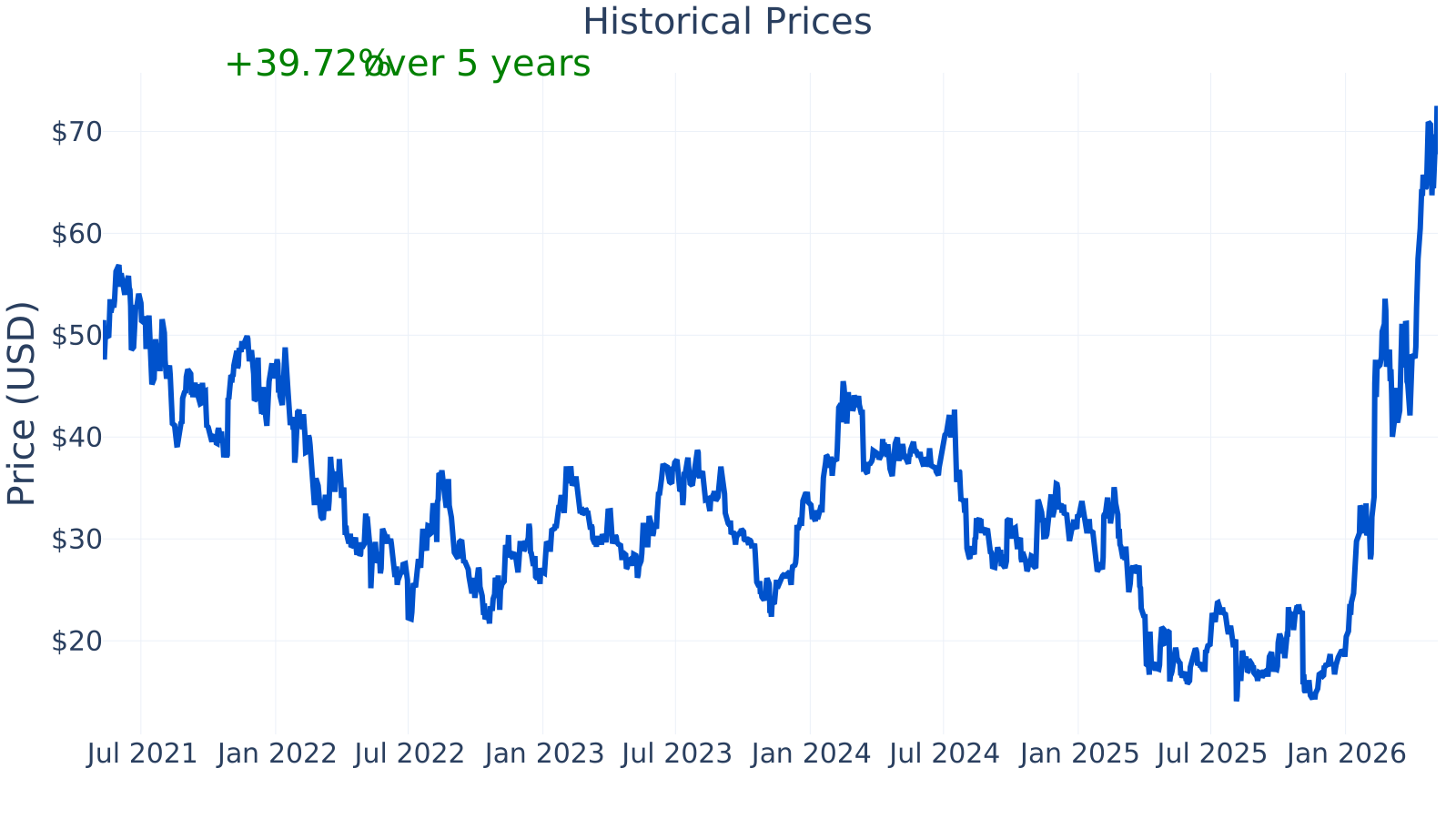
Ichor’s market capitalization is about $2.48B, and its beta of about 1.88 indicates the stock has historically been more volatile than the broader market. The latest profit margin shown is about -5.28% versus an industry median around 8.18%, meaning the company is currently reporting losses while many peers are profitable.
Year-over-year revenue growth is about 4.7% versus an industry median around 11.5%, pointing to slower recent growth than the typical company in its peer set. On leverage, debt-to-equity is about 6.4% versus an industry median around 23.1%, which suggests a relatively conservative balance-sheet position compared with many peers. Free cash flow over the last twelve months is close to break-even (about $0.137M), which is a notable cooling from earlier positive levels.
Growth (Medium)
Ichor operates in the semiconductor equipment and materials ecosystem, which is tied to long-term drivers such as rising compute demand, ongoing chip complexity, and the need for advanced manufacturing capacity. That said, this part of the market is cyclical: equipment spending can rise sharply during expansion phases and fall during downturns as customers digest prior capacity additions.
Strategically, the company’s positioning centers on being a key supplier of complex, engineered subsystems that must meet strict performance and reliability requirements. If semiconductor toolmakers introduce new platforms or increase tool shipments, suppliers of qualified subsystems can participate in that ramp. Potential catalysts typically include broader semiconductor capital expenditure recoveries, major technology transitions that increase tool intensity, and the scaling of new or expanded fabrication plants—though the timing and magnitude of these cycles are difficult to forecast.
Revenue growth has been uneven over time: strong positive growth in parts of 2021–2022 was followed by significant declines in 2023, then a return to positive growth through much of 2024–2025, with the most recent quarter around +4.7% year-over-year. This pattern is consistent with a business that is sensitive to semiconductor equipment demand cycles.
Free cash flow improved from negative levels in 2022 to solidly positive levels in 2023–2024, but it has since trended down to near break-even (about $0.137M on a trailing twelve-month basis). For long-term business durability, sustained positive free cash flow can matter because it supports reinvestment and reduces reliance on external financing.
Risks (High)
The largest risk is cyclical demand. Because Ichor supplies the semiconductor equipment supply chain, its sales can decline when chipmakers and equipment OEMs reduce spending. This cyclicality can also pressure margins if volumes fall, because fixed costs (facilities, engineering, and overhead) become harder to absorb.
A second major risk is customer concentration and program dependency, which is common in subsystem suppliers: losing share on a major tool platform, a change in customer sourcing strategy, or delays in a customer’s ramp can materially affect results. There is also execution risk around manufacturing quality, yields, and delivery performance; in semiconductor equipment supply chains, qualification standards are strict and failures can be costly.
Balance-sheet leverage has decreased substantially from earlier periods. The latest debt-to-equity is about 6.4%, well below the industry median near 23.1%. Lower leverage can reduce financial strain during downturns, but it does not remove the earnings and cash-flow volatility that can come from the cycle itself.
Profitability has weakened versus peers. The profit margin moved from positive levels in 2021–mid 2023 to negative territory from late 2023 through the latest period (about -6.69% most recently), while the industry median remains positive (about 8.14% most recently). This gap suggests the company is currently facing cost structure, pricing, mix, utilization, or other operational pressures relative to many competitors.
In terms of competitive positioning, Ichor participates in a crowded and sophisticated supply chain that includes other subsystem and component providers serving similar OEM customers. Competitive advantages in this niche tend to come from long qualification cycles, deep process know-how, reliability track records, manufacturing scale, and close engineering collaboration with OEMs. However, leadership can be program-specific rather than industry-wide, and share can shift as tool platforms evolve. Key competitors typically include other suppliers of gas delivery and fluid handling subsystems and related precision assemblies for semiconductor tools (as described in company filings), and competition often centers on performance, cost, delivery, and the ability to support global production ramps.
Valuation
A price-to-earnings (P/E) ratio can be useful when earnings are stable and positive. Here, the historical P/E is shown for periods where it was meaningful; in more recent periods, the P/E is not meaningful (and therefore not shown) because earnings were negative. This is consistent with the negative profit margin discussed above.
When a company is in a loss-making phase, valuation is often discussed using other lenses (for example, revenue-based multiples or cash-flow normalization), but those require additional inputs not provided here. In this context, what can be stated from the available fundamentals is that recent profitability has been below the industry median, recent growth has been below the peer median, and cash generation has recently weakened toward break-even—factors that can heavily influence how the market values cyclical semiconductor supply-chain businesses at different points in the cycle.
Conclusion
Ichor is a semiconductor equipment supply-chain company whose results tend to follow industry capital spending cycles. The long-term industry backdrop benefits from ongoing demand for more advanced and higher-volume chip manufacturing, but the path is typically volatile.
The recent financial picture shows mixed signals: revenue has recovered from 2023 lows and is modestly positive year-over-year, leverage is relatively low compared with peers, but profitability remains negative and free cash flow has faded to near break-even. Relative to the industry median, the company’s latest margin and growth metrics are weaker, which highlights the importance of monitoring whether operating performance and cash generation improve as the cycle evolves.
Sources:
- SEC EDGAR — Ichor Holdings, Ltd. filings (Form 10-K, Form 10-Q)
- Ichor Holdings, Ltd. — Investor Relations materials and press releases
- Wikipedia — “Ichor Holdings” (basic company background)
This article is for informational purposes only and does not constitute financial advice. Some content is AI-generated. See Disclaimer