Stock Analysis · Globalfoundries Inc (GFS)
Overview
GlobalFoundries Inc. (GFS) is a semiconductor manufacturer (“chip foundry”). Instead of designing its own branded chips, it manufactures chips for other companies based on their designs. This type of business is often described as “foundry” manufacturing and is used by customers that want to outsource production while focusing on chip design, software, and end products.
GlobalFoundries focuses largely on chips made with “mature” and “specialty” manufacturing processes (rather than only the very smallest, cutting-edge transistor nodes). In practice, that means production for chips used in areas like smartphones and connectivity, automotive systems, industrial equipment, data centers, and other electronics that prioritize reliability, specialized features, power efficiency, or long product lifecycles.
Revenue mainly comes from manufacturing wafers (the silicon disks on which many chips are produced at once) and related services for customers. In its reporting, GlobalFoundries typically describes revenue as coming primarily from its wafer fabrication business (foundry manufacturing), with additional revenue streams that can include technology licensing and other related items (the exact breakdown can vary by period and reporting format).
Main sources of revenue (typical high-level breakdown):
- Foundry manufacturing / wafer revenue (the core business and largest contributor)
- Other revenue (may include items such as technology licensing and related services, depending on the period)
The longer-term financial path shown here highlights how profitability can swing with industry conditions: revenue and gross profit rose meaningfully from 2021 to 2022, then profitability softened later as the broader semiconductor cycle cooled. Operating results turned negative in 2024 before recovering to positive operating income and net income in 2025, illustrating the cyclical nature of chip manufacturing.
Key Figures
| Metric | Value | Industry ⓘ |
|---|---|---|
| Date | Feb 16, 2026 | |
| Context | ||
| Sector | Technology | |
| Industry | Semiconductors | |
| Market Cap ⓘ | $27.22B | |
| Beta ⓘ | 1.49 | |
| Fundamental | ||
| P/E Ratio ⓘ | N/A | 45.38 |
| Profit Margin ⓘ | 13.03% | 10.84% |
| Revenue Growth ⓘ | N/A | 15.50% |
| Debt to Equity ⓘ | 13.73% | 25.62% |
| PEG ⓘ | 0.88 | |
| Free Cash Flow ⓘ | $1.01B | |
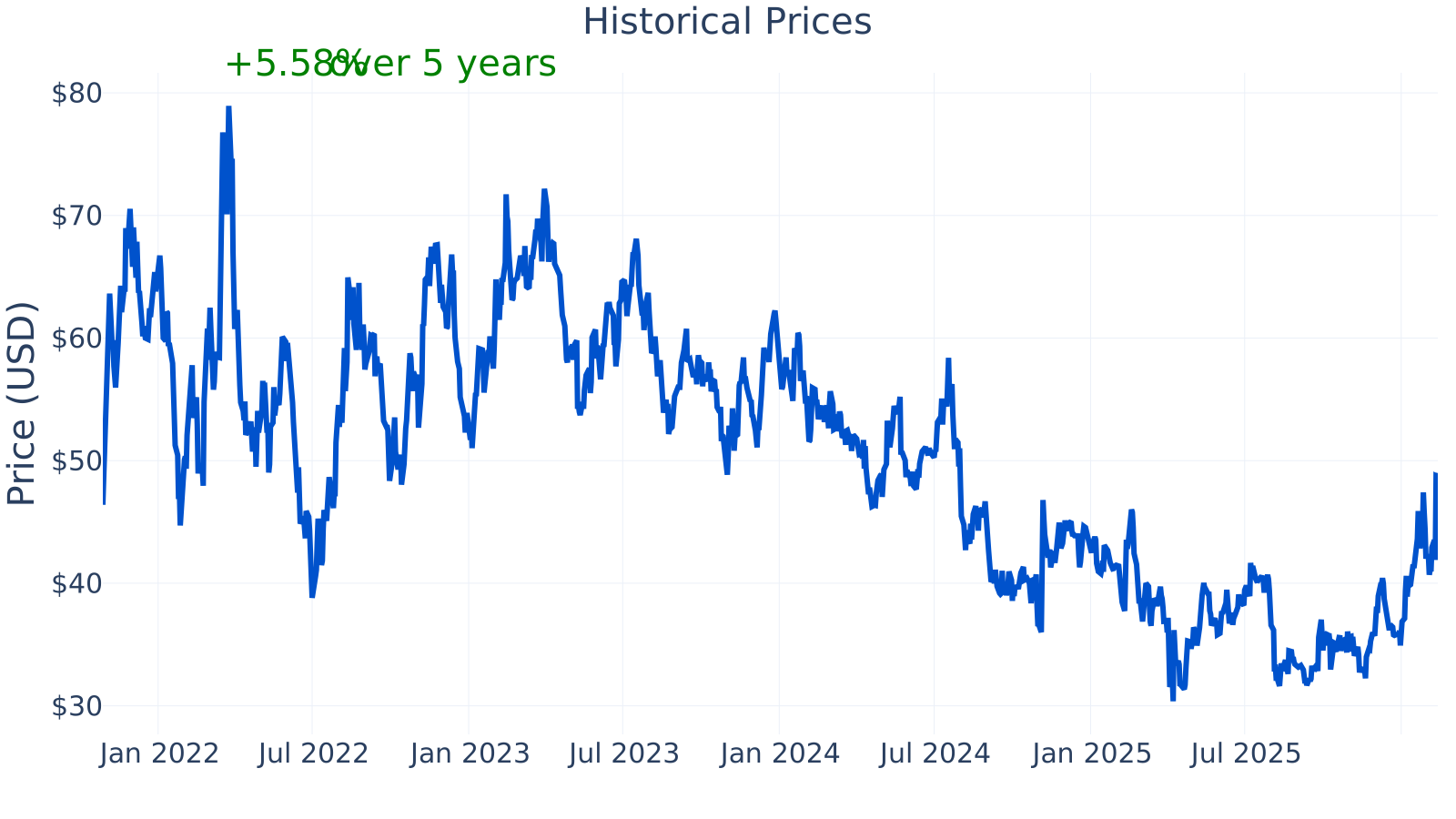
GlobalFoundries’ market capitalization is about $27.2B and the stock has shown relatively high sensitivity to market moves (beta ~1.49). Profit margin is about 13.0%, above the industry median (~10.8%), while revenue growth year over year is approximately 0% versus an industry median around 15.5%, suggesting the company has recently grown more slowly than many peers. Debt-to-equity is about 13.7%, below the industry median (~25.6%), indicating a comparatively lower leverage profile. Free cash flow over the trailing twelve months is about $1.0B, and the PEG ratio is shown near 0.88 (a ratio that relates valuation to growth expectations, though it can be unstable when growth is cyclical).
Growth (Medium)
The semiconductor industry is structurally important to the global economy, with long-term demand supported by trends such as increasing chip content in vehicles, factory automation, connectivity, and continued data infrastructure buildout. At the same time, the industry is cyclical: customers can shift quickly from shortages to inventory corrections, which can temporarily reduce demand for foundry capacity.
GlobalFoundries’ strategy is positioned around specialty and mature-node manufacturing, where product lifecycles can be longer (notably in automotive and industrial markets) and where differentiation can come from process features beyond transistor size (for example, power management, radio frequency, and embedded memory technologies). This approach differs from a “race to the smallest node” strategy and can align with customer needs that emphasize supply assurance, reliability, and stable long-term production.
The year-over-year revenue growth pattern reflects a downcycle after strong growth in 2022, followed by stabilization. Several quarters of negative growth through 2023–2024 improved into small positive growth in parts of 2025, ending near flat (~0%) most recently. In simple terms, this shows a business that has been moving from contraction toward stabilization, but not yet back to strong expansion.
Free cash flow (cash generated after operating needs and capital spending) has also been volatile: it moved from positive levels in 2022 to negative in 2023, then returned to around $1.0B in 2024–2025. For a capital-intensive manufacturer, this swing is important because building and upgrading fabs requires large, ongoing investment, and free cash flow can vary significantly across the cycle.
Potential catalysts for future growth (described broadly in company filings and investor materials) typically include improved utilization of manufacturing capacity as demand recovers, expanding long-term supply agreements, and continued investment in specialty technologies that deepen customer relationships. Another industry-level driver is the ongoing focus on supply chain resilience and geographic diversification of chip manufacturing, which can support demand for additional capacity over time (though the pace and economics depend on customer commitments and execution).
Risks (High)
Semiconductor manufacturing carries several recurring risks. The first is cyclicality: demand can fall quickly when customers reduce orders due to excess inventory, weaker end-market demand, or macroeconomic slowdowns. The second is capital intensity: fabs require substantial spending, and returns depend on keeping capacity well utilized. The third is pricing and mix: profitability can change based on which products customers order (and at what terms), as well as competitive pricing pressure.
Profitability has been uneven over time. Margins rose into 2022–2023, then turned negative in late 2024 and much of 2025 before returning to about 13.0% most recently. While the latest level is above the industry median shown, the recent history signals that profitability can deteriorate meaningfully during weaker periods, which is an important consideration for a long-term view.
Leverage appears comparatively moderate: debt-to-equity declined over time to about 13.7%, below the industry median (~25.6%). Lower leverage can help resilience during downturns, but it does not remove the underlying business risk from large fixed costs and the need for ongoing capital expenditures.
Competitive positioning is another key risk area. GlobalFoundries operates in a market with very large and well-resourced competitors. The company is not generally viewed as the global leader in leading-edge manufacturing; instead, its positioning is more concentrated in specialty and mature processes. Competitive advantages can include established manufacturing know-how, qualified process technologies with long customer qualification cycles, switching costs tied to re-qualifying chips for regulated or high-reliability markets, and geographically diversified manufacturing footprints. However, customers can still shift volumes over time, and large competitors may invest aggressively across overlapping process categories.
Main competitors (broadly):
- Taiwan Semiconductor Manufacturing Company (TSMC) (largest pure-play foundry)
- Samsung Electronics (foundry business alongside memory and other semiconductor products)
- Intel (growing foundry efforts alongside its own product manufacturing)
- UMC and SMIC (notable foundry competitors, particularly in mature nodes; competitive dynamics vary by geography and export controls)
Additional risks described in filings for companies in this industry commonly include customer concentration (large customers can represent a meaningful share of revenue), export controls and trade restrictions, geopolitical and supply chain disruptions, operational execution challenges in ramping capacity, and the pace of technology change.
Valuation
The price-to-earnings (P/E) ratio shown for GlobalFoundries has generally been in the mid-20s to mid-30s at several points, with periods where it is not meaningful (displayed as 0 on the chart). The latest plotted point is around the mid-20s, while the industry median shown is higher (mid-40s). A lower P/E than the peer median can occur for different reasons, such as lower expected growth, higher perceived cyclicality, or differences in business mix and profitability stability.
Because GlobalFoundries’ earnings and margins have recently swung from profit to losses and back to profit, valuation metrics based on earnings can be harder to interpret in isolation. For this type of business, it is often important to pair P/E observations with context such as revenue stability, margin durability across cycles, and cash generation through capital spending peaks and troughs.
Conclusion
GlobalFoundries is a major contract chip manufacturer with a strategy centered on specialty and mature-node production for end markets that often value reliability and long product lifecycles. The business operates in a structurally important industry, but the company’s results and cash generation have shown clear cyclicality, including a notable profitability downturn in 2024 and a recovery by 2025.
From a balance sheet perspective, leverage appears relatively moderate compared with the industry median shown, which can support flexibility during weaker periods. The main long-term uncertainties are tied to the competitive environment (with several very large rivals), the ability to keep fabs efficiently utilized through industry cycles, and how consistently margins can be sustained while continuing to fund heavy capital investment.
Sources:
- SEC EDGAR — GlobalFoundries Inc. filings (Form 10-K, 10-Q, 8-K)
- GlobalFoundries — Investor Relations materials (earnings releases and shareholder materials)
- Wikipedia — “GlobalFoundries” (basic company background)
This article is for informational purposes only and does not constitute financial advice. Some content is AI-generated. See Disclaimer


