Stock Analysis · Fabrinet (FN)
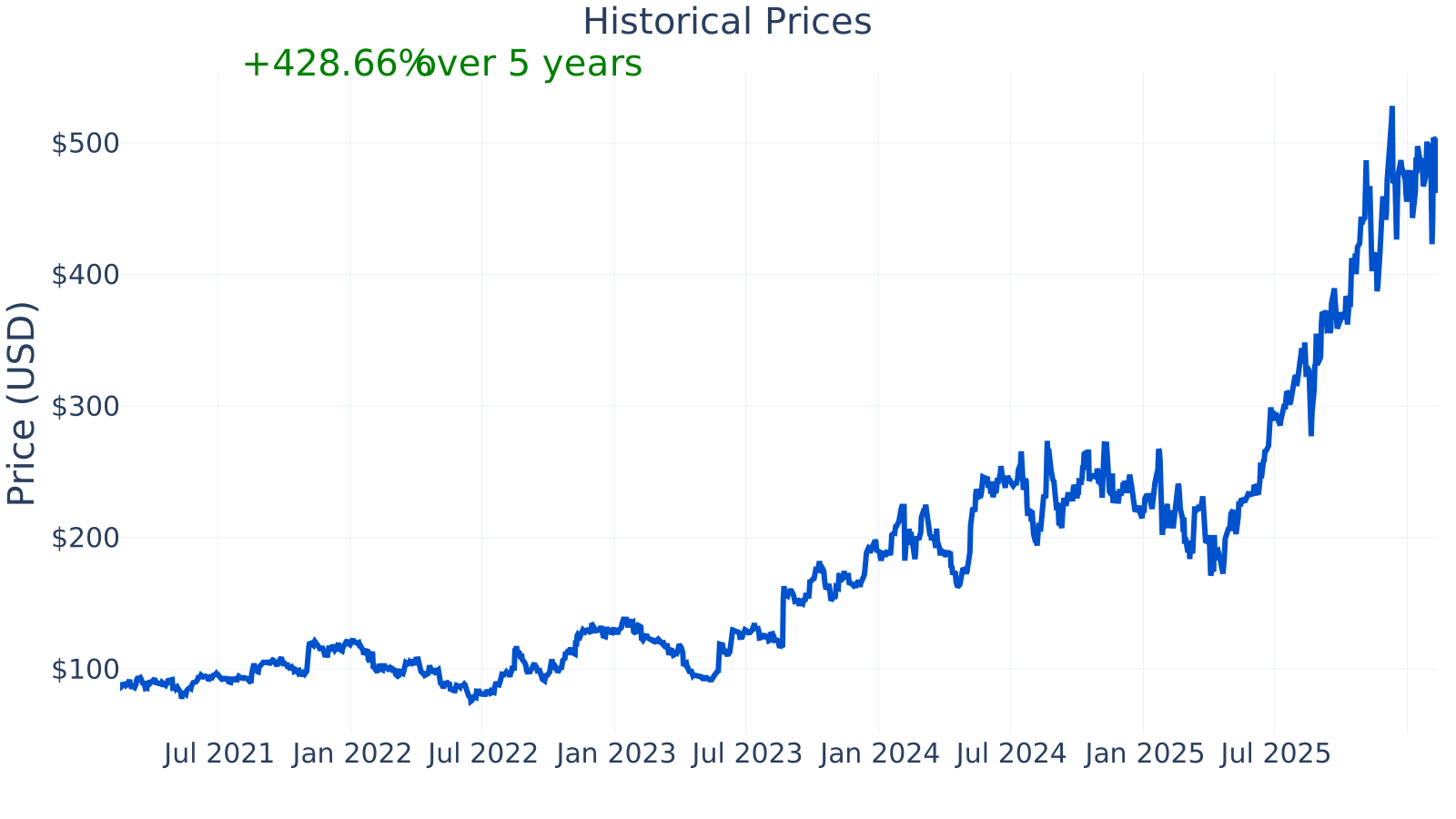
Overview
Fabrinet is a contract manufacturer that builds complex products for other companies, mainly in optical communications and other high-precision electronics. In simple terms, many well-known technology firms design equipment, and Fabrinet helps turn those designs into finished, test-verified hardware at scale. The company’s operations are largely based in Asia, with manufacturing and advanced production services that are designed to meet strict quality and reliability requirements.
Its revenue typically comes from manufacturing services across a few main end-markets (the exact mix can shift over time based on customer demand and product cycles). Based on company disclosures, Fabrinet’s business is commonly described in these categories:
- Optical communications products (often the largest portion): manufacturing for optical modules and related telecom/datacom hardware.
- Industrial lasers: manufacturing and assembly for laser-related systems used in industrial applications.
- Other: additional advanced manufacturing programs that can include automotive, medical, or other specialized electronics depending on customer projects.
One helpful way to understand Fabrinet is that it generally earns money on manufacturing execution (quality, yields, on-time delivery, cost control) rather than owning the end-customer brand. That can make results sensitive to customer order patterns, but it can also allow the company to participate in multiple technology trends without needing to “pick the winning brand” in each category.
Over the last several fiscal years shown, total revenue increased (from about $1.88B to about $3.42B), and net income also rose (from about $148M to about $333M). Costs of revenue remain the largest expense line, which is typical for a manufacturing-led business, while operating income expanded in absolute dollars as revenue grew.
Key Figures
| Metric | Value | Industry ⓘ |
|---|---|---|
| Date | Feb 13, 2026 | |
| Context | ||
| Sector | Technology | |
| Industry | Electronic Components | |
| Market Cap ⓘ | $16.55B | |
| Beta ⓘ | 1.03 | |
| Fundamental | ||
| P/E Ratio ⓘ | 44.26 | 41.23 |
| Profit Margin ⓘ | 9.69% | 6.11% |
| Revenue Growth ⓘ | 35.90% | 13.80% |
| Debt to Equity ⓘ | 0.37% | 39.00% |
| PEG ⓘ | 1.19 | |
| Free Cash Flow ⓘ | $101.79M | |
Fabrinet’s market capitalization is about $16.6B, and its beta is about 1.03, which indicates the shares have historically moved roughly in line with the broader market. The company’s P/E ratio is ~44.3 versus an industry median of ~41.2, while its profit margin is ~9.69% versus an industry median of ~6.11%. Recent year-over-year revenue growth is ~35.9% (industry median ~13.8%). The balance sheet leverage appears very low with debt-to-equity around 0.37% (industry median ~39.0%). Trailing twelve-month free cash flow is about $101.8M, and the PEG ratio is ~1.19 (a metric that compares valuation to growth expectations, but it depends on forward-looking estimates).
Growth (Medium)
Fabrinet operates in areas tied to long-term demand for faster data movement and more computing capacity—especially optical connectivity used in data centers and telecom networks. In many technology cycles, rising bandwidth needs translate into more optical components, higher performance requirements, and additional manufacturing complexity. For a specialist manufacturer, complexity can matter because customers may prefer partners that can reliably scale advanced processes, maintain high quality, and manage supply chains for difficult-to-build products.
The company’s growth approach is generally based on expanding manufacturing capacity and deepening relationships with existing customers, while adding new programs that fit its advanced manufacturing skill set. This strategy can make sense when customers want to outsource challenging production steps, shorten time-to-ramp for new products, or diversify manufacturing partners.
Revenue growth has varied over time, slowing into mid-2023 and then accelerating meaningfully more recently. The latest reading shows year-over-year revenue growth of about 35.9%, which is notably above the industry median level shown.
Free cash flow has also fluctuated. It rose to about $347M (TTM) around 2024-03-31, then moved down to about $273M around 2025-03-31, and is currently around $102M (TTM). For a manufacturer, this type of variability can be influenced by working capital needs (inventory, receivables), timing of customer ramps, and capital spending cycles.
Potential catalysts described in company materials often relate to new product ramps at customers, broader optical upgrade cycles, and expansion in specialized manufacturing programs. The key practical point for long-term watchers is whether strong demand translates into sustained volume, stable margins, and healthy cash generation after necessary capital expenditures.
Risks (Medium-High)
Fabrinet’s main risks are typical for a high-precision contract manufacturer. A major one is customer concentration: if a small number of customers account for a large share of revenue, changes in their ordering, product transitions, or supplier decisions can have an outsized impact. Another risk is cyclicality in end-markets like telecom and data center spending—demand can be strong for a period and then pause as customers digest inventory or delay projects.
Operational execution is also central. Manufacturing businesses can face risks from yield issues, supply chain disruptions, labor and wage pressures, and the need to invest in new equipment ahead of demand. In addition, because Fabrinet builds products for other companies, it may have limited control over end-market pricing and product strategies compared with branded equipment vendors.
One mitigant visible in the balance sheet metrics is leverage. Fabrinet’s debt-to-equity has trended down over time and is currently around 0.37%, far below the industry median shown (about 39%). Low leverage can reduce financial risk during downturns, though it does not eliminate business-cycle risk.
Profitability has been comparatively steady versus the industry median shown. Fabrinet’s profit margin is around 9.61%, and it has generally remained in a tight range over recent years while staying above the industry median in the chart. For contract manufacturing, consistent margins can indicate solid execution and disciplined cost control, although margins can still be pressured if customer mix changes or if competition intensifies.
On competitive advantages, Fabrinet’s positioning is often associated with manufacturing know-how in optical and other precision products, established customer relationships, and the ability to scale production while meeting demanding quality standards. Leadership is harder to define because the company competes within a broad outsourcing ecosystem rather than a single “winner-take-all” market.
Main competitors typically include other electronics manufacturing services providers and optical-focused manufacturing partners. Depending on the specific program, competition can come from large global contract manufacturers (broad EMS players) as well as specialized manufacturers with optical or photonics expertise. Fabrinet’s place in this landscape is often characterized by being more specialized than the largest generalist EMS firms, which can be beneficial for complex optical builds, but it also means the company’s results can be more tied to a narrower set of end-markets.
Valuation
Valuation for a contract manufacturer is often discussed using earnings multiples and how they compare to peers, as well as whether current growth and margins appear durable. Fabrinet’s latest P/E ratio is about 44.3, above the industry median metric shown (about 41.2). The company also shows higher profit margin than the industry median and significantly higher recent year-over-year revenue growth.
Historically, the P/E ratio in the chart moved from the mid-teens to low-30s for long stretches, and more recently reached the low-40s. That pattern suggests the market has assigned a higher earnings multiple over time, which commonly happens when growth accelerates, profitability holds up, and business momentum is perceived as stronger. A higher multiple, however, also means results may be more sensitive to any slowdown in growth, margin compression, or changes in customer demand.
Another lens is the PEG ratio (~1.19), which relates the P/E ratio to expected growth. While this can be a useful shorthand, it depends on forward-looking estimates and can change quickly if growth expectations or earnings change.
Conclusion
Fabrinet is a specialized manufacturing company that participates in long-term technology demand areas such as optical connectivity, with a business model focused on executing complex production for customers rather than selling a branded end product. Financially, it shows a combination of relatively steady profitability, very low leverage, and periods of strong revenue growth, alongside cash flow that can vary with operating and investment cycles.
The most important factors to track over time are customer demand durability (and customer concentration), the pace of optical and related infrastructure spending, the company’s ability to maintain margins as programs scale, and whether cash generation strengthens after capital needs. Valuation metrics indicate the shares have recently traded at a higher earnings multiple than much of the recent past and around (or somewhat above) the industry median shown, which places more weight on continued execution and sustained growth.
Sources:
- SEC EDGAR — Fabrinet, Inc. Form 10-K (Annual Report)
- SEC EDGAR — Fabrinet, Inc. Form 10-Q (Quarterly Report)
- Fabrinet Investor Relations — Annual Report materials and SEC filings section
- Wikipedia — “Fabrinet” (basic company background)
This article is for informational purposes only and does not constitute financial advice. Some content is AI-generated. See Disclaimer


