Stock Analysis · Dlocal Ltd (DLO)
Overview
Dlocal Ltd (DLO) is a cross-border payments company. In simple terms, it helps international businesses accept and send payments in countries where payment methods, currencies, and banking rules can be complex. Its platform is designed to connect global merchants (for example, online marketplaces, digital services, travel, or gaming companies) with local payment rails such as bank transfers, cards, and alternative payment methods, while also handling steps like currency conversion and settlement.
The company’s revenue is primarily generated from fees tied to payment processing and related services provided through its platform. In its SEC filings, Dlocal describes its business around enabling payments (collections and payouts) and related value-added services. Public filings typically describe revenue at an aggregate level rather than as a simple “menu” with fixed percentages for each sub-service, and the exact mix can shift over time based on transaction volumes, customer mix, and countries served.
From a high-level view, revenue tends to be driven by:
- Payment processing fees (collections): earning a spread/fee when enabling customers to accept local payments.
- Payout and disbursement services: earning fees for sending funds to local recipients (for example, sellers, contractors, or partners).
- Other payment-related services: items such as FX-related economics and additional platform services, depending on contract structure and payment method.
Over time, the company’s operating profile shown below suggests that growth has been accompanied by rising operating expenses (notably sales/administration and R&D), and profitability has fluctuated as the business scaled.
From 2021 to 2024, total revenue increased materially (from about $244 million to about $746 million). Over the same period, operating income rose in absolute dollars but did not increase in a straight line, and net income in 2024 was lower than in 2023. This pattern is consistent with a company investing to scale while also being exposed to country, customer, and payment-method mix effects that can influence margins from year to year.
Key Figures
| Metric | Value | Industry ⓘ |
|---|---|---|
| Date | Mar 23, 2026 | |
| Context | ||
| Sector | Technology | |
| Industry | Software - Infrastructure | |
| Market Cap ⓘ | $3.58B | |
| Beta ⓘ | 1.11 | |
| Fundamental | ||
| P/E Ratio ⓘ | 21.68 | 27.33 |
| Profit Margin ⓘ | 18.00% | 7.12% |
| Revenue Growth ⓘ | 65.20% | 15.80% |
| Debt to Equity ⓘ | 0.74% | 24.92% |
| PEG ⓘ | N/A | |
| Free Cash Flow ⓘ | $157.32M | |
Dlocal’s market capitalization is about $3.6 billion, and the stock’s beta is about 1.11, which indicates the share price has historically moved somewhat more than the broader market on average. The latest P/E ratio is about 21.7 versus an industry median around 27.3 (Software - Infrastructure), while profit margin is about 18% versus an industry median around 7.1%.
Recent growth and balance sheet figures stand out: revenue growth year-over-year is shown at about 65.2% versus an industry median around 15.8%, and debt-to-equity is close to 0.7% versus an industry median around 24.9%, indicating relatively low financial leverage compared with many peers. Free cash flow (TTM) is shown at about $157 million.
Growth (Medium)
Dlocal operates in digital payments infrastructure, a segment supported by long-term shifts toward e-commerce, marketplace business models, and electronic payments. The company’s positioning is tied to enabling cross-border merchants to operate in markets where local payment methods, compliance requirements, and settlement processes can be barriers to entry. If cross-border commerce and digital services continue expanding in emerging markets, the “plumbing” that connects global merchants to local payment rails remains a relevant need.
The revenue growth trend shown is high in several periods but also uneven. After very high rates earlier in the timeline, growth appears to slow sharply in parts of 2024 before re-accelerating in 2025 (with readings above 49% and 52% in the most recent points shown). For long-term readers, this is an important nuance: the business can grow quickly, but growth may depend on customer ramp-ups, country-level conditions, and changes in transaction mix rather than progressing smoothly each quarter.
Free cash flow is an additional lens on growth quality. The chart shows strong improvement through 2024, followed by a sharp drop by 2025-03-31 (TTM). This can happen when working capital moves (for example, timing of receivables/payables and settlement flows) or profitability changes affect cash generation. For a payments business, cash flow can be influenced by how funds move through the system and the timing of settlements, so investors often review cash flow statements closely in addition to earnings.
Potential catalysts are typically tied to execution: expanding coverage of countries and payment methods, winning additional large global merchants, increasing wallet share with existing customers (more volume and more services), and improving unit economics (take rates, fraud outcomes, authorization rates, and cost efficiency) as scale increases. These items are usually discussed in company filings and earnings materials as part of strategy and operating priorities.
Risks (High)
Dlocal’s risk profile is meaningfully shaped by the countries and currencies where it operates and by the nature of cross-border payments. Key categories include regulatory and compliance risk (payments are heavily regulated and rules can change), country and macroeconomic risk (capital controls, currency volatility, inflation, political changes), and operational risk (fraud, disputes, chargebacks, service reliability, and dependence on banks and payment networks).
Customer concentration can also matter in payments businesses: if a limited number of large customers represent a significant portion of volume or revenue, changes in those relationships can quickly affect results. In addition, competition is strong: global payment platforms and regional specialists can compete on pricing, authorization performance, payout speed, local method coverage, and compliance support.
On financial leverage, the company appears conservatively financed compared with the industry median. Debt-to-equity is shown at about 0.7% (versus an industry median around 24.9%). There is a noticeable spike late in 2024 in the time series, followed by a return to low levels in 2025, which suggests leverage has not been structurally high but can move depending on balance sheet dynamics.
Profitability has remained positive across the period shown, but margins have compressed from earlier highs. Net profit margin trends from roughly the low-30% range in 2021 toward the high-teens more recently (about 17.8% at the latest point shown). Even after this decline, the margin appears above the industry median in the chart. For long-term monitoring, the key question is whether margin pressure is a temporary effect of mix and investment, or a more structural outcome of competition and pricing.
Regarding competitive advantages, Dlocal’s differentiation (as described in filings) typically centers on local market coverage, integrations, compliance capabilities, and the ability to support both collections and payouts for global merchants. However, it is not a “winner-take-all” space: large diversified payment processors, specialized cross-border platforms, and local acquirers can all be credible alternatives depending on geography and use case.
Main competitor groups commonly include:
- Global enterprise payment platforms with broad product suites and large distribution.
- Cross-border payment specialists focused on emerging markets and alternative payment methods.
- Local acquirers and payment processors with strong domestic coverage in specific countries.
Dlocal’s competitive position therefore depends heavily on execution details (local coverage quality, success rates, fraud tools, compliance, and pricing) and on maintaining reliable banking and network relationships in each market.
Valuation
Valuation is often framed as a trade-off between growth, profitability, and risk. One simple reference point is the price-to-earnings (P/E) ratio, which compares the company’s market value to its earnings. Based on the latest metric shown, Dlocal’s P/E is about 21.7, below the industry median of about 27.3. This suggests the stock is priced at a lower earnings multiple than the typical company in its stated industry group, though that comparison does not adjust for differences in geography exposure, revenue quality, or volatility.
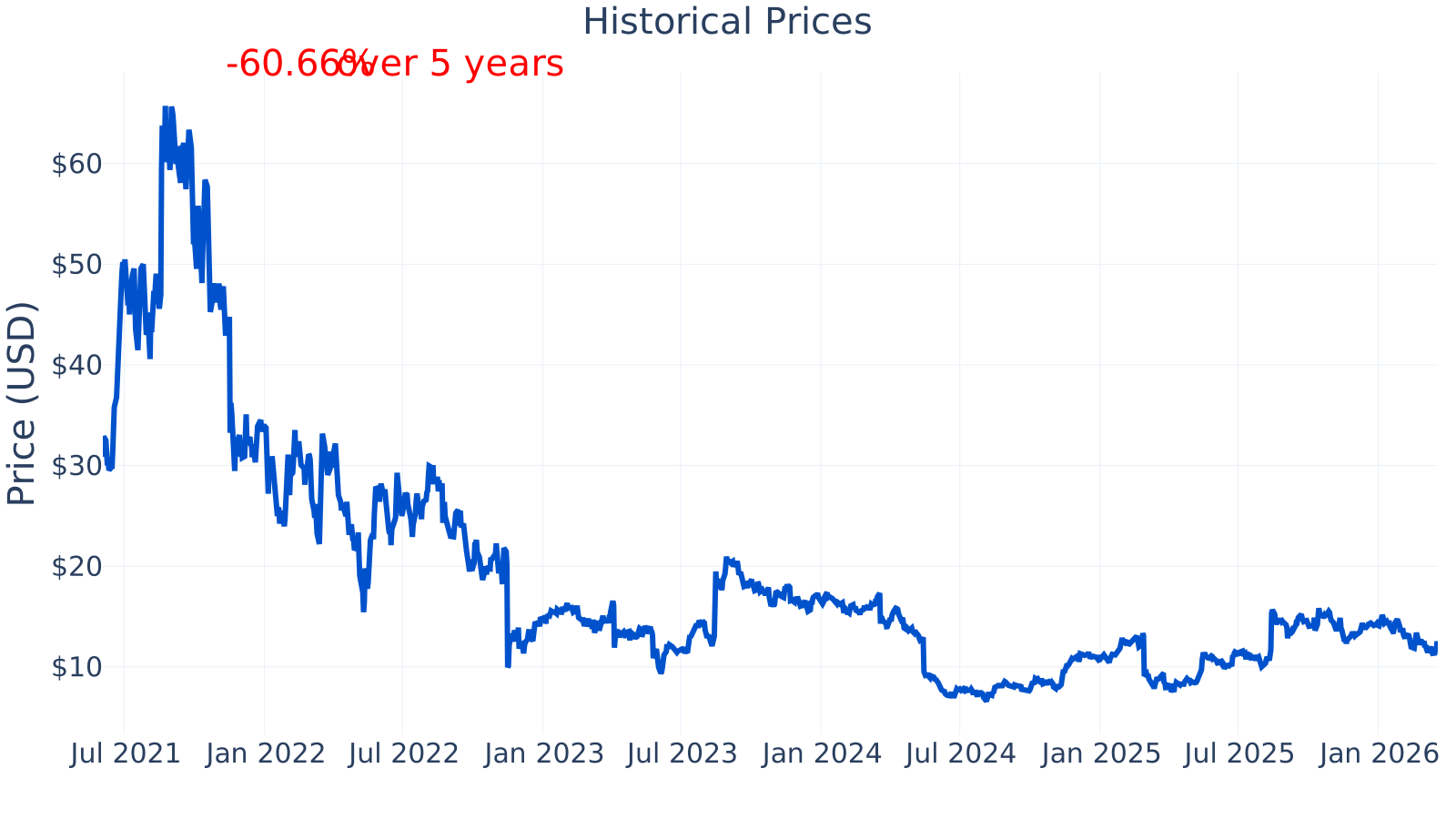
The historical P/E series shows a major compression from very high levels in 2021–2022 down to levels that are closer to (and at times below) the industry median in 2024–2026. In practical terms, this means the market has, over time, assigned a less “expensive” valuation to each dollar of earnings than it did shortly after the company became public.
Whether the current valuation level is “justified” depends on how one weighs several moving pieces visible elsewhere in the article: uneven but sometimes very high growth rates, still-positive but lower margins than in earlier years, and elevated operating and country/regulatory risks typical for cross-border payments in emerging markets. A P/E below the industry median can reflect market skepticism about durability of growth, earnings quality, or risk, rather than signaling anything definitive on its own.
Conclusion
Dlocal is a payments infrastructure company focused on enabling cross-border commerce in markets that can be operationally and regulatorily complex. The business has demonstrated substantial revenue expansion from 2021 to 2024 and has maintained positive profitability, with current profit margins still above the industry median despite a clear downward trend from earlier peaks. Leverage appears low relative to many peers, which can reduce one common financial risk factor.
At the same time, the company’s profile includes meaningful uncertainties that can matter to long-term outcomes: growth has not been smooth across periods, free cash flow has shown volatility in the most recent timeline presented, and the business operates in a setting where regulation, currency movement, country risk, customer concentration, and intense competition can all affect results. The valuation metrics shown indicate a lower earnings multiple than the industry median and a large decline versus early post-IPO levels, which is consistent with the market applying a more cautious view than in the past.
Sources:
- SEC EDGAR — Dlocal Ltd filings (Form 20-F/annual report equivalents, Form 6-K, and other submitted reports as available)
- Dlocal Ltd Investor Relations — Public shareholder materials and press releases (business description and operating updates)
- Wikipedia — “dLocal” (basic company background and history)
This article is for informational purposes only and does not constitute financial advice. Some content is AI-generated. See Disclaimer


