Stock Analysis · Credo Technology Group Holding Ltd (CRDO)
Overview
Credo Technology Group Holding Ltd (CRDO) designs semiconductor connectivity solutions that help move data faster and more efficiently inside data centers and other high-bandwidth computing systems. In simple terms, it builds the “high-speed links” used to connect pieces of modern computing hardware (for example, chips, circuit boards, cables, and systems) so that very large amounts of information can travel with less power and better signal quality.
The company’s products are generally tied to the demand for higher networking speeds (such as next-generation Ethernet) and for scaling AI and cloud infrastructure, where data must move quickly between servers, switches, storage, and accelerators. Credo’s business model is typically based on selling semiconductor intellectual property (IP) and chip/retimer-related products used to improve signal integrity over electrical connections (especially as speeds increase).
Based on how the business is described in company filings, revenue is commonly generated from a mix of licensing and product shipments. A simplified way to think about Credo’s revenue streams is:
- Product revenue (sales of connectivity semiconductors and related solutions)
- Licensing revenue (licensing of semiconductor IP)
- Services and other revenue (typically smaller)
Exact percentages can vary by fiscal period and are best read directly from the latest annual report/quarterly filing where the company breaks out revenue categories and customer concentration.
Over time, the company’s operating expense structure shows substantial spending on research and development and operating costs while revenue has expanded. More recently, the income profile has shifted meaningfully, with operating income and net income turning positive in the latest period shown, suggesting improved scale and/or stronger gross profit contribution relative to operating expenses.
Key Figures
| Metric | Value | Industry ⓘ |
|---|---|---|
| Date | Mar 06, 2026 | |
| Context | ||
| Sector | Technology | |
| Industry | Semiconductors | |
| Market Cap ⓘ | $21.16B | |
| Beta ⓘ | 2.68 | |
| Fundamental | ||
| P/E Ratio ⓘ | 63.04 | 44.92 |
| Profit Margin ⓘ | 31.81% | 10.84% |
| Revenue Growth ⓘ | 201.50% | 16.00% |
| Debt to Equity ⓘ | 0.68% | 21.24% |
| PEG ⓘ | N/A | |
| Free Cash Flow ⓘ | $283.69M | |
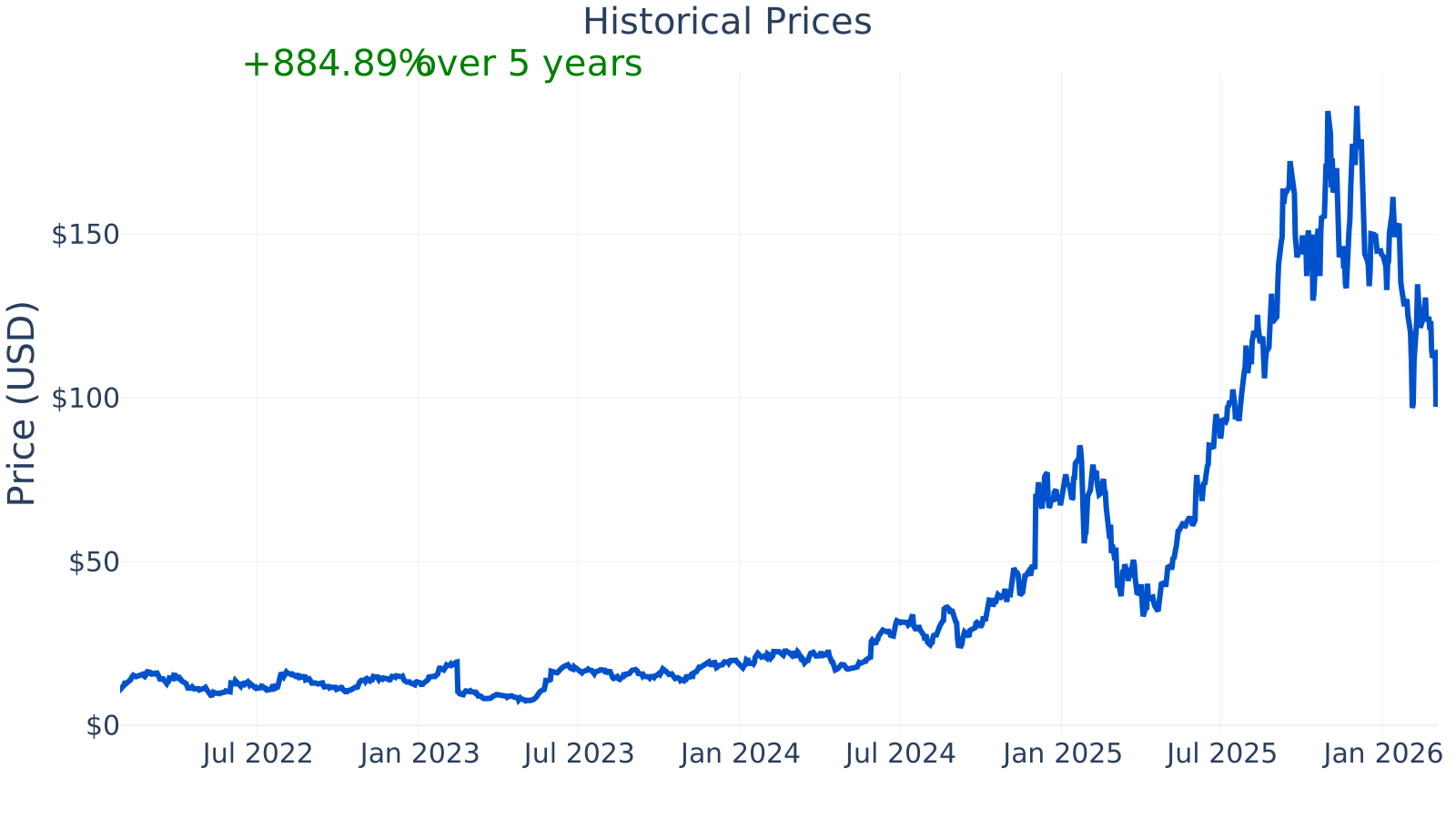
Credo’s market capitalization is about $21.2B, and the stock has shown high volatility (beta about 2.68, which indicates it has historically moved much more than the overall market). Profitability and growth metrics stand out: the company’s latest profit margin is about 31.8% versus an industry median near 10.8%, and the latest year-over-year revenue growth is about 201% versus an industry median near 16%. Leverage appears low, with debt-to-equity around 0.7% compared with an industry median near 21.2%. Trailing twelve-month free cash flow is about $283.7M, indicating cash generation after operating costs and capital spending.
Growth (high)
Credo operates in the broader semiconductor and data infrastructure ecosystem, where long-term demand is influenced by cloud computing, AI workloads, and the ongoing need for faster and more power-efficient connectivity inside data centers. As networking speeds rise and system complexity increases, maintaining signal quality over electrical connections becomes harder—creating a continued need for specialized connectivity solutions.
A key part of Credo’s growth logic is that each new step up in bandwidth (for example, moving to higher-speed interconnect standards) can increase the need for signal-conditioning components and/or advanced IP. If the company is well-positioned in these transitions, new platform ramps can act as catalysts. Another potential catalyst is deeper penetration into hyperscale data center supply chains, where design wins can translate into multi-year production volume.
The revenue growth pattern shows a period of slowdown/declines followed by a sharp acceleration. The latest year-over-year growth of roughly 201% is far above the semiconductor industry median shown, which suggests company-specific momentum rather than only a broad industry upswing. The main question for long-term context is how much of this surge is sustainable versus tied to a small number of programs, customers, or product cycles.
Free cash flow has also improved substantially over time, moving from negative levels in earlier periods to around $283.7M in the latest trailing twelve months. For a hardware and semiconductor-related business, positive free cash flow can matter because it can help fund R&D and working capital needs without relying heavily on new debt.
Risks (high)
Semiconductor businesses tied to data center buildouts can face sharp swings in demand due to customer inventory cycles, delays in platform transitions, and changes in capital spending. Credo’s high stock volatility is consistent with a market perception that outcomes can vary widely depending on execution and the timing of adoption cycles.
The balance sheet leverage shown here is very low (latest debt-to-equity around 0.7%), well below the industry median. Low leverage can reduce financial risk during downturns, but it does not eliminate operating risk (for example, demand shocks or pricing pressure).
Profitability has improved dramatically from negative margins in earlier periods to a latest profit margin around 31.8%, well above the industry median displayed. While this improvement is a positive operating signal, it can also be sensitive to product mix, customer pricing, and how quickly operating expenses grow as the company invests for the next cycle.
Competitive dynamics are a central risk. Credo participates in markets where competitors can include large semiconductor suppliers and specialized connectivity companies with substantial engineering resources and established customer relationships. Competition often centers on performance (speed, power), interoperability with ecosystem standards, time-to-market, and total cost. In addition, large customers may pursue dual sourcing or in-house designs, which can reduce supplier bargaining power.
Other risks typically disclosed in filings for companies in this space include:
- Customer concentration: a small number of large customers can materially affect results if ordering patterns change.
- Technology transitions: product relevance can shift quickly as standards evolve, requiring sustained R&D effectiveness.
- Supply chain and manufacturing dependence: reliance on external foundries/packaging/test partners can create constraints or cost variability.
- Pricing pressure: as competitors enter or customers gain leverage, gross margin can compress.
- Execution risk: delays in qualification, interoperability issues, or missed performance targets can disrupt adoption.
On competitive advantages, the company’s recent profitability and growth suggest it may have achieved strong product-market fit in at least some high-speed connectivity niches. Whether it is a “leader” depends on the specific segment (for example, a given interconnect speed generation or product category), and leadership can shift with each technology transition. For a long-term view, the durability of design wins and the ability to keep pace with next-generation requirements are critical.
Valuation
At a trailing P/E ratio of about 63.0, Credo trades above the semiconductor industry median shown (about 44.9). A higher P/E often indicates that the market is pricing in stronger future growth, higher expected margins, or both. The historical P/E line also shows that the multiple can change quickly, reflecting how sensitive valuation can be to earnings levels and market expectations.
Because the company’s revenue growth and profit margin have recently been unusually strong relative to industry medians, a higher-than-median valuation multiple can be consistent with that operating profile. At the same time, the combination of a high P/E and high volatility means the valuation can be vulnerable if growth decelerates, if margins normalize, or if large customers reduce orders. In other words, the valuation appears more dependent on continued execution and sustained demand than it would be for a slower-growing, more mature semiconductor supplier.
Conclusion
Credo is positioned in a part of the semiconductor ecosystem that benefits from long-term demand for faster, more energy-efficient data movement in data centers. The recent fundamentals shown—very high year-over-year revenue growth, a sharp improvement in profit margin, and materially positive free cash flow—indicate meaningful operating momentum, while low debt-to-equity reduces balance-sheet leverage risk.
The main offsets are typical of fast-moving semiconductor connectivity markets: customer and cycle sensitivity, intense competition, and the need to keep delivering next-generation performance as standards evolve. The stock’s higher valuation multiple relative to the industry median and its high volatility suggest that market expectations are elevated and outcomes may be more sensitive to changes in growth and profitability.
Sources:
- U.S. SEC EDGAR — Credo Technology Group Holding Ltd filings (Form 10-K, 10-Q, 8-K)
- Credo Technology Group Holding Ltd — Investor Relations materials and press releases
- Credo Technology Group Holding Ltd — Company-hosted earnings call transcripts (when available)
- Wikipedia — “Credo Technology Group” (basic company background)
This article is for informational purposes only and does not constitute financial advice. Some content is AI-generated. See Disclaimer


