Stock Analysis · Credo Technology Group Holding Ltd (CRDO)
Overview
Credo Technology Group Holding Ltd (CRDO) is a semiconductor company focused on moving data quickly and efficiently inside large computing systems. In simple terms, it designs technology that helps high-speed connections work reliably between chips, circuit boards, and systems—an important need in modern data centers and high-performance computing, where enormous amounts of information must travel with low delay and low power use.
Credo’s products are generally used in networking and connectivity hardware, such as the equipment that links servers and switches together. The company’s offering typically includes high-speed connectivity solutions (for example, chip-based and chiplet-based connectivity, and related intellectual property) that help system builders reach higher bandwidth while managing power consumption and signal quality.
From a business model point of view, semiconductor companies like Credo commonly earn revenue through a mix of (1) selling semiconductor products and (2) licensing technology (intellectual property) and related services. Exact revenue split by category can vary by year and depends on how the company reports segments in its filings.
Main sources of revenue (high-level):
- Product revenue (sale of semiconductor solutions used in high-speed connectivity)
- Licensing / royalty revenue (licensing of connectivity-related intellectual property, when applicable)
- Other / services (when applicable, based on contract structure and reporting)
One visible theme in the company’s income structure is that operating expenses have historically been heavily influenced by research and development, which is typical for a chip designer investing to stay relevant as standards and speeds advance.
Over the years shown, total revenue rises from about $58.7M (FY2021) to about $436.8M (FY2025). The earlier years show operating losses alongside sizable R&D spending, while the latest year shown includes a move to positive operating income and net income—suggesting a scaling phase where revenue growth outpaced operating cost growth.
Key Figures
| Metric | Value | Industry ⓘ |
|---|---|---|
| Date | Feb 07, 2026 | |
| Context | ||
| Sector | Technology | |
| Industry | Semiconductors | |
| Market Cap ⓘ | $20.12B | |
| Beta ⓘ | 2.65 | |
| Fundamental | ||
| P/E Ratio ⓘ | 96.03 | 45.89 |
| Profit Margin ⓘ | 26.63% | 9.42% |
| Revenue Growth ⓘ | 272.10% | 13.10% |
| Debt to Equity ⓘ | 1.00% | 25.62% |
| PEG ⓘ | N/A | |
| Free Cash Flow ⓘ | $143.61M | |
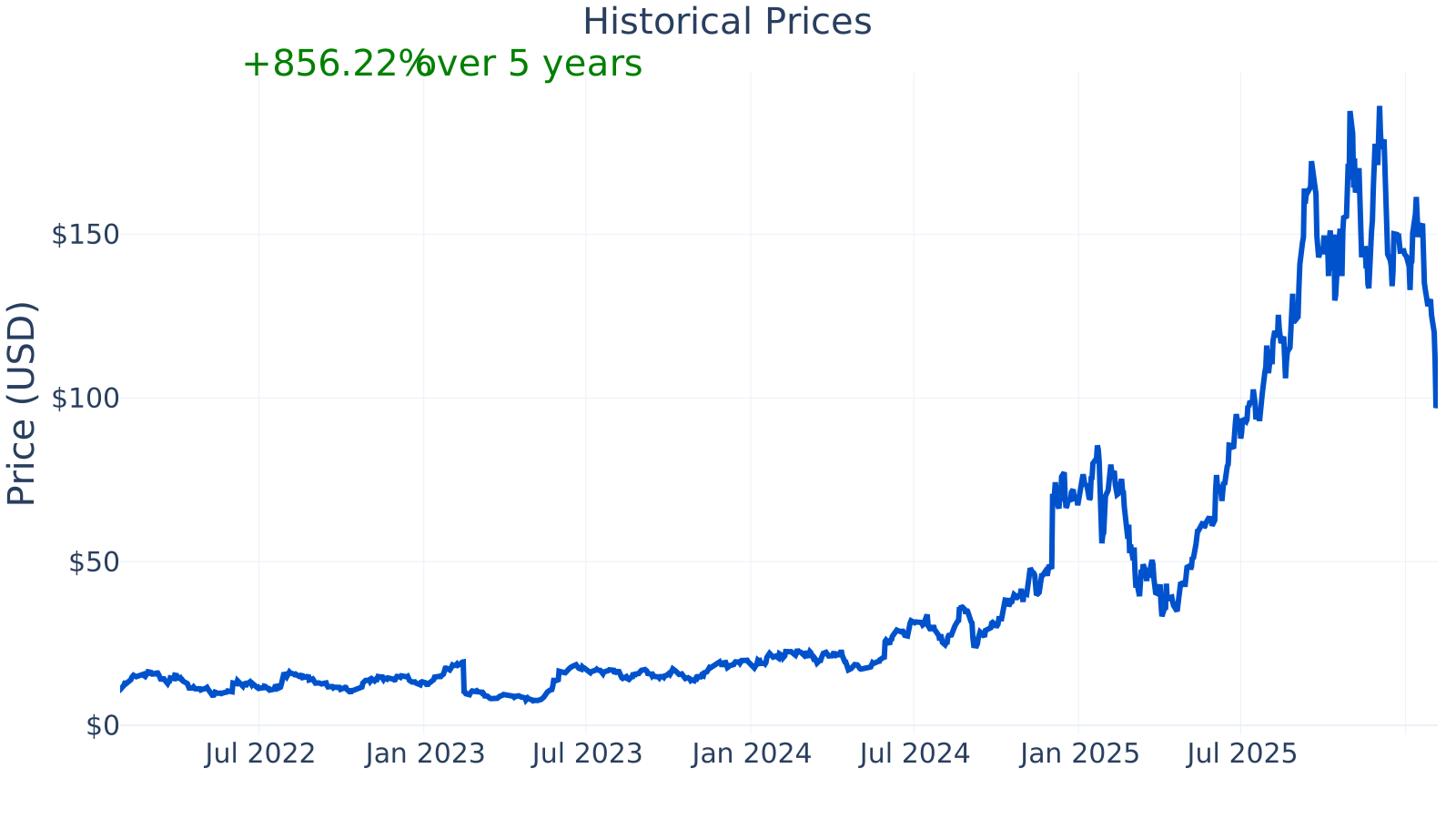
Credo’s market capitalization is about $20.1B, and the stock’s beta of 2.65 indicates historically high price volatility compared with the broader market. Profitability metrics show a notable improvement: the latest profit margin is ~26.6%, higher than the semiconductor industry median ~9.4% in the same comparison set. Growth is also unusually strong: the latest year-over-year revenue growth is ~272% versus an industry median ~13%. Leverage is very low with debt-to-equity ~1.0% compared with an industry median ~25.6%. Free cash flow over the trailing twelve months is shown as +$143.6M, which is notable for a company that had negative free cash flow in some earlier periods.
Growth (High)
Credo operates in an area supported by long-term demand: more cloud services, more AI workloads, and higher data movement inside data centers generally require faster and more power-efficient connectivity. As computing clusters scale up, the links between chips and systems become a bottleneck if they do not keep pace. This makes high-speed interconnect technology an important enabling layer rather than a “nice to have.”
The company’s strategy—investing in advanced connectivity solutions that help customers push bandwidth while managing power and signal integrity—fits the direction of modern infrastructure. In practice, this market can expand when data-center operators refresh equipment to higher speeds and when new system architectures increase the amount of traffic between compute, memory, and networking.
Revenue growth has been volatile but shows a clear acceleration in the most recent periods displayed. After negative year-over-year growth during parts of 2023 and early 2024, the company returned to strong expansion, reaching roughly +272% YoY in the latest point shown. This kind of surge often reflects a combination of customer adoption, product cycle timing, and comparison against a weaker prior-year period.
Cash generation has also fluctuated across the timeline. Free cash flow moved from negative levels in earlier periods to positive most recently (about +$143.6M TTM). For long-term business durability, sustained positive free cash flow can matter because it provides internal funding for R&D and capacity to absorb industry slowdowns—though it can vary significantly in semiconductors depending on working capital needs and revenue timing.
Potential catalysts (in a factual, non-predictive sense) typically include (1) transitions to new connectivity speeds/standards, (2) broad data-center upgrade cycles, and (3) design wins where a company’s solution becomes part of a customer’s platform and scales with that customer’s shipments.
Risks (High)
This article is for informational purposes only and does not constitute financial advice. Some content is AI-generated. See Disclaimer


