Stock Analysis · Bitdeer Technologies Group (BTDR)
Overview
Bitdeer Technologies Group (BTDR) is a bitcoin mining and mining-services company. In simple terms, it operates large-scale computing facilities and equipment that help run the Bitcoin network, and it earns money either by mining bitcoin for its own account or by providing computing capacity and related services to customers. The business is closely tied to energy costs, access to specialized mining machines, and the market price of bitcoin.
Based on how bitcoin-mining businesses typically report results in SEC filings, Bitdeer’s revenue generally comes from a mix of (1) self-mining (earning bitcoin from operating its own machines), (2) hosting or colocation (customers place their machines in Bitdeer-operated facilities and pay fees for power and infrastructure), and (3) other mining-related services and equipment-related activities (which can include cloud/hashrate services and the sale of mining machines, depending on the period and company strategy). Exact segment percentages can change significantly from year to year because revenue can swing with bitcoin price cycles, hashrate economics, and capacity expansions.
One notable pattern in the multi-year income flow is that revenue increased meaningfully from 2024 to 2025 (from about $350M to about $620M), while gross profit stayed relatively modest (about $66M in 2024 vs. about $61M in 2025). This highlights how sensitive results can be to operating costs (especially power and equipment-related costs) even when revenue is rising.
Key Figures
| Metric | Value | Industry ⓘ |
|---|---|---|
| Date | Apr 27, 2026 | |
| Context | ||
| Sector | Technology | |
| Industry | Software - Application | |
| Market Cap ⓘ | $2.93B | |
| Beta ⓘ | 2.28 | |
| Fundamental | ||
| P/E Ratio ⓘ | N/A | 25.81 |
| Profit Margin ⓘ | 10.58% | 7.87% |
| Revenue Growth ⓘ | 225.80% | 16.05% |
| Debt to Equity ⓘ | 136.92% | 25.08% |
| PEG ⓘ | N/A | |
| Free Cash Flow ⓘ | -$2.03B | |
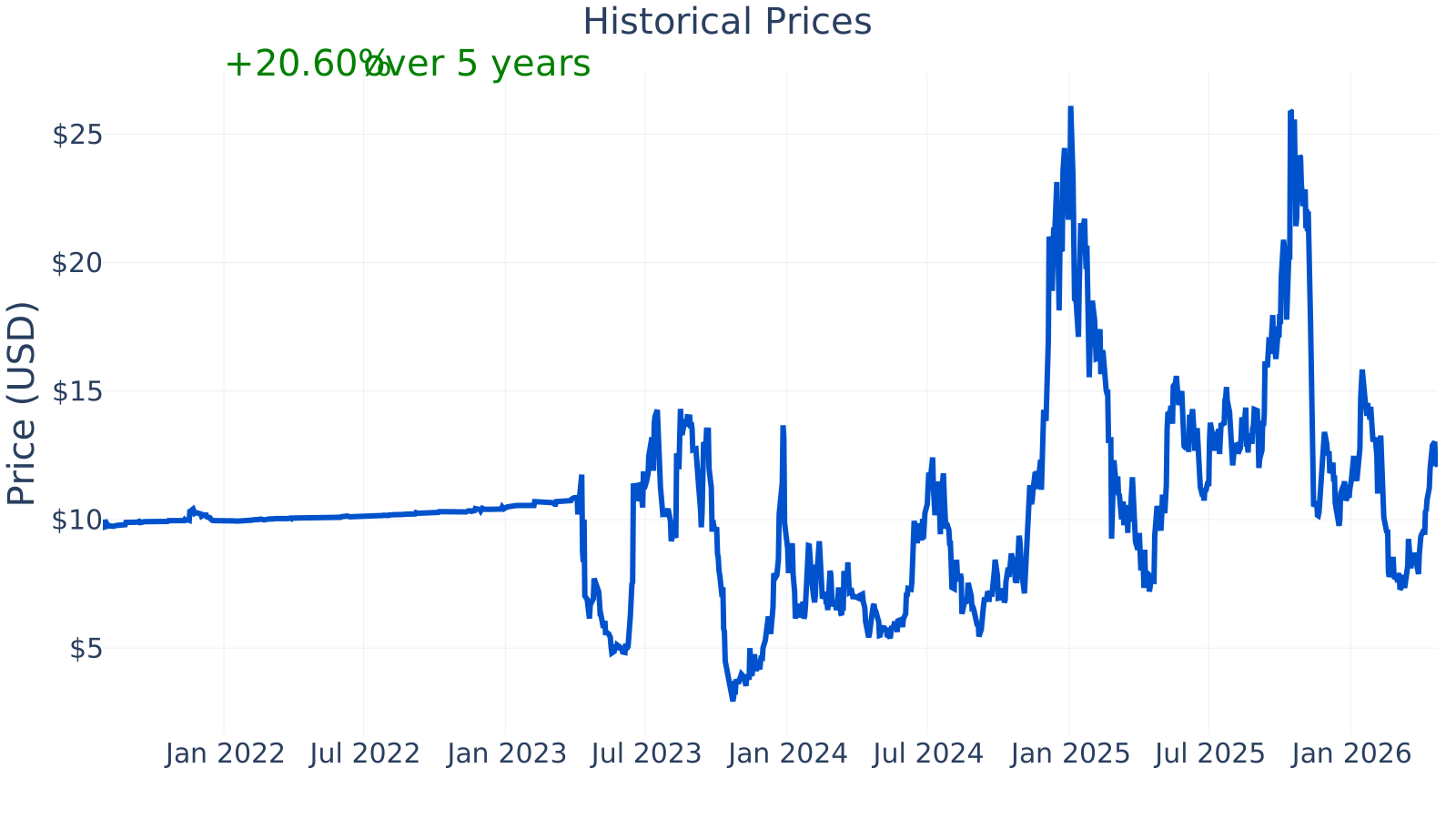
At a market capitalization of about $2.93B, BTDR sits in the small-to-mid cap range. The stock’s beta (~2.28) signals that price moves have historically been much larger than the broader market, which is common for companies exposed to bitcoin economics.
On operating performance, the latest profit margin shown is about 10.6%, which is above the industry median shown (~7.9%) for the referenced peer set. However, the cash picture is more mixed: trailing twelve-month free cash flow is negative (~-$2.03B), which often reflects heavy capital spending, working-capital swings, or financing-related impacts—items that are especially important to review in the company’s most recent SEC filings to understand what drove the outflows and whether they are expected to persist.
Growth (High)
Bitcoin mining is a cyclical industry with periods of rapid expansion and contraction. Over the long run, it has been shaped by (1) bitcoin price cycles, (2) mining difficulty (how competitive mining is), (3) access to low-cost and reliable power, and (4) the industry’s steady push toward newer, more efficient mining equipment. Companies that can scale capacity while keeping power and hardware costs competitive tend to be better positioned when mining economics tighten.
Recent year-over-year revenue growth has been highly volatile. The latest point shown is exceptionally high (about 226% year-over-year), following earlier quarters that ranged from strong growth to meaningful declines. This pattern is consistent with an industry where revenue can swing with bitcoin prices, network difficulty, changes in operating capacity, and the timing of new site or equipment ramp-ups.
Free cash flow has recently been negative and trending more negative across the periods shown (reaching roughly -$937.5M by 2025-03-31 in the chart). For a capital-intensive business like mining, negative free cash flow can occur during aggressive build-outs (new sites, infrastructure, and mining rigs), but it also raises a practical question for long-term fundamentals: whether future operating cash generation can cover ongoing expansion needs without frequent equity dilution or heavier borrowing.
Potential catalysts for growth in this business model typically include expanding energization and capacity at mining sites, upgrading to more efficient mining hardware, improving power economics, and favorable bitcoin market conditions. Another recurring catalyst for miners is the broader cycle around Bitcoin “halving” events (which reduce the bitcoin reward per block), since halvings can force weaker operators out while more efficient, well-capitalized operators may gain share—though outcomes vary widely by company execution and balance-sheet strength.
Risks (Very High)
Bitdeer’s risk profile is driven largely by bitcoin mining economics and the company’s capital intensity. Revenue and profitability can change quickly with bitcoin price moves, changes in network difficulty, and power prices. In addition, mining operations face operational risks such as equipment downtime, delays connecting new capacity to the grid, and the need to continually refresh hardware as technology improves.
Leverage appears to have increased substantially over time. The latest debt-to-equity value shown is about 137%, well above the industry median shown (about 25%). The chart also shows periods where leverage was much lower earlier on, followed by sharp increases in later periods. Higher leverage can amplify outcomes—helping fund expansion in good conditions, but also increasing financial pressure if mining margins compress.
Profitability has also been volatile. The profit margin chart shows extended periods of negative margins, including very deep losses in several quarters, followed by a return to a positive margin (about 10.6%) in the latest period shown. Compared with the peer-set median (generally positive in more recent periods), this underlines that Bitdeer’s earnings profile has been less stable than a typical software/application peer group classification might suggest—an important reminder that its economic drivers are closer to energy- and commodity-like dynamics than to subscription software models.
Competitive positioning in bitcoin mining typically depends on scale, cost of power, equipment efficiency, uptime, and access to capital. The company may have advantages if it can secure attractive power arrangements and deploy efficient fleets quickly, but durable “moats” are difficult in mining because competitors can expand and upgrade hardware as well, and network difficulty adjusts to industry-wide capacity.
Main competitors are other large bitcoin miners and hosting providers. Comparisons usually focus on hashrate scale, fleet efficiency, power cost per kWh, balance-sheet flexibility, and execution in bringing new capacity online. The company’s SEC filings and investor materials are typically the best place to verify how management benchmarks these factors versus peers and how concentrated revenue is across products, customers, or sites.
Valuation
For valuation, the price-to-earnings (P/E) approach can be difficult to interpret for highly cyclical businesses because earnings can swing from losses to profits across cycles, making P/E ratios unstable or not meaningful in many periods. The chart reflects this issue: many points are not shown (set to 0) when the P/E becomes negative or extremely high. Where a P/E is shown historically (for example, ~69 in early 2022), it is above the industry median referenced in the table (~25.8), but this comparison should be treated cautiously because (1) the peer-set is “Software - Application,” while Bitdeer’s economics behave more like a cyclical infrastructure/commodity-exposed business, and (2) a single-period earnings snapshot may not represent mid-cycle earnings power.
Given the combination of large revenue swings, materially negative free cash flow in the periods shown, and increased leverage, valuation discussions often rely more on balance-sheet strength, liquidity runway, and unit economics (such as power costs and fleet efficiency) than on traditional steady-growth software multiples. In practice, whether the current price level is “expensive” or “cheap” cannot be determined reliably from P/E alone without a clear view of normalized profitability across a bitcoin cycle and the expected funding needs for expansion.
Conclusion
Bitdeer is a bitcoin mining and mining-services company whose long-term outcomes are closely linked to bitcoin market cycles, operating efficiency, and the company’s ability to finance and execute capacity expansion. The recent profile shows sharp revenue growth at times and a return to positive profit margin in the latest period shown, alongside very large negative free cash flow and a meaningful rise in leverage.
For a long-term fundamental view, the central questions to verify in the most recent SEC filings are: how sustainable profitability is through different bitcoin price environments, what is driving cash outflows (and whether they are temporary growth investments or ongoing requirements), and how the capital structure (debt and potential dilution) could influence outcomes during downturns. The combination of cyclicality, operational complexity, and leverage makes the overall risk level high, even when growth metrics look strong in certain quarters.
Sources:
- SEC EDGAR — Bitdeer Technologies Group filings (Form 10-K, Form 10-Q, Form 8-K)
- Bitdeer Technologies Group — Investor Relations materials and press releases (company-hosted)
- Wikipedia — “Bitdeer Technologies Group” (basic company background)
This article is for informational purposes only and does not constitute financial advice. Some content is AI-generated. See Disclaimer


