Stock Analysis · Bitdeer Technologies Group (BTDR)
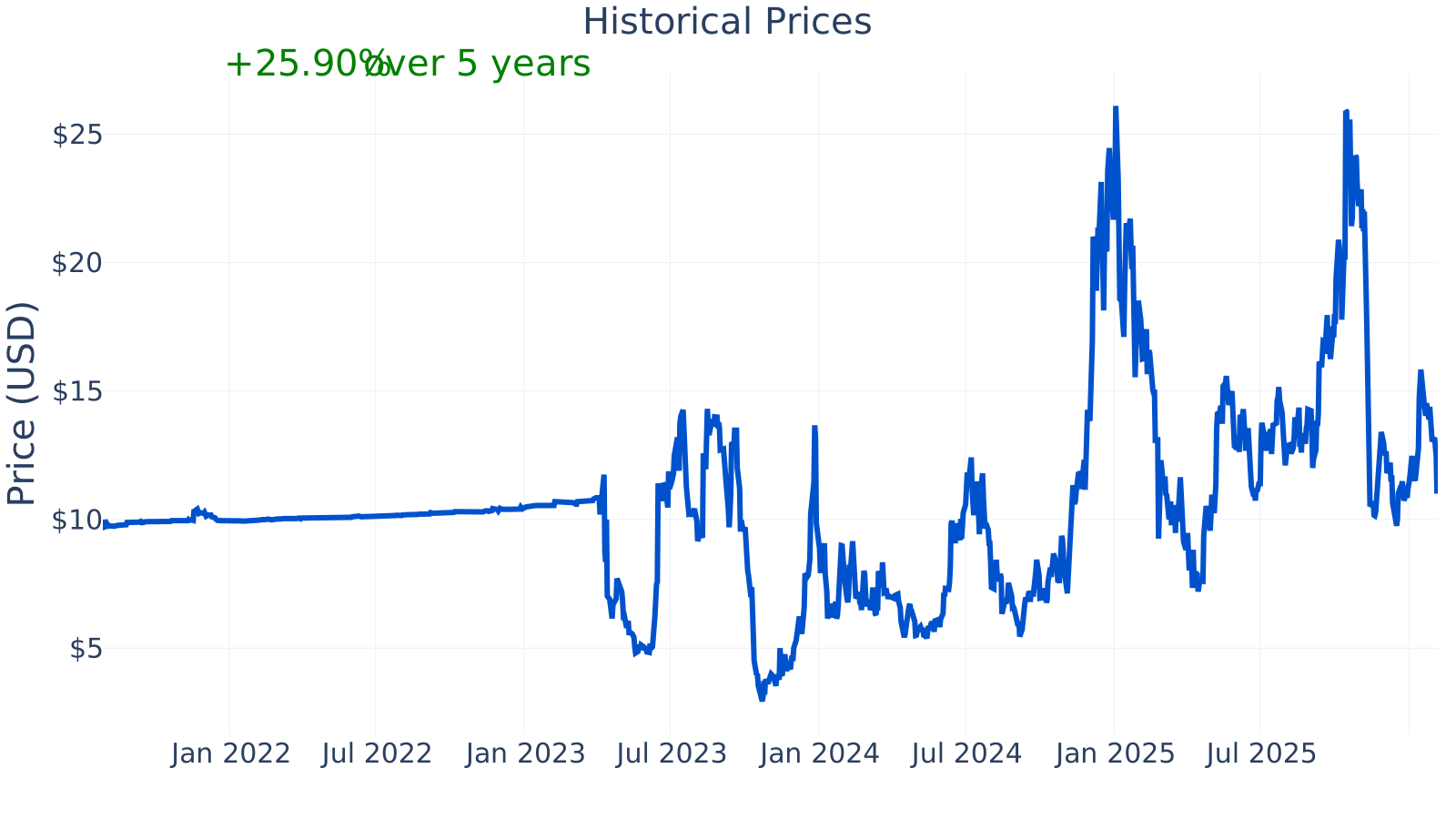
Overview
Bitdeer Technologies Group (BTDR) is a digital infrastructure company focused on Bitcoin mining. In simple terms, it operates and builds large-scale computing facilities and uses specialized machines to secure the Bitcoin network and earn Bitcoin rewards. It also provides mining-related services to other parties, which can include hosting customers’ mining machines in Bitdeer-operated facilities and selling mining hardware and related solutions.
In its SEC filings, Bitdeer describes multiple business lines tied to Bitcoin mining and mining infrastructure. Because the exact revenue mix can change materially quarter to quarter (and depends heavily on Bitcoin price, network difficulty, and customer demand), a stable, up-to-date percentage split is not always consistent across periods. Broadly, the revenue sources typically fall into these categories (largest to smallest can vary by period):
- Self-mining (earning Bitcoin mining rewards from Bitdeer’s own mining operations)
- Cloud mining / hashrate-related services (selling computing power tied to mining to customers under contracts)
- Hosting (housing and operating customers’ mining machines in Bitdeer facilities, usually for a service fee)
- Hardware and other mining-related services (selling mining rigs or providing related solutions and services)
The company’s cost structure is heavily influenced by electricity and data center operations (power is typically the single most important input cost in mining), plus depreciation of equipment and facility-related expenses.
Over the last several years, total revenue has stayed in a broadly similar range (roughly the mid-$300 millions annually), while profitability has fluctuated significantly. A notable feature is the sharp deterioration in bottom-line results in 2024, where operating expenses rose substantially versus prior years, contributing to a much larger net loss than in 2022–2023.
Key Figures
| Metric | Value | Industry ⓘ |
|---|---|---|
| Date | Feb 08, 2026 | |
| Context | ||
| Sector | Technology | |
| Industry | Software - Application | |
| Market Cap ⓘ | $2.79B | |
| Beta ⓘ | 2.33 | |
| Fundamental | ||
| P/E Ratio ⓘ | N/A | 27.79 |
| Profit Margin ⓘ | -115.59% | 6.02% |
| Revenue Growth ⓘ | 173.60% | 15.80% |
| Debt to Equity ⓘ | 159.63% | 25.15% |
| PEG ⓘ | N/A | |
| Free Cash Flow ⓘ | -$1.75B | |
Bitdeer’s market capitalization is about $2.79B. The stock shows high volatility (beta of 2.33), meaning it has tended to move much more than the overall market.
Recent fundamentals show a mixed picture: reported year-over-year revenue growth of ~174% is far above the listed industry median (~16%), but profitability is deeply negative (profit margin about -116% versus an industry median near 6%). Leverage also stands out: debt-to-equity is about 160% compared with an industry median around 25%. Free cash flow over the trailing twelve months is also negative (about -$1.75B), which highlights the scale of cash spending relative to cash generated recently.
Growth (Medium)
Bitcoin mining is part of the broader digital asset ecosystem, and it tends to be cyclical. Industry activity is influenced by several forces that can move in different directions: Bitcoin price (drives revenue potential), Bitcoin network difficulty (drives how hard it is to earn rewards), the “halving” cycle (periodically reduces the block subsidy paid to miners), and energy prices (a key driver of operating costs). As a result, the industry can grow in computing capacity over time while still experiencing sharp swings in profitability.
Bitdeer’s strategy, as described in its filings, centers on scaling mining capacity and controlling key inputs such as access to power and data center infrastructure. If the company can secure reliable electricity at competitive rates and keep its fleet efficient, that can support growth when industry conditions are favorable. Potential catalysts typically discussed for companies in this segment include expansions in energized capacity, improvements in fleet efficiency, and shifts in market conditions for Bitcoin and mining economics (though these are outside management’s control).
Revenue growth has been volatile, with periods of contraction followed by sharp acceleration. The most recent point shown is a very large positive swing (about +174% YoY), following declines earlier in 2024 and early 2025. This pattern fits an industry where timing, pricing, and mining economics can change quickly.
Free cash flow has moved from near break-even levels in 2022–2023 to significantly negative in 2024–2025 (down to roughly -$0.94B by 2025-03-31 on the chart, and -$1.75B on the latest metrics snapshot). For long-term business durability, a key question is whether this cash outflow reflects temporary investment/expansion that later translates into stronger operating cash generation, or whether it reflects sustained pressure from unfavorable mining economics and/or elevated ongoing costs.
Risks (High)
This article is for informational purposes only and does not constitute financial advice. Some content is AI-generated. See Disclaimer


