Stock Analysis · Ambarella Inc (AMBA)
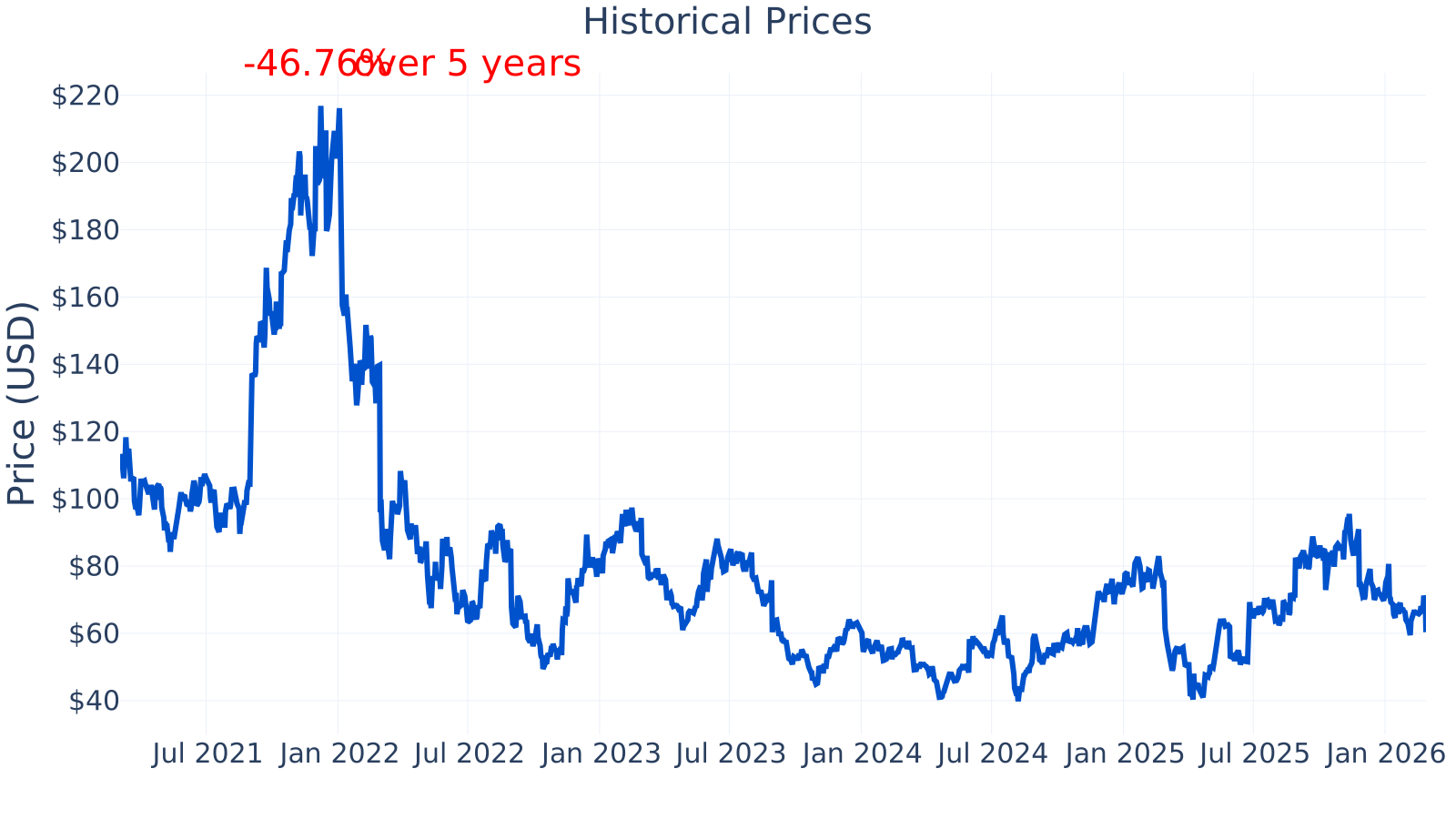
Overview
Ambarella, Inc. is a semiconductor company that designs chips used to process video and “computer vision” (software-like perception done on the chip). In simple terms, its products help devices such as security cameras, automotive cameras, and other edge devices capture video, compress it efficiently, and increasingly “understand” what they see (for example, detecting objects or events without sending everything to the cloud).
Ambarella is a “fabless” chip designer, meaning it typically designs its semiconductors and relies on external manufacturing partners to produce them. The company sells its solutions to device makers (and, in some cases, to partners in the supply chain) who integrate the chips into finished products.
Based on the company’s public filings, Ambarella’s revenue is primarily generated from the sale of semiconductor products and related technology (for example, licensing or development-related elements may exist, but the core business is chip-based solutions). In its filings, Ambarella commonly discusses its business in end-market categories such as:
- Video security / intelligent cameras (e.g., IP cameras and AI-enabled security devices)
- Automotive (camera-based systems and advanced driver-assistance-related processing)
- Other edge applications (depending on product cycles and customer demand)
The mix between these areas can change meaningfully over time depending on customer product cycles and inventory levels in the electronics supply chain.
One notable pattern in the company’s recent income flow is that research and development spending is very large relative to revenue (for example, in the most recent annual period shown, R&D is roughly $239M against about $391M of revenue). This aligns with a strategy centered on building more advanced chips, but it also helps explain why reported net income has stayed negative in recent years.
Key Figures
| Metric | Value | Industry ⓘ |
|---|---|---|
| Date | Mar 02, 2026 | |
| Context | ||
| Sector | Technology | |
| Industry | Semiconductor Equipment & Materials | |
| Market Cap ⓘ | $2.60B | |
| Beta ⓘ | 1.94 | |
| Fundamental | ||
| P/E Ratio ⓘ | N/A | 48.57 |
| Profit Margin ⓘ | -19.42% | 7.37% |
| Revenue Growth ⓘ | 20.10% | 8.10% |
| Debt to Equity ⓘ | 2.26% | 25.99% |
| PEG ⓘ | 4.97 | |
| Free Cash Flow ⓘ | $75.87M | |
Ambarella’s market capitalization is about $2.6B, and the stock’s beta of ~1.94 indicates it has historically moved more than the broader market (higher volatility). The company’s profit margin is about -19% versus an industry median near +7%, reflecting ongoing losses.
On the other hand, the latest year-over-year revenue growth shown is about +20%, above the displayed industry median (about +8%). Ambarella also shows a very low debt-to-equity ratio (~2%) versus the industry median (about 26%), suggesting a balance sheet that relies relatively little on debt financing.
Free cash flow (trailing twelve months) is shown at about $75.9M, indicating that cash generation can differ from accounting profits (net income) due to factors like non-cash expenses and working-capital movements.
Growth (Medium)
Ambarella operates in areas tied to long-term technology trends: more cameras in more places, higher video quality, and more on-device AI processing. In general, “edge AI” (doing inference on the device rather than in a distant data center) is often pursued to reduce latency, lower bandwidth needs, and improve privacy. Security and automotive are also markets where reliability and local processing can matter.
Strategically, Ambarella’s emphasis on computer vision can be viewed as an attempt to move beyond basic video processing into higher-value chips that help devices identify and interpret what is in the scene. If customers adopt these higher-end capabilities broadly, it can support growth through richer product content per device and new use cases.
The year-over-year revenue growth trend shows a sharp downturn through parts of 2023–2024 (with several negative readings), followed by a strong rebound during 2025 and into early 2026. The latest point is still positive (around +20%), but the pattern also highlights that revenue can be cyclical, with pronounced swings.
Free cash flow over the periods shown remains positive but uneven (roughly $29M in early 2022 and early 2023, down to about $7M in early 2024, then improving to about $23M in early 2025). The latest table value indicates a higher trailing figure (~$76M), which may suggest improving cash dynamics, though cash flow can fluctuate based on timing of customer orders, inventory, and payments.
Potential catalysts, based on how the business is described in filings, generally come from new chip generations, customer design wins (being selected for new devices), and market recoveries after inventory corrections. In semiconductors, these can materially change revenue trajectories, but they often take time to show up consistently in reported results.
Risks (High)
A key risk is that Ambarella’s profitability has been challenged. Even when revenue recovers, the company must balance heavy ongoing investment (especially R&D) with the need to improve operating results. If revenue growth slows or product ramps are delayed, losses can persist longer.
The profit margin history shown is negative throughout the entire period and was especially weak around 2024, before improving to about -19% most recently. This remains far below the industry median margin (mid-to-high single digits). The direction has improved from the worst point, but the company is still not consistently profitable on a net basis in the view shown here.
Debt levels appear low compared with peers. The latest debt-to-equity ratio is about 2% versus an industry median near 24%. This can reduce financial risk related to interest costs and refinancing, but it does not remove the core business risks tied to competition and execution.
Competition is another major consideration. Ambarella operates in semiconductor markets where alternatives can come from large, well-capitalized chip vendors and from customers developing in-house solutions. Competitors can include companies offering:
- Video processing and camera SoCs for security and consumer devices
- Automotive and edge AI processors used in camera-based systems
- General-purpose edge AI chips that can be adapted to vision workloads
Because chip performance, power efficiency, software tools, and total system cost all matter, competitive advantages tend to come from a combination of technical capability, customer relationships, and proven reliability in the field. Ambarella positions itself around high-quality video and computer vision processing, but it is not a “winner-takes-all” market; design wins can be competitive and product cycles can shift share over time.
Other risks commonly highlighted in semiconductor company filings include customer concentration (a small number of customers representing a meaningful portion of revenue), reliance on third-party manufacturers and the broader supply chain, pricing pressure as competitors respond, and the possibility that end-market demand (security, automotive, industrial) moves slower than expected.
Valuation
For many investors, a common valuation tool is the price-to-earnings (P/E) ratio. In Ambarella’s case, the P/E chart is not meaningful across most of the period shown (displayed as zero), which typically happens when earnings are negative or unusually volatile—making “earnings-based” valuation less informative.
In the latest metrics table, an industry median P/E is shown around 48.6, but Ambarella’s own P/E is not provided there, consistent with the idea that profits have been negative. In situations like this, market value is often discussed more in terms of factors such as revenue trajectory, gross margin structure, operating expense levels, cash position and cash flow, and whether the company can achieve sustained profitability over time.
The current market capitalization (about $2.6B) should be interpreted in the context of (1) a business that recently returned to strong year-over-year revenue growth, (2) continuing net losses, and (3) substantial ongoing R&D spending. Whether the stock price is “expensive” cannot be determined from P/E alone here; instead, it largely depends on how durable revenue growth proves to be and how quickly operating results can improve relative to spending.
Conclusion
Ambarella is a specialized chip designer focused on video processing and on-device computer vision, with exposure to long-term trends in intelligent cameras and edge AI. Recent results show a rebound in year-over-year revenue growth and positive free cash flow, while profitability remains negative and has been a persistent challenge.
The company’s financial profile combines low leverage (very low debt relative to equity) with high operating investment (notably R&D) and meaningful competitive pressure typical of semiconductors. The key long-term question embedded in the fundamentals is whether Ambarella can translate product adoption in its target markets into sustained revenue growth while narrowing losses and moving toward consistent profitability.
Sources:
- U.S. SEC EDGAR — Ambarella, Inc. filings (Form 10-K, Form 10-Q)
- Ambarella Investor Relations — Annual Report materials and shareholder communications (company-hosted)
- Wikipedia — “Ambarella” (basic company background)
This article is for informational purposes only and does not constitute financial advice. Some content is AI-generated. See Disclaimer


