Stock Analysis · CLARIVATE PLC (CLVT)
Overview
Clarivate Plc is an information services company. It provides data, software, and workflow tools that help organizations research, protect, and commercialize innovations. Its products are commonly used by universities, research institutions, corporations (including life sciences and technology companies), law firms, and intellectual property (IP) professionals.
In simple terms, Clarivate sells “trusted information + tools” that customers use to make decisions and document work in areas such as scientific research and patents. Many offerings are delivered as subscriptions, which can create recurring revenue, although contract renewals depend on customer budgets and perceived value.
Main revenue sources are typically described by business segments in the company’s annual report (percentages can change year to year). A common segment view includes:
- Intellectual Property (IP): tools and data that support patent search, patent analytics, and IP management workflows.
- Life Sciences & Healthcare: data and analytics used in drug development, competitive intelligence, and related workflows.
- Academia & Government: research intelligence and analytics used by universities and public-sector research organizations.
Across these segments, revenue generally comes from a mix of subscriptions (recurring access to platforms and content), term licenses, and services (implementation, training, and support). The exact split and segment shares are disclosed in the company’s Form 10-K.
Over the period shown, total revenue trends downward (from about $2.66B in 2022 to about $2.46B in 2025). Costs of revenue and selling/administrative spending also decline, and operating income turns positive in 2025 (about $71M). Net income remains negative in each year shown, and interest expense stays large (roughly $265M–$294M per year), highlighting the weight of debt financing on bottom-line results.
Key Figures
| Metric | Value | Industry ⓘ |
|---|---|---|
| Date | Mar 09, 2026 | |
| Context | ||
| Sector | Technology | |
| Industry | Information Technology Services | |
| Market Cap ⓘ | $1.76B | |
| Beta ⓘ | 1.51 | |
| Fundamental | ||
| P/E Ratio ⓘ | N/A | 19.90 |
| Profit Margin ⓘ | -8.19% | 4.91% |
| Revenue Growth ⓘ | -6.90% | 6.25% |
| Debt to Equity ⓘ | 92.49% | 60.43% |
| PEG ⓘ | 0.18 | |
| Free Cash Flow ⓘ | $628.50M | |
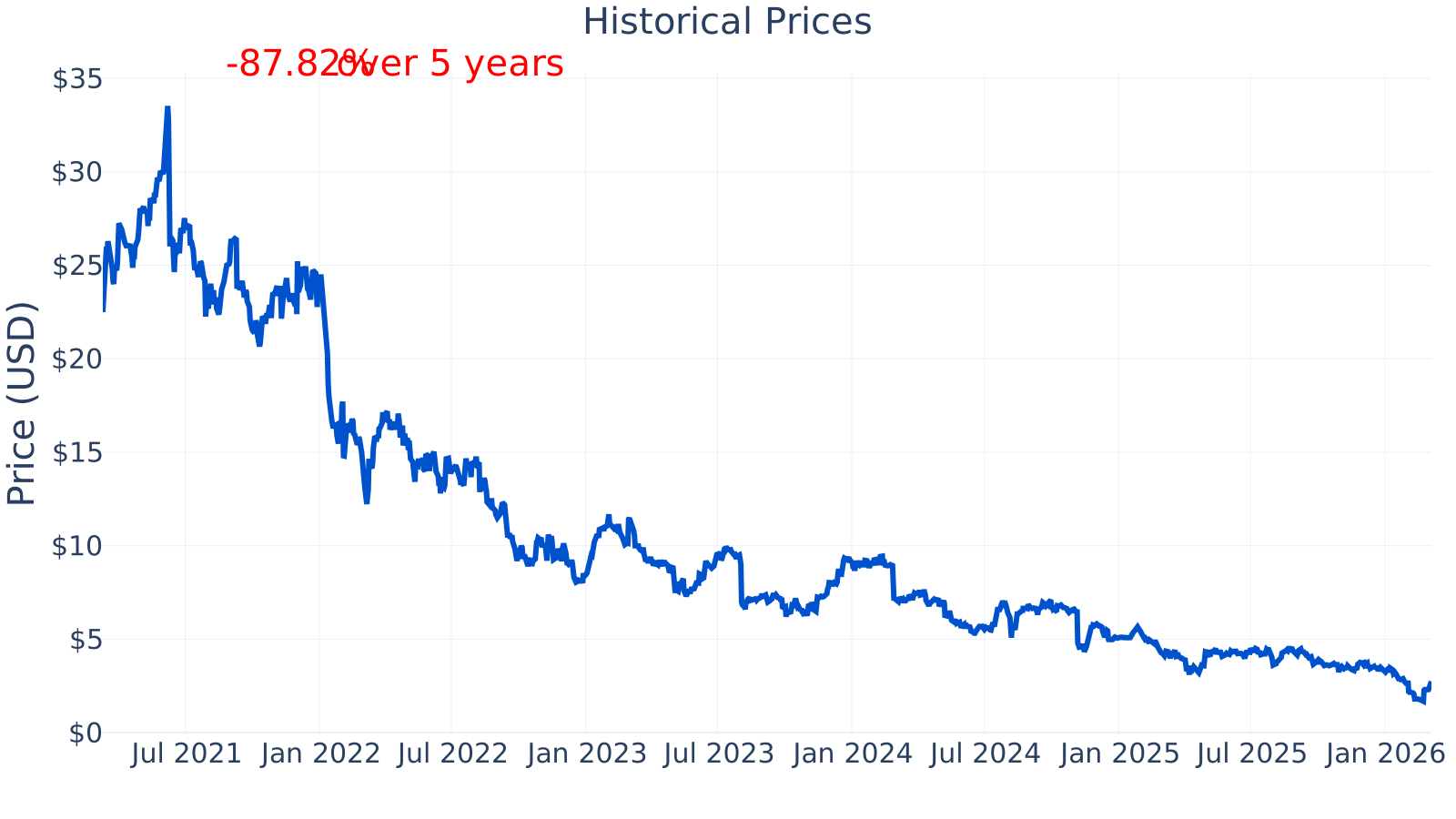
Clarivate’s market capitalization is about $1.76B. The stock’s beta of 1.52 suggests it has historically moved more than the overall market (higher volatility). The company shows a profit margin of about -8.2%, below the industry median of about +4.9%, meaning it is currently unprofitable on a net income basis. Revenue growth year-over-year is about -6.9%, compared with an industry median near +6.3%. Debt-to-equity is about 92.5%, higher than the industry median around 60.4%. Despite net losses, free cash flow over the trailing twelve months is shown at about $628.5M, indicating meaningful cash generation after operating and capital spending (though free cash flow can be influenced by one-time or timing effects, and should be reviewed alongside the cash flow statement in filings).
Growth (Medium)
Clarivate operates in markets tied to long-term trends: digitization of research workflows, growing volumes of scientific publication and patent activity, and increased demand for analytics and decision-support tools. These themes can be supportive over time, because organizations often want to standardize tools used to manage research and IP processes.
That said, the company’s recent topline picture in the figures shown looks more like stabilization than expansion. A key question for future growth is whether Clarivate can sustain renewals and improve net retention (customers expanding usage over time) while also adding new customers, especially in budget-sensitive customer groups like academia and government.
The chart shows a shift from very high growth in 2021–2022 to roughly flat-to-negative growth from 2023 onward, ending at about -6.9% year-over-year in late 2025. For a long-term growth narrative, this places more emphasis on execution: product relevance, pricing power, and the ability to cross-sell across segments.
Free cash flow improves significantly compared with early 2022 and remains positive through 2025 in the series shown (roughly $264M in 2021, dipping near $90M in 2022, then rising to the $350M–$460M range in 2023–2025). Sustained free cash flow can matter because it is one way a company can reduce debt, reinvest in products, or absorb downturns without raising new capital.
Potential catalysts (in a neutral, factual sense) often include: improved product bundling across segments, higher renewal/retention rates, and deleveraging (using cash flow to reduce net debt and interest burden). Whether these occur is typically monitored through quarterly filings and earnings materials.
Risks (High)
Clarivate’s risk profile is influenced by three visible factors: profitability that remains negative at the net income level, comparatively higher leverage, and a recent period of declining revenue. In addition, customers such as universities and public institutions can face budget cycles that slow purchasing or renewals.
Debt-to-equity rises over time in the chart, reaching about 92.5% most recently versus an industry median near 60.4%. Higher leverage can increase sensitivity to interest rates and refinancing conditions, and it helps explain why interest expense remains a large line item in the multi-year profit bridge shown earlier.
Profit margin stays negative across the timeline, though it improves substantially from the very large losses seen in 2022–2023 to about -8.2% most recently. The industry median stays positive (around mid-single digits). This gap suggests the company has not consistently converted revenue into bottom-line profitability at levels typical for peers, which can limit flexibility if growth slows.
Competition is also a meaningful risk. Clarivate participates in markets with well-established alternatives, including large information and workflow providers and specialized niche platforms. Competitors can include (depending on the segment) other research analytics providers, IP search and management software vendors, and broader data-and-tools companies with the ability to bundle offerings. Competitive advantages for Clarivate can come from trusted content, embedded workflows, switching costs (teams trained on a platform), and breadth across IP, life sciences, and research intelligence; however, whether these translate into sustained pricing power is ultimately reflected in retention, margins, and growth trends reported in filings.
Finally, many information services businesses grow through acquisitions and integration. Integration challenges, product overlap, and amortization or impairment charges are items that can affect reported earnings and should be tracked in SEC filings.
Valuation
Traditional valuation using the price-to-earnings (P/E) ratio is difficult when a company reports net losses, because P/E becomes not meaningful or is often shown as unavailable. In the table, an industry median P/E is shown around 19.9, but Clarivate’s own P/E is not provided, which commonly occurs when earnings are negative.
Because P/E is not informative here, valuation discussions often shift to other lenses such as free cash flow generation, revenue stability, and balance-sheet strength (especially debt and interest costs). In the figures shown, the combination of positive free cash flow and negative net income highlights the importance of understanding non-cash charges, acquisition-related accounting, and interest expense. The company’s ability to sustain cash generation while improving profitability and managing leverage is central context when interpreting the stock’s valuation.
Conclusion
Clarivate provides subscription-oriented information and workflow tools used in research, life sciences, and intellectual property work. The business operates in areas that can benefit from long-running demand for data-driven decision-making and standardized professional workflows.
At the same time, the recent profile shown here includes declining revenue, net losses (despite improving margins), and higher leverage than the industry median, with a sizable ongoing interest expense. Offsetting those concerns is meaningful positive free cash flow in the most recent periods shown and signs of operating improvement in 2025.
Overall, the long-term investment debate for Clarivate tends to center on whether the company can translate its product breadth and customer embedment into consistent organic growth and durable profitability while keeping leverage manageable—topics that are best monitored through ongoing SEC filings and the company’s reported segment performance, retention trends, and cash flow priorities.
Sources:
- SEC EDGAR — Clarivate Plc Form 10-K (Annual Report) (business description, segment information, risk factors, financial statements)
- SEC EDGAR — Clarivate Plc Form 10-Q (Quarterly Reports) (updates on operations, liquidity, and financial statements)
- Clarivate Investor Relations — SEC Filings & Annual Report materials (company-hosted copies and supplementary investor documents)
- Wikipedia — “Clarivate” (basic company background; non-financial context)
This article is for informational purposes only and does not constitute financial advice. Some content is AI-generated. See Disclaimer


