Stock Analysis · Amcor PLC (AMCR)
Overview
Amcor plc is a global packaging company that designs and manufactures packaging used mostly for everyday products. Its packaging is commonly found in food and beverages, medical and pharmaceutical products, personal care items, and household goods. The company operates manufacturing and distribution sites across many countries and typically works with large consumer brands that need packaging at scale and with consistent quality.
Amcor’s business is generally organized around two main packaging types: flexible packaging (such as pouches, wraps, and sachets) and rigid packaging (such as plastic bottles and containers). Revenue mainly comes from selling packaging products under customer contracts, with results influenced by packaging volumes (how much customers produce), product mix (which types of packaging sell), and input costs (like resins and other materials) that can move with commodity prices.
Main sources of revenue (high-level):
- Flexible packaging (largest segment): packaging for food, beverages, healthcare, and consumer goods
- Rigid packaging: primarily containers and closures used in beverages and other consumer end markets
Amcor also emphasizes packaging innovation and sustainability initiatives (for example, efforts to make packaging recyclable, reusable, or compostable), which can influence product design choices and customer demand over time.
Across recent fiscal years shown, revenue has moved within a relatively narrow band (about $12.9B to $15.0B). Over the same span, interest expense increased (from about $153M to about $396M), and net income fluctuated materially (from about $939M down to about $511M), highlighting how financing costs and operating conditions can affect bottom-line results even when sales are relatively stable.
Key Figures
| Metric | Value | Industry ⓘ |
|---|---|---|
| Date | Feb 16, 2026 | |
| Context | ||
| Sector | Consumer Cyclical | |
| Industry | Packaging & Containers | |
| Market Cap ⓘ | $23.14B | |
| Beta ⓘ | 0.67 | |
| Fundamental | ||
| P/E Ratio ⓘ | 37.66 | 22.22 |
| Profit Margin ⓘ | 3.04% | 5.56% |
| Revenue Growth ⓘ | 68.10% | 5.90% |
| Debt to Equity ⓘ | 145.24% | 137.29% |
| PEG ⓘ | 0.61 | |
| Free Cash Flow ⓘ | $1.62B | |
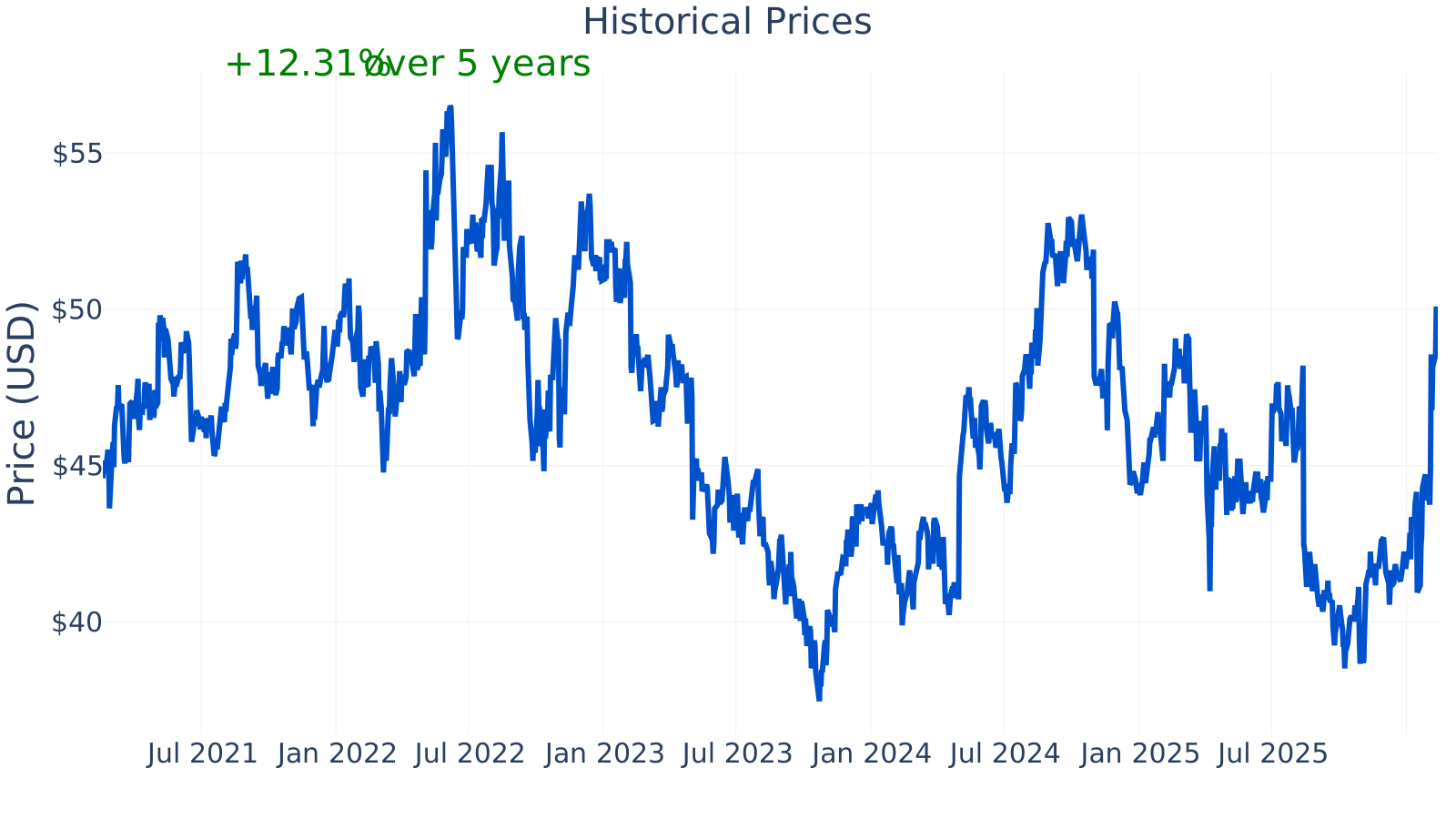
Amcor’s market capitalization is about $23.1B, and the stock’s beta is about 0.67, which indicates the share price has historically tended to move less than the overall market. The P/E ratio is ~37.7, higher than the industry median of ~22.2. The latest profit margin is ~3.0%, below the industry median of ~5.6%. Reported year-over-year revenue growth is ~68.1% (well above the industry median of ~5.9%), while debt-to-equity is ~145%, slightly above the industry median (~137%). The company also shows TTM free cash flow of ~$1.62B, which is a key support for dividends, debt reduction, and reinvestment.
Growth (Medium)
Packaging is generally considered a steady-demand industry because it is closely tied to everyday consumption (food, beverages, healthcare, and household products). Long-term growth is often influenced by population trends, shifts in consumption, and how product manufacturers choose packaging formats (for example, more single-serve, e-commerce-friendly, or convenience-oriented packaging). Compared with fast-growing technology sectors, packaging is typically more mature, but it can still expand through market share gains, new product innovation, and expansion in certain end markets.
A central part of Amcor’s future-facing strategy is sustainability-oriented packaging development—especially solutions designed to be recyclable or to use less material—because brand owners and regulators increasingly focus on packaging waste and recyclability. If customers accelerate redesigns of product packaging to meet sustainability targets, suppliers with strong engineering, materials know-how, and global production capabilities can be positioned to capture that demand. In practice, this can show up as new product wins, improved mix, or longer-term customer relationships rather than sudden one-time jumps.
The year-over-year revenue growth trend has been uneven: it was positive in 2021–2022, turned negative through much of 2023–2024, and then rebounded sharply in 2025 (ending at about +68%). For context, the industry median is much lower (about +6%), so the recent spike stands out. When revenue growth changes this quickly, it can reflect temporary factors (such as pricing, currency, acquisitions/divestitures, or demand normalization) as well as underlying volume trends, so it is important to interpret the jump as part of a broader multi-year pattern rather than a single-period result.
Free cash flow has also varied over time, ranging from roughly $716M (2023) to about $1.09B (2021 and 2025), with the latest TTM figure at about $1.62B. For a packaging manufacturer, consistent free cash flow matters because the business requires ongoing spending on plants and equipment, and because it provides flexibility to handle cycles in raw material costs and customer demand.
Risks (Medium)
This article is for informational purposes only and does not constitute financial advice. Some content is AI-generated. See Disclaimer


