Stock Analysis · Taboola (TBLA)
Overview
Taboola is a digital advertising and content recommendation company. Its technology helps publishers and app owners show “you may also like” style recommendations and ads across websites and apps. In practice, Taboola sits between two groups: (1) media owners that want to earn money from their audience without relying only on subscriptions, and (2) advertisers that want to reach people while they are reading news, shopping, or browsing other content.
The company’s business model is mainly performance-oriented: advertisers pay when users interact with ads (for example, clicking), and Taboola then shares a large portion of that advertising revenue with the publisher or app that displayed the recommendation. This structure means Taboola’s revenue is closely tied to advertising demand and to traffic trends at its publisher partners.
In its SEC filings, Taboola generally describes revenue as coming primarily from advertising placed through its recommendation platform (often referred to as “native” or “content” recommendations), with revenue generated across its network of publisher and app partners. Public filings typically emphasize that a meaningful portion of gross billings is paid out as traffic acquisition costs (payments to partners) as part of delivering ads on third-party properties.
Main sources of revenue (high-level):
- Advertising on third-party digital properties (publisher websites and apps that show Taboola recommendations/ads) — described in filings as the core revenue driver.
- Other/adjacent offerings (as described in filings and investor materials, such as additional products to help partners manage and monetize on-site experiences) — typically positioned as supporting the core advertising platform.
From the most recent annual flow shown, the cost structure suggests a business where partner payments and operating costs are significant compared with revenue. Over time in the chart, operating income moves from negative to positive in the latest year shown, which is consistent with management prioritizing efficiency while trying to keep growing the network.
Key Figures
| Metric | Value | Industry ⓘ |
|---|---|---|
| Date | Feb 23, 2026 | |
| Context | ||
| Sector | Communication Services | |
| Industry | Internet Content & Information | |
| Market Cap ⓘ | $1.01B | |
| Beta ⓘ | 1.31 | |
| Fundamental | ||
| P/E Ratio ⓘ | 42.50 | 15.68 |
| Profit Margin ⓘ | 1.35% | 9.94% |
| Revenue Growth ⓘ | 14.70% | 6.80% |
| Debt to Equity ⓘ | 18.50% | 5.95% |
| PEG ⓘ | N/A | |
| Free Cash Flow ⓘ | $168.43M | |
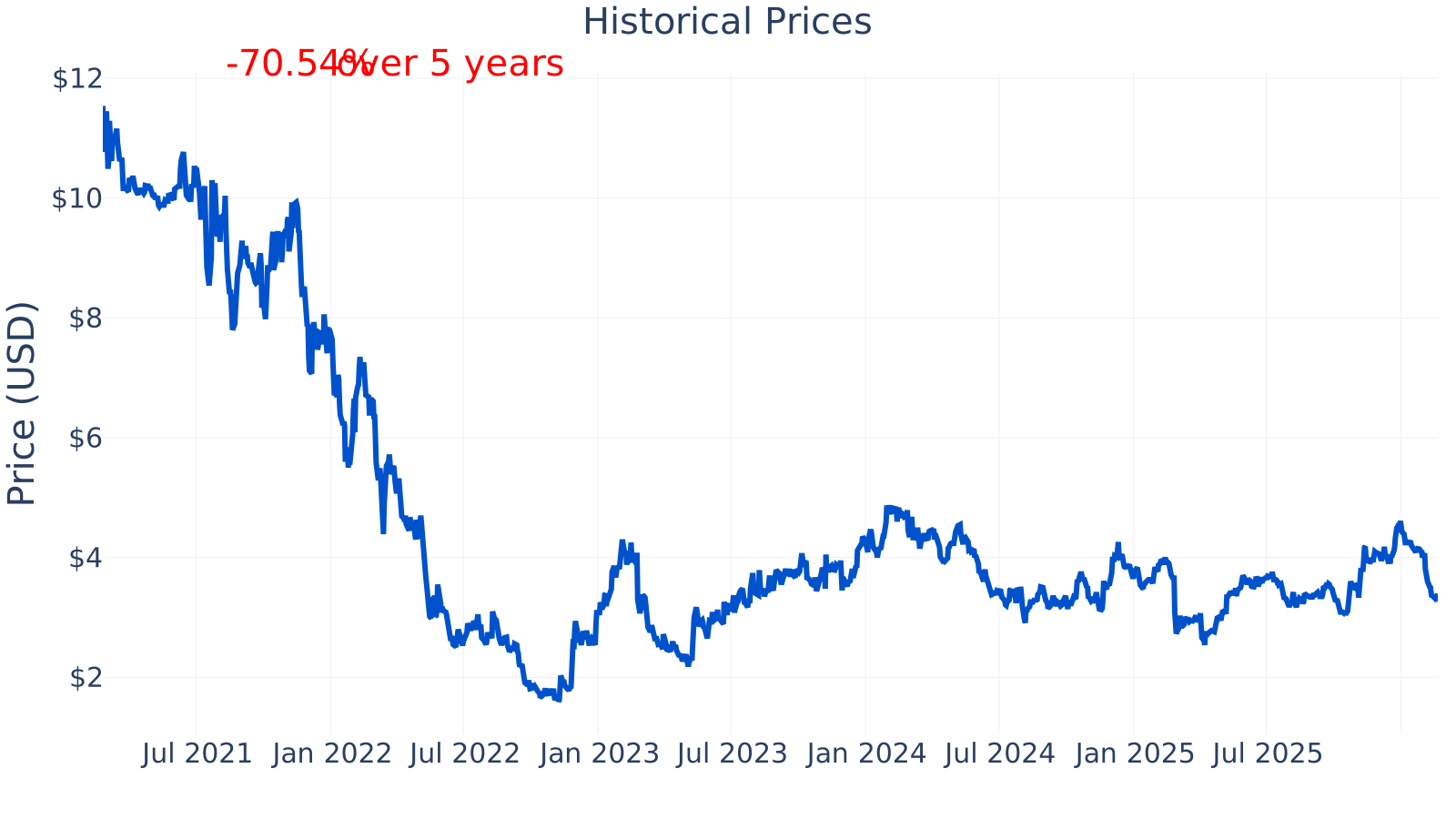
Taboola’s market capitalization is about $1.01B, placing it among smaller public companies where results can be more volatile. The stock’s beta of 1.31 indicates it has tended to move more than the overall market.
On valuation and profitability metrics, Taboola shows a P/E ratio of 42.5 versus an industry median near 15.7, while its profit margin is about 1.35% compared with an industry median around 9.94%. That combination (higher P/E with lower margin) usually implies the market is assigning value based on expectations of improved profitability and/or sustained growth, rather than current earnings power.
On growth and balance sheet indicators, the most recent year-over-year revenue growth is about 14.7% versus an industry median near 6.8%. Debt-to-equity is about 18.5% (industry median ~6.0%), and trailing twelve-month free cash flow is about $168.4M, which can matter because cash generation can help fund product development and reduce reliance on external financing.
Growth (Medium)
Taboola operates in digital advertising, a large market that has benefited over time from audiences and commerce shifting online. Within that broad space, its positioning is tied to “open web” publishers and apps (properties outside the largest closed platforms). That area can grow when publishers expand their audiences and when advertisers look for alternatives to major platforms, but it can also face pressure if budgets concentrate with the biggest ecosystems.
The year-over-year revenue growth pattern shown is uneven: strong growth in parts of 2024, a slowdown in early 2025, and a re-acceleration to the mid-teens in the latest period shown. This type of pattern is consistent with an ad-driven business where growth is influenced by broader ad-market cycles, changes in partner traffic, and advertiser demand.
The free cash flow trend improves meaningfully over the period shown, rising to about $158M by early 2025 and about $168M on the latest trailing basis in the table. For a company in advertising technology, expanding free cash flow can be an important potential catalyst because it can provide flexibility for reinvestment, balance sheet strengthening, and resilience during weaker advertising conditions.
Strategically, Taboola’s long-run growth depends on (1) maintaining and expanding distribution with publishers and apps, (2) improving ad performance so advertisers keep spending, and (3) increasing “take rate” or efficiency—earning more operating profit per dollar of revenue—without damaging partner relationships that rely on revenue sharing.
Risks (High)
This article is for informational purposes only and does not constitute financial advice. Some content is AI-generated. See Disclaimer