Stock Analysis · Nayax Ltd (NYAX)
Overview
Nayax Ltd (NYAX) provides technology that helps operators of unattended points of sale accept digital payments and manage their businesses. In practice, that often includes places like vending machines, coffee machines, kiosks, amusement/arcade machines, laundromats, and other self-service retail setups. The company combines payment acceptance (card and other cashless methods), connectivity/telemetry for machines, and software tools that help operators monitor performance, inventory, and service needs.
Its business model is typically described as a combination of (1) payments-related revenue generated when an end-customer makes a purchase at a connected machine, (2) recurring software and connectivity fees, and (3) hardware sales (payment devices installed on machines). Over time, the mix generally matters because recurring and usage-based revenue can be more predictable than one-time hardware revenue. Public filings should be used to confirm the exact segment labels and the latest revenue split, since the breakdown can change over time.
Main sources of revenue (typical structure; confirm exact percentages in the most recent annual report):
- Transaction-based revenue (fees linked to payment volume processed through Nayax-enabled devices)
- Recurring software/connectivity revenue (subscriptions and service fees to manage and connect devices)
- Hardware revenue (sale of payment terminals and related equipment)
Across recent years, total revenue increased substantially, while operating profitability improved over time, moving from operating losses to positive operating income. Interest expense rose in the later period shown, which is important context when evaluating how much of operating improvement ultimately reaches net income.
Key Figures
| Metric | Value | Industry ⓘ |
|---|---|---|
| Date | Mar 13, 2026 | |
| Context | ||
| Sector | Technology | |
| Industry | Software - Infrastructure | |
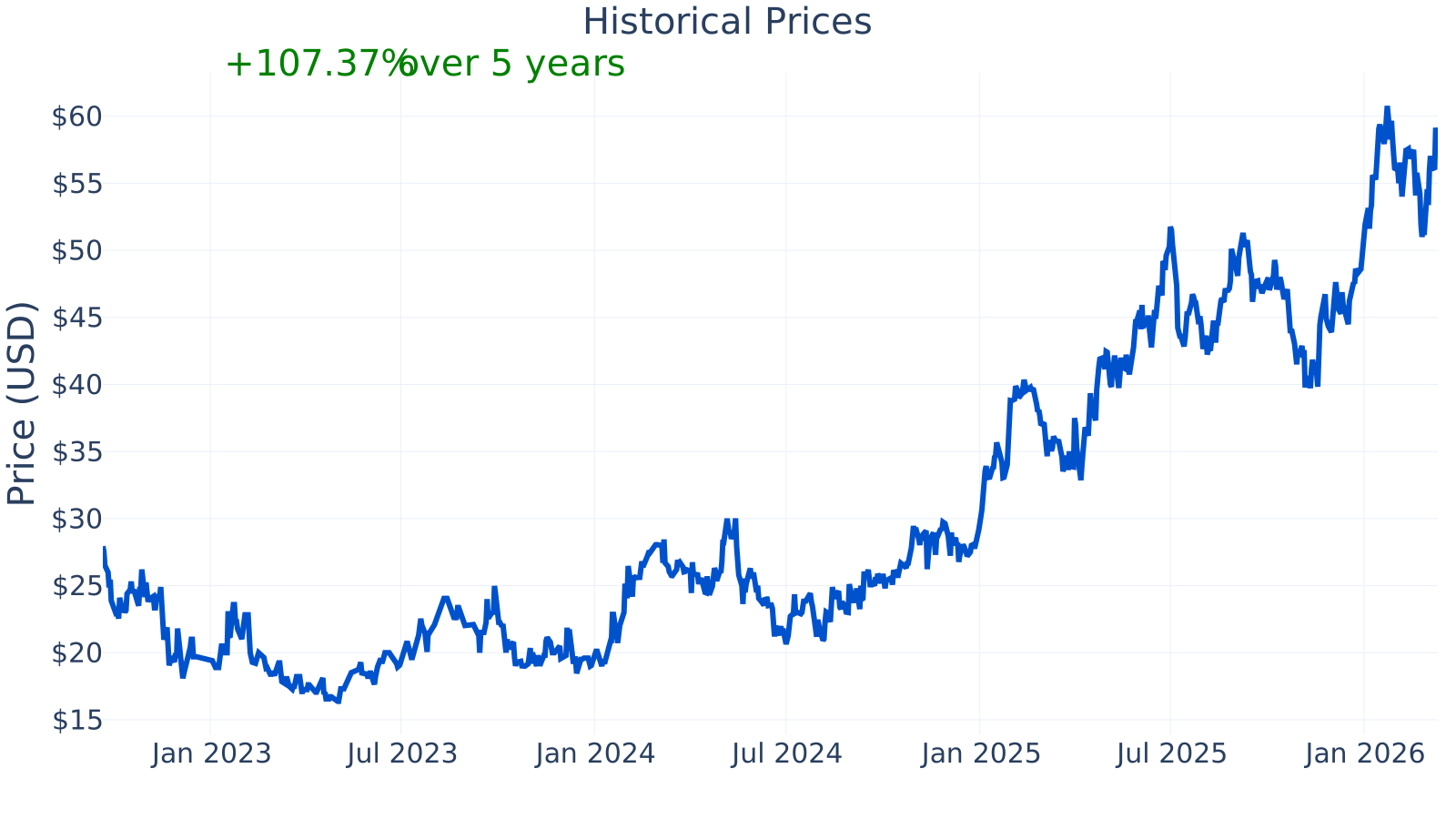
| Market Cap ⓘ | $2.18B | |
| Beta ⓘ | -0.28 | |
| Fundamental | ||
| P/E Ratio ⓘ | 91.97 | 27.58 |
| Profit Margin ⓘ | 8.87% | 7.12% |
| Revenue Growth ⓘ | 34.30% | 17.10% |
| Debt to Equity ⓘ | 146.15% | 24.92% |
| PEG ⓘ | N/A | |
| Free Cash Flow ⓘ | $31.60M | |
Nayax’s market capitalization is about $2.18B. The company shows a P/E ratio near 92, well above the industry median shown (~28), meaning the market price reflects higher expected growth and/or improving profitability. Recent profit margin is ~8.9%, above the industry median (~7.1%). Year-over-year revenue growth is ~34.3%, also above the industry median (~17.1%). Debt-to-equity is ~146%, substantially higher than the industry median (~25%). Trailing twelve-month free cash flow is about $31.6M.
Growth (Medium-High)
Nayax operates in a part of the economy that benefits from long-running trends: more digital payments, more self-service retail, and more connected devices in the field. Many unattended points of sale historically relied on cash; adding cashless acceptance can increase sales conversion (more people can pay) and can make operations more efficient through remote monitoring and data-driven replenishment and maintenance.
The strategy typically centers on expanding the installed base of connected devices and increasing monetization per device over time. Hardware placements can act as an on-ramp, while transaction fees and software/connectivity can provide ongoing revenue as usage grows. This structure can support growth if the company continues adding devices, expanding into additional geographies/verticals, and sustaining payment volume per machine.
Revenue growth has been strong but not linear. The year-over-year growth rate moved from very high levels earlier in the period (above 50% at times) to the 20%–40% range more recently, ending around 37% in the most recent point shown. Relative to the industry median displayed (~17%), Nayax has been growing faster, which helps explain why valuation metrics can screen as elevated versus peers.
Free cash flow improved materially over time, shifting from negative levels (around -$50.9M in 2022 and -$39.5M in early 2023) toward positive territory, reaching about $16.6M in early 2025 and roughly $31.6M on a trailing twelve-month basis in the latest table. For long-term fundamentals, this shift matters because consistent positive free cash flow can help fund growth internally and reduce dependence on external financing.
Potential catalysts (in general terms) often include: continued growth in the number of deployed devices, rising payment volume per device, improved operating leverage as the cost base scales, and progress in keeping churn low while adding new operators and locations. Confirmation of these drivers should be taken from the company’s annual report and earnings materials.
Risks (High)
A key risk is financial: Nayax’s leverage appears elevated compared with the industry median. Higher debt can amplify outcomes—helpful when growth is strong, but more challenging if growth slows, interest rates rise, or margins compress. The business also has execution risk: maintaining device reliability, uptime, fraud controls, and payment network compliance is essential in payments-related services.
Debt-to-equity increased over the period shown, ending around 146%, versus an industry median near 25%. The path was not steady—there were periods of lower leverage—yet the latest reading stands out as a point to monitor alongside interest expense and refinancing needs.
Profitability improved significantly. Net profit margin moved from deeply negative in 2022 (around -25%) and gradually climbed to positive territory in 2025, reaching about 8.9% at the most recent point shown. That is above the industry median displayed (about 6.9%). Even so, the historical volatility suggests margins can be sensitive to scale, mix (hardware vs. recurring/transactions), and operating expense levels.
Competitive positioning is also a central risk factor. Nayax participates in markets where competitors may offer payment terminals, telemetry, or broader payment processing services. Switching costs can exist (device installation, software workflows, operator training), but competition can still pressure pricing, customer acquisition costs, or take rates. In addition, larger payment companies and specialized unattended-payment providers may compete through distribution partnerships, integrated offerings, or pricing power.
Main competitors can include: (1) other unattended payment and telemetry providers, (2) general payment processors expanding into unattended use cases, and (3) machine management software providers that integrate with third-party payments. The precise peer set depends on geography and vertical (vending, micro-markets, parking, kiosks, etc.), and is best verified using the “Competition” and “Business” sections in the company’s annual report.
Valuation
The company’s P/E ratio (where meaningful values are shown) has been well above the industry median in the later portion of the timeline, with readings that moved down from very high levels (above 200 at one point shown) to around the 60–75 range more recently on the chart. The latest metrics table shows a P/E around 92 versus an industry median around 28.
In plain terms, this indicates the market price embeds expectations of continued strong growth and improving profitability. When a company trades at a multiple far above peers, valuation tends to be more sensitive to changes in growth rate, margins, and financing costs. The company’s above-median revenue growth and improving profit margin support the narrative behind a higher multiple, while the elevated leverage and historical variability in profitability are counterweights that can affect how the market prices risk.
Conclusion
Nayax is positioned in long-running trends—cashless payments, self-service retail, and connected devices—and it has shown strong revenue growth with meaningful improvement in profitability and free cash flow over time. The business model’s mix of transaction-linked revenue and recurring software/connectivity revenue can support scaling if device deployments and payment volumes keep expanding.
At the same time, the company shows higher leverage than the industry median, and valuation metrics indicate the stock price reflects relatively high expectations compared with many peers. The long-term discussion therefore hinges on whether Nayax can sustain above-industry growth, keep improving margins, and manage debt and interest costs while operating in a competitive environment.
Sources:
- Nayax Ltd — Annual Report (Form 20-F): “Business”, “Risk Factors”, and “Management’s Discussion and Analysis” sections
- SEC EDGAR — Nayax Ltd filings (Form 20-F and other submitted reports)
- Nayax Ltd — Investor Relations materials (shareholder letters, presentations, and company press releases, when published on the IR site)
- Wikipedia — “Nayax” (basic company background; non-financial context)
This article is for informational purposes only and does not constitute financial advice. Some content is AI-generated. See Disclaimer