Stock Analysis · Global-E Online Ltd (GLBE)
Overview
Global-E Online Ltd (GLBE) provides software and services that help brands and retailers sell directly to international customers. In simple terms, it aims to make cross-border e-commerce feel “local” to shoppers in other countries by handling key friction points such as localized checkout and pricing, local payment methods, taxes and duties estimation, shipping options, and returns. The company primarily serves merchants that want to expand internationally without building their own complex country-by-country commerce setup.
In its public filings, Global-E describes revenue coming mainly from services provided to merchants for enabling and managing cross-border transactions (including fees tied to transaction volume), along with other related services. Exact percentages by revenue stream can vary by period and are not always presented as a simple split in filings; the common way to think about the business is that revenue is mostly driven by merchant transaction activity and the services attached to those transactions.
Main revenue drivers (high-level, based on company reporting structure):
- Transaction-based and service fees from merchants tied to cross-border sales enabled through Global-E’s platform (primary driver).
- Other services and fees related to international enablement (smaller and varies by period).
The business model typically benefits when merchants increase international sales volume, expand to more countries, and adopt more of Global-E’s services across their checkout and fulfillment flow.
Over the last several years, revenue and gross profit expanded materially, while operating losses narrowed and then turned into operating income in the most recent year shown. A notable shift is that operating expenses, which were previously large relative to revenue during the earlier growth phase, became more controlled versus revenue as the company scaled.
Key Figures
| Metric | Value | Industry ⓘ |
|---|---|---|
| Date | Feb 23, 2026 | |
| Context | ||
| Sector | Consumer Cyclical | |
| Industry | Internet Retail | |
| Market Cap ⓘ | $6.12B | |
| Beta ⓘ | 1.24 | |
| Fundamental | ||
| P/E Ratio ⓘ | N/A | 32.68 |
| Profit Margin ⓘ | 7.10% | 6.46% |
| Revenue Growth ⓘ | 28.00% | 13.05% |
| Debt to Equity ⓘ | 4.50% | 32.25% |
| PEG ⓘ | N/A | |
| Free Cash Flow ⓘ | $294.75M | |
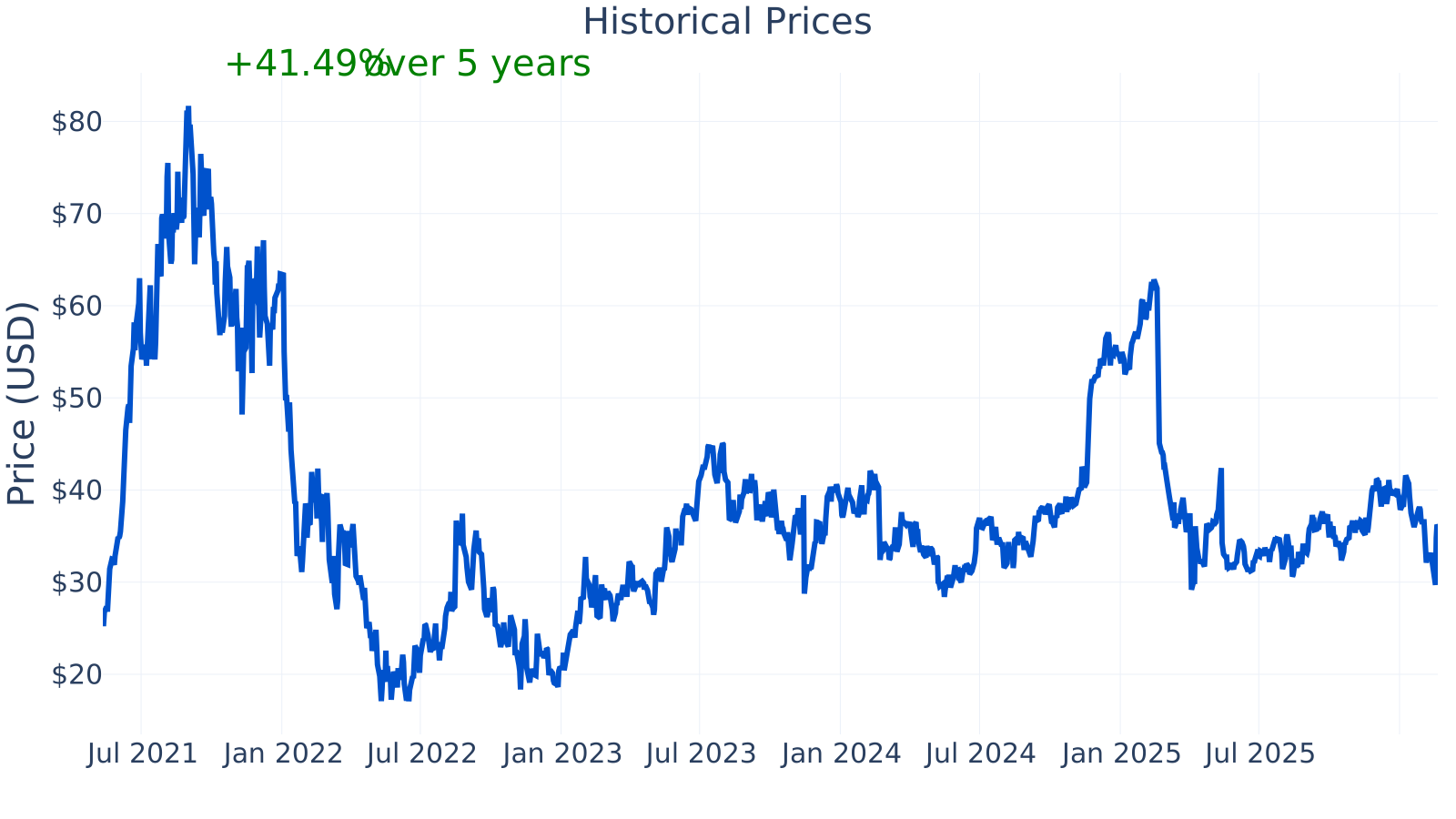
At a market capitalization of about $6.1B, Global-E sits in the mid-cap range. The stock’s beta (~1.24) suggests it has tended to move more than the broader market. Recent profitability and growth metrics show a mixed but improving picture: profit margin ~7.1% (above the industry median ~6.5%) and year-over-year revenue growth ~28% (above the industry median ~13.1%). Leverage appears low with debt-to-equity ~4.5% versus an industry median around 32.2%. The company also shows meaningful trailing twelve-month free cash flow of about $295M. The P/E ratio may be unavailable or not consistently meaningful in some periods, especially when earnings were negative or affected by accounting items.
Growth (Medium)
Global-E operates in cross-border e-commerce enablement, which is supported by long-term trends: more consumers shopping online, brands pursuing direct-to-consumer distribution, and merchants seeking growth outside their home markets. Cross-border selling is operationally harder than domestic e-commerce (payments, compliance, shipping, returns), which creates demand for specialized platforms that reduce complexity and improve conversion at checkout.
Strategically, Global-E’s approach is built around embedding its capabilities into the merchant’s international shopping experience. If merchants expand into more geographies and route a larger share of international demand through Global-E’s solution, the company can grow through higher transaction volume, broader adoption of services, and increased merchant count. A practical catalyst for growth tends to be merchant expansion (existing customers entering new markets) and new merchant wins, because each additional country and each additional brand can add incremental transaction volume without requiring proportional increases in cost.
Revenue growth has been strong but has also normalized from very high levels earlier in the period. Quarterly year-over-year growth rates moved from roughly 50%–80% in 2022 to a range closer to the mid-20% to low-40% area more recently, ending near ~28% in the latest period shown. That pattern is common for companies scaling from a smaller base: growth can remain healthy even as it becomes less extreme.
Free cash flow increased over time, rising from roughly $24M (2021) to about $150M (2025), and the latest trailing figure shown is about $295M. In plain language, this indicates the business has recently been generating more cash after operating needs and investment spending—an important marker as a company transitions from “growth at any cost” toward more self-funded expansion.
Risks (High)
Global-E’s results are closely linked to consumer spending and e-commerce activity, especially for discretionary categories where international orders may be more sensitive to economic slowdowns. Cross-border commerce is also exposed to country-specific disruptions such as customs changes, tax and duty rule updates, shipping constraints, currency fluctuations, and geopolitical events. Any friction that increases delivery times or landed costs can reduce international conversion rates and transaction volume.
Competition is a central risk. Global-E overlaps with large commerce platforms and payment providers that can build or bundle cross-border features, as well as logistics and cross-border specialists. Depending on merchant needs, alternatives can include building capabilities in-house, using broader e-commerce platforms, or adopting other providers for payments, tax calculation, localization, or shipping. In practice, this can create pricing pressure or raise customer acquisition costs. Global-E’s competitive advantages are generally associated with specialized cross-border functionality, operational know-how across many destination markets, and the ability to offer a more integrated experience—but the durability of that advantage depends on product execution and maintaining strong merchant outcomes (conversion, cost, delivery experience).
Leverage has been very low throughout the period shown, ending around ~4.5% debt-to-equity, well below the industry median levels displayed in the same chart. Low leverage can reduce financial strain during weaker demand periods, but it does not remove operating risks such as competitive dynamics or demand volatility.
Profitability improved meaningfully over time. Profit margin was deeply negative earlier in the period (reflecting heavy investment and scaling costs) and then gradually improved, turning positive and reaching about ~7.1% in the latest period shown. While this is an encouraging operational change, margins can still fluctuate due to investment cycles, mix shifts in services, and the cost of supporting expansion into additional markets.
Valuation
Valuation for Global-E can be harder to summarize with a single metric because earnings were negative for extended periods, which can make traditional P/E ratios unreliable or not meaningful. When profitability turns positive, the P/E ratio may appear abruptly and can be high if earnings are still relatively small compared with the company’s market value.
The latest P/E ratio shown is about ~103, compared with an industry median near ~44 at the same time. This kind of gap often indicates the market is assigning a higher valuation to expected future growth or margins (or reflecting differences in business models and accounting). A higher P/E can be justified by faster growth and improving profitability, but it also increases sensitivity to execution: if growth slows more than expected or margins compress, valuation multiples can contract even if the company continues to expand.
Conclusion
Global-E is positioned in cross-border e-commerce enablement, a segment supported by long-term digital commerce adoption and the ongoing push by brands to reach customers internationally. The company’s recent profile shows solid revenue growth, improving margins that have turned positive, strong increases in free cash flow, and low balance-sheet leverage.
At the same time, the business faces meaningful risks tied to consumer demand cycles, the operational complexity of cross-border trade, and competition from both specialized providers and larger platforms with the ability to bundle similar features. From a valuation perspective, the available P/E indication is substantially above the industry median, which tends to imply higher expectations for future performance and can amplify market reactions to changes in growth or profitability.
Sources:
- SEC EDGAR — Global-E Online Ltd filings (Annual Report on Form 20-F; Quarterly reports furnished on Form 6-K)
- Global-E Online Ltd Investor Relations — Shareholder materials and financial results press releases
- Wikipedia — “Global-e” (basic company background)
This article is for informational purposes only and does not constitute financial advice. Some content is AI-generated. See Disclaimer


