Stock Analysis · Jfrog Ltd (FROG)
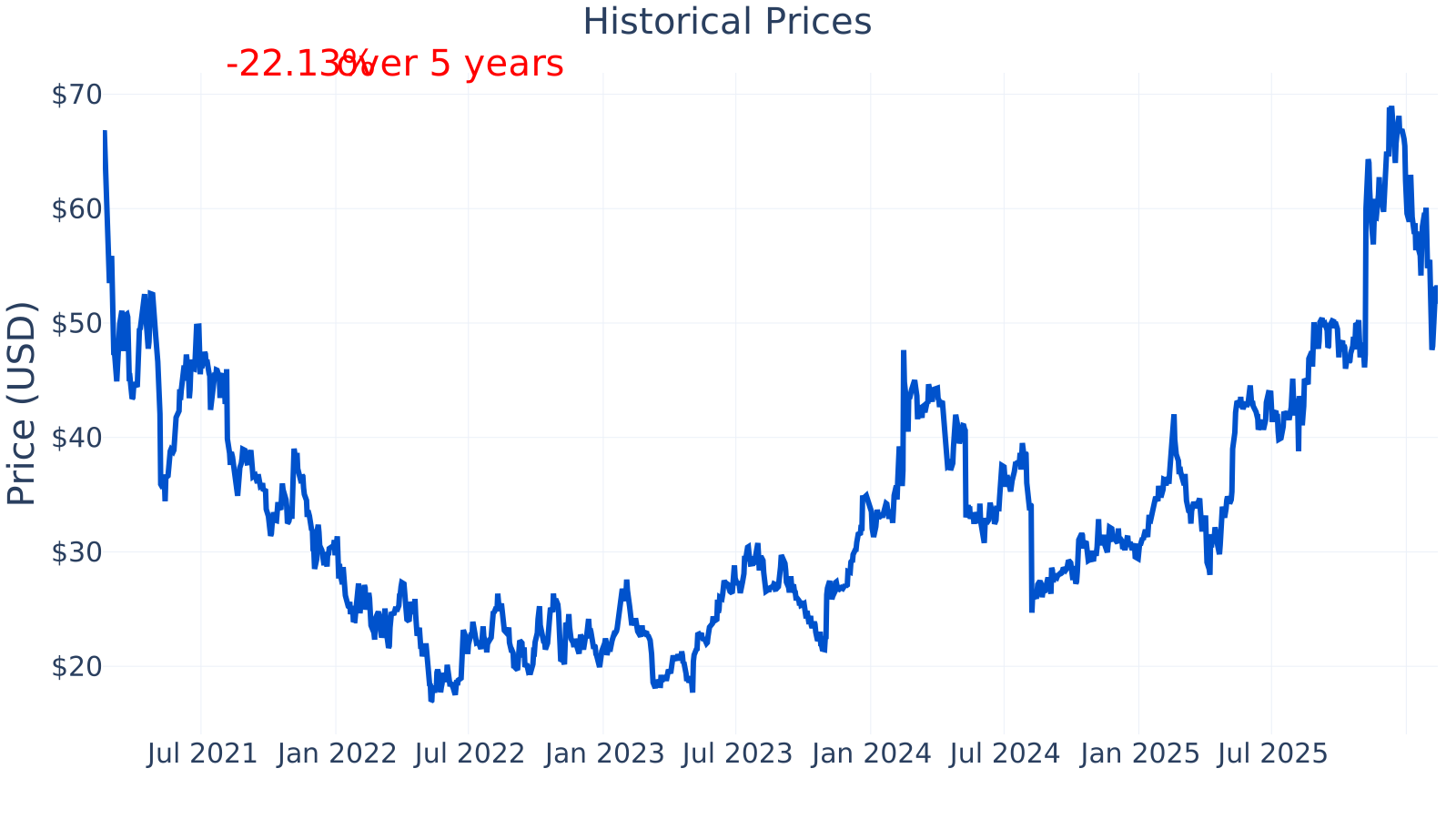
Overview
JFrog Ltd (NASDAQ: FROG) is a software company that helps organizations build, secure, store, and deliver software in a reliable way. In simple terms, when a team creates an application, it is made of many “building blocks” (internal code plus third-party components). JFrog’s products help companies manage these building blocks, automate software releases, and reduce the risk of shipping vulnerable components.
The company primarily sells its platform as subscription-based software (customers pay recurring fees), and it also offers related services. In its SEC filings, JFrog typically describes revenue in broad categories rather than breaking out many small product lines.
Main sources of revenue (high-level):
- Subscription revenue (recurring contracts for the JFrog platform and related modules) — typically the largest portion
- Services revenue (professional services such as implementation and support) — typically smaller than subscriptions
From the income statement trend over recent years, JFrog has been increasing total revenue while continuing to spend heavily on research and development, which is common for software companies focused on expanding their product platform.
Across 2021–2025, total revenue increased from about $206.7M (2021) to about $531.8M (2025). Over the same period, the company’s largest operating cost categories remained research & development and selling, general & administrative, which helps explain why operating income stayed negative even as gross profit rose.
Key Figures
| Metric | Value | Industry ⓘ |
|---|---|---|
| Date | Feb 16, 2026 | |
| Context | ||
| Sector | Technology | |
| Industry | Software - Application | |
| Market Cap ⓘ | $6.11B | |
| Beta ⓘ | 1.16 | |
| Fundamental | ||
| P/E Ratio ⓘ | N/A | 27.48 |
| Profit Margin ⓘ | -15.88% | 7.66% |
| Revenue Growth ⓘ | 25.50% | 15.80% |
| Debt to Equity ⓘ | 2.16% | 24.71% |
| PEG ⓘ | N/A | |
| Free Cash Flow ⓘ | $142.27M | |
JFrog’s market capitalization is about $6.1B, placing it in the mid-cap range. The stock’s beta (~1.16) suggests it has tended to move somewhat more than the broader market. Profitability is currently negative (profit margin about -15.9% versus an industry median near +7.7%), while growth has been stronger than the industry median (revenue growth about +25.5% year-over-year versus an industry median near +15.8%). The balance sheet appears conservatively leveraged, with debt-to-equity around 2.2% (industry median roughly 24.7%). Free cash flow over the trailing twelve months is about $142.3M, indicating the business has been generating cash despite accounting losses.
Growth (Medium)
JFrog operates in software tooling used by development and IT teams—often described in filings and industry discussions as part of the broader shift toward cloud adoption, faster software release cycles, and software supply-chain security. These themes have remained important as more businesses deliver products and services through software and want faster, more automated releases.
The company’s strategy is centered on building a platform that becomes part of a customer’s day-to-day development workflow. In practice, tools embedded in how software is built and released can be “sticky” over time, because switching them can be disruptive. That said, long-term growth still depends on continued adoption, expanding usage within existing customers, and maintaining product relevance as tools and standards evolve.
Year-over-year revenue growth has generally stayed positive but has cooled from the ~30–40% range earlier in the period to the ~20–25% range more recently. The most recent point shown is about +25.2% year-over-year, which remains above the industry median shown in the latest metrics.
Free cash flow improved meaningfully over time, rising from about $11.5M (TTM ending 2023-03-31) to about $119.3M (TTM ending 2025-03-31), with the latest table showing about $142.3M TTM. For many software companies, improving free cash flow can be an important signal that the business model is scaling, even if net income remains negative due to non-cash expenses and continued investment.
Risks (Medium-High)
A central risk for JFrog is profitability. While revenue has grown, the company has reported ongoing net losses across the years shown, meaning operating expenses have remained high relative to revenue. If growth slows further or costs rise faster than expected, the path to sustained profitability could take longer.
Profit margin has been negative throughout the period shown. It improved from very low levels in 2022 (around -35%) to a less negative level more recently (about -13.5% at the latest point). Even with that improvement, it remains below the industry median (positive in the latest period), which highlights that peers—on average—are generating profits while JFrog is still in an investment phase.
Competition is another key risk. The market for software development and “artifact/package” management includes large platform vendors and specialized tool providers. Competitors can bundle similar functionality into broader software suites, put pricing pressure on standalone tools, or benefit from existing relationships with large enterprises. JFrog’s competitive position often rests on the breadth of its platform, integrations into many developer ecosystems, and the difficulty of replacing tools embedded in release processes, but it does not operate alone in this space.
Balance-sheet risk appears lower than many software peers because leverage is modest.
Debt-to-equity has generally trended down over time and sits around 2.2% at the latest point, well below the industry median (about 25%). Lower leverage can reduce financial pressure during weaker demand cycles, although it does not remove operating risks tied to growth and spending levels.
Additional risks commonly described in software company filings include customer budget cycles (IT spending can slow during uncertain macro conditions), security and reliability expectations (a platform involved in software delivery has high uptime and trust requirements), and execution risk (product development priorities and go-to-market efficiency need to stay aligned as the company scales).
Valuation
For JFrog, a traditional price-to-earnings (P/E) ratio is often not meaningful when earnings are negative, which is why the company P/E series is shown as zeros (values can be undefined or not useful in loss-making periods). The industry median P/E shown on the chart declines over time (from higher levels earlier to roughly the mid-30s by the latest point), which provides context on how valuation multiples for the broader application software group have moved.
In practice, valuation discussions for a company in this stage often focus more on whether revenue growth, gross profit expansion, and free cash flow generation are strengthening enough to justify the market’s expectations, while also monitoring whether operating losses narrow over time. From the figures shown earlier, JFrog has delivered solid revenue growth and improving free cash flow, but it still reports negative profit margins—two facts that tend to pull valuation interpretations in opposite directions.
Conclusion
JFrog is a software platform company positioned in workflows that many organizations consider mission-critical: building and delivering applications at scale with stronger controls. Financially, the company has grown revenue substantially over the last several years and has recently shown stronger free cash flow generation, while maintaining relatively low balance-sheet leverage.
The main open question for long-term fundamentals is the durability of growth and the pace of progress toward sustained profitability. Profit margins remain negative relative to the industry median, and competition in developer tooling is active, including vendors that can bundle similar capabilities into broader platforms. Overall, the long-term profile combines a growing product category and improving cash generation with ongoing profitability and competitive execution risks.
Sources:
- SEC EDGAR — JFrog Ltd filings (Form 10-K, Form 10-Q)
- JFrog Investor Relations — Annual Report materials and shareholder communications (company-hosted)
- Wikipedia — “JFrog” (basic company background)
This article is for informational purposes only and does not constitute financial advice. Some content is AI-generated. See Disclaimer


