Stock Analysis · Nova Ltd (NVMI)
Overview
Nova Ltd (NVMI) operates in the semiconductor equipment and materials industry. In simple terms, the company makes tools that help chip manufacturers and semiconductor equipment companies measure and inspect extremely small patterns on silicon wafers during the chipmaking process. These measurement steps are used to control quality and improve “yield” (how many good chips are produced from a batch), which can have a direct impact on a customer’s costs and output.
Nova’s business is generally tied to how much the semiconductor industry is investing in manufacturing capacity and new technology generations. When chipmakers expand or upgrade factories, demand for process control and metrology equipment typically rises; when the industry slows, orders can soften.
The company’s revenue is primarily generated by selling metrology systems and related offerings to semiconductor manufacturers and, in some cases, to other equipment makers. Public filings typically describe revenue in terms of product/system sales and service-related revenue (such as support and maintenance). The exact split can vary by year and is best tracked in the company’s annual report segment and revenue note disclosures.
From 2021 to 2025, total revenue increased from about $416 million to about $881 million. Over the same period, research and development spending rose from about $66 million to about $143 million, reflecting continued investment in new products. Net income also increased (about $93 million in 2021 to about $259 million in 2025), indicating that growth was accompanied by higher bottom-line profitability.
Key Figures
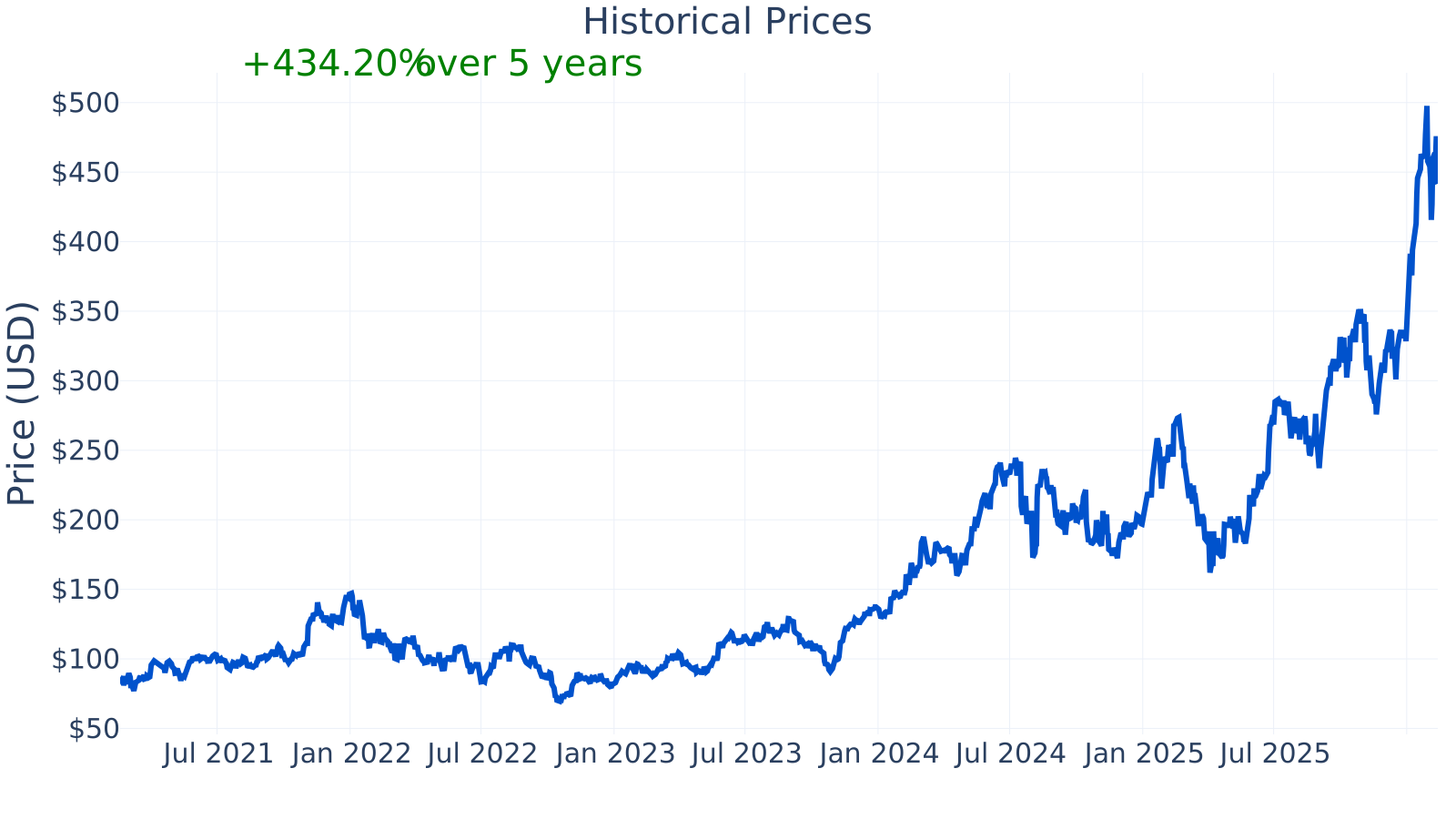
The stock price history shown above highlights that NVMI has experienced meaningful up and down moves over multi-quarter periods, which is common for companies tied to semiconductor capital spending cycles.
| Metric | Value | Industry ⓘ |
|---|---|---|
| Date | Feb 16, 2026 | |
| Context | ||
| Sector | Technology | |
| Industry | Semiconductor Equipment & Materials | |
| Market Cap ⓘ | $13.16B | |
| Beta ⓘ | 1.82 | |
| Fundamental | ||
| P/E Ratio ⓘ | 55.61 | 48.26 |
| Profit Margin ⓘ | 29.44% | 8.62% |
| Revenue Growth ⓘ | 14.30% | 12.90% |
| Debt to Equity ⓘ | 60.62% | 20.73% |
| PEG ⓘ | N/A | |
| Free Cash Flow ⓘ | $217.91M | |
Nova’s market capitalization is about $13.16B. The beta of 1.82 suggests the stock has tended to move more than the broader market. Profit margin is about 29.44% versus an industry median near 8.62%, indicating stronger profitability than many peers. Year-over-year revenue growth is about 14.30% versus an industry median near 12.90%, placing it slightly above the peer midpoint on current growth. Debt-to-equity is about 60.62% versus an industry median near 20.73%, meaning balance-sheet leverage is higher than the typical company in its peer set. The current P/E ratio is about 55.61 versus an industry median near 48.26, indicating a higher earnings multiple than the median peer.
Growth (Medium)
Nova operates in a part of the semiconductor value chain that is supported by long-term drivers: continued demand for computing (including AI workloads), ongoing complexity increases in chip manufacturing, and the need to reduce defects as features shrink. Process control and metrology tools are commonly used more intensively as manufacturing becomes harder, because tighter tolerances require more measurement and monitoring steps.
Revenue growth has been cyclical. After very high growth in 2021–2022, growth turned negative in 2023 (a period consistent with a semiconductor equipment down-cycle), and then rebounded strongly in 2024 and into 2025. The most recent figure shown is about 14.3% year-over-year, which suggests growth continued but at a more moderate pace than the earlier rebound.
Free cash flow over the trailing twelve months has trended upward over the period shown, rising from about $74.7 million (2021) to about $221.7 million (2025). For long-term business durability, consistently positive and growing free cash flow can matter because it indicates the company is generating cash after operating needs and capital spending.
Potential catalysts for the business tend to be industry- and technology-driven rather than one-time events: larger semiconductor capital expenditure cycles, new manufacturing nodes that require additional measurement steps, and expanding use of advanced packaging and memory technologies that also demand tighter process monitoring. The company’s continued R&D investment also suggests a strategy centered on maintaining relevance as chipmaking requirements evolve.
Risks (High)
A key risk for Nova is cyclicality. Semiconductor equipment demand can change quickly with customer capital spending plans, and revenue growth may swing from strong to weak (or negative) across years. This can make results less predictable than in industries with steadier demand.
Nova’s debt-to-equity ratio is currently about 60.6%, which is notably above the industry median shown (about 20.7%). The chart also shows a sharp increase during 2025 after a period of lower leverage earlier in 2024–mid 2025. Higher leverage can reduce financial flexibility if industry conditions weaken, and it can increase sensitivity to interest costs and refinancing needs (even if interest expense appears relatively small in the income statement figures shown for recent years).
Profitability has been a clear strength in recent years. The profit margin has steadily risen to about 29.4%, while the industry median shown declined over time to single digits. This gap can reflect competitive positioning, product mix, pricing power, operating discipline, or a combination of factors. However, strong margins can also attract competition, and margins can compress if the industry slows, if customers push harder on pricing, or if costs rise.
Competition risk is material in semiconductor equipment. Nova participates in metrology and process control, where customers are large, technically demanding, and often prefer proven vendors. Competitive advantages in this space typically come from measurement accuracy, repeatability, throughput (speed), tool uptime, and deep integration into customer process steps. Switching costs can be meaningful once a tool is qualified in a production environment, but customers may still dual-source or change suppliers over time if performance or total cost of ownership shifts.
Main competitors are other companies selling metrology and inspection tools to semiconductor manufacturers, including large, diversified semiconductor equipment providers with process control offerings. Relative positioning is often judged by tool performance at specific steps and customer adoption in high-volume manufacturing. Nova’s high profit margin relative to the peer median is consistent with strong execution, but it does not by itself prove category leadership across all metrology segments.
Additional risks include customer concentration (a small number of large semiconductor manufacturers can represent a significant share of demand), geopolitical and export-control constraints affecting where tools can be shipped or supported, and the operational challenge of sustaining innovation as process complexity increases.
Valuation
Valuation is often discussed through earnings multiples for profitable semiconductor equipment companies, while keeping in mind that earnings can be cyclical. Nova’s current P/E ratio is about 55.6, compared with an industry median around 48.3, which places it above the peer midpoint on this metric.
The historical P/E trend shown indicates the multiple has moved meaningfully over time, with periods where Nova traded at a premium to the industry median and periods closer to (or below) it. Because earnings and sentiment can change across semiconductor cycles, the P/E ratio can shift even if the underlying business remains strong.
Whether the current multiple is “high” or “low” depends on how durable recent growth and elevated profitability prove to be through the next down-cycle, and on whether the company can keep translating revenue expansion into cash flow. The combination of above-median profitability and a higher-than-median P/E suggests the market is assigning value to margin strength and growth, while the higher leverage (relative to the peer median) adds an extra factor to weigh when interpreting that multiple.
Conclusion
Nova Ltd is a semiconductor process control and metrology company whose results are closely linked to long-term chip manufacturing complexity and shorter-term equipment spending cycles. Over 2021–2025, the company expanded revenue and net income meaningfully while increasing R&D investment, and it has produced rising free cash flow over the period shown.
The main points that stand out are (1) strong profitability versus the peer median, (2) growth that has been cyclical but recently positive, and (3) a leverage profile that is currently higher than the peer median and that rose sharply in 2025. The valuation, as reflected in the P/E ratio, is above the industry median, which implies that future results and resilience through industry cycles are particularly important for how the stock is priced at a given time.
Sources:
- SEC EDGAR — Nova Ltd filings (Annual Report on Form 20-F; Quarterly results furnished on Form 6-K)
- Nova Ltd — Investor Relations materials (annual report, earnings releases, and company-hosted presentations)
- Wikipedia — “Nova Ltd.” (basic company background only)
This article is for informational purposes only and does not constitute financial advice. Some content is AI-generated. See Disclaimer


