Stock Analysis · Radware Ltd (RDWR)
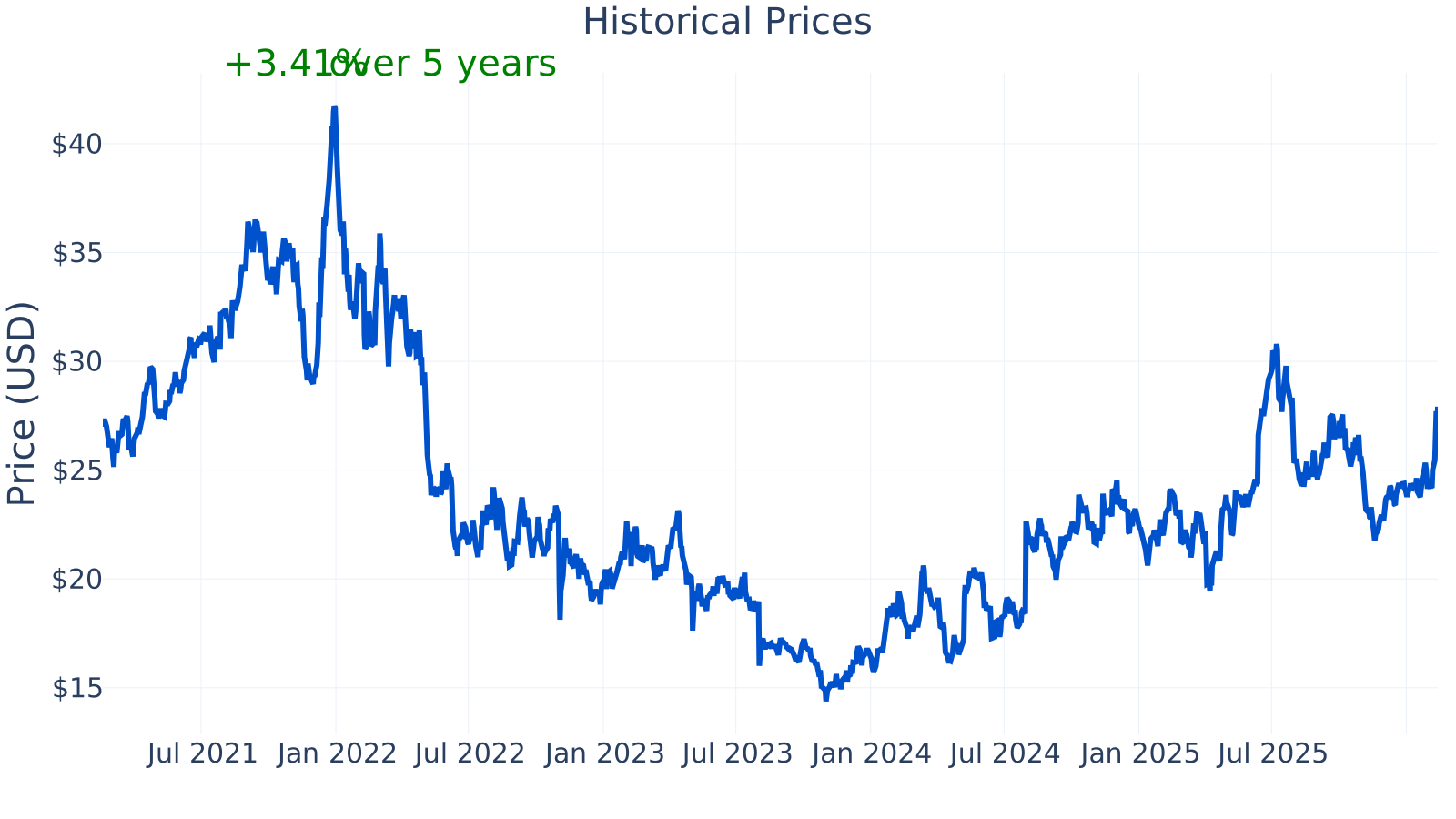
Overview
Radware Ltd (RDWR) is a cybersecurity company focused on keeping applications and digital services available, fast, and protected. In simple terms, it helps organizations defend their websites, apps, and networks against attacks (especially disruption-style attacks) and performance issues. Its offerings include security and availability solutions delivered as software and as cloud-based services, typically sold to enterprises, service providers, and public-sector organizations.
Radware’s revenue is generally generated from a mix of product/solution sales and ongoing services (including cloud-based security services and maintenance/support). In its reporting, revenue is commonly discussed through broad categories such as:
- Subscription and cloud security/services (recurring revenue tied to cloud-delivered protection and subscriptions)
- Maintenance and support (ongoing customer support and updates)
- Product and licenses (appliances and/or software licenses, typically more upfront in nature)
The exact percentage split can vary by year and should be taken from the most recent annual report for the latest breakdown by category and geography.
Over the 2021–2025 period shown, total revenue trends upward overall (from about $286.5M in 2021 to about $301.9M in 2025). Profitability also looks uneven across the years, with net income dipping negative in 2022–2023 and then recovering to about $20.3M in 2025. Research and development spending remains a major cost line, which is typical for cybersecurity vendors that must continuously update products to respond to new threats.
Key Figures
| Metric | Value | Industry ⓘ |
|---|---|---|
| Date | Feb 16, 2026 | |
| Context | ||
| Sector | Technology | |
| Industry | Software - Infrastructure | |
| Market Cap ⓘ | $1.21B | |
| Beta ⓘ | 0.97 | |
| Fundamental | ||
| P/E Ratio ⓘ | 62.04 | 25.13 |
| Profit Margin ⓘ | 6.71% | 6.91% |
| Revenue Growth ⓘ | 9.90% | 15.25% |
| Debt to Equity ⓘ | 4.87% | 19.82% |
| PEG ⓘ | 30.49 | |
| Free Cash Flow ⓘ | $42.79M | |
Radware’s market capitalization is about $1.21B, placing it in the smaller end of publicly traded cybersecurity-focused software/infrastructure firms. The stock’s beta of ~0.97 suggests price moves that have been roughly in line with the broader market on average (though any single stock can still be volatile). The company’s P/E ratio is ~62.0 versus an industry median around 25.1, meaning the market is valuing Radware at a higher multiple of earnings than many peers. Profit margin is about 6.7%, close to the industry median (~6.9%). Revenue growth year-over-year is about 9.9%, below the industry median (~15.3%). Debt-to-equity is about 4.9%, notably below the industry median (~19.8%). Trailing twelve-month free cash flow is about $42.8M.
Growth (Medium)
Cybersecurity is a structurally important area of technology because organizations increasingly operate online, rely on cloud services, and face persistent threats. Within cybersecurity, protecting applications (including web applications and APIs) and maintaining availability during attacks are ongoing priorities because downtime can directly impact revenue, operations, and reputation.
Radware’s strategy—combining application protection, availability, and cloud-delivered security services—fits a market where many customers prefer recurring, subscription-like services rather than one-time hardware purchases. A continued shift toward cloud and subscription delivery can support more predictable revenue over time, but it also increases competition since customers can compare providers more easily.
The year-over-year revenue pattern appears cyclical: positive growth in 2021, a contraction phase during 2022–2023, and then a return to growth through 2024–2025. The latest shown growth rate is around 9.9%, which indicates expansion, but it is still below the industry median in the table—suggesting Radware may be growing more slowly than many comparable infrastructure software firms at this moment.
Free cash flow (cash generated after operating costs and capital spending) fluctuates meaningfully across the period shown: roughly $49.4M (2021), down to $8.7M (2022), then improving to $32.9M (2023), dipping to $13.4M (2024), and rising to $68.3M (2025). This variability can matter for long-term evaluation because steady cash generation often helps fund product development and go-to-market investment without relying heavily on debt or dilution.
Potential growth catalysts for a company like Radware typically include increased demand for DDoS mitigation and application/API protection, customer migration to cloud-delivered security, and adoption of broader security platforms that bundle multiple protections. However, the pace at which those translate into Radware’s results depends on execution, competitive wins, and customer budgets.
Risks (Medium)
Radware operates in a highly competitive cybersecurity market where customers can switch vendors and where larger competitors may bundle services across broader platforms. Pricing pressure, longer sales cycles, and shifts in customer spending (especially in enterprise IT/security budgets) can affect growth and margins.
Another risk is the constant need to keep up with evolving attack methods. This requires sustained investment in research and development, which can weigh on profitability during periods when revenue growth slows. Operationally, cybersecurity providers also face reputational risk: a widely publicized failure to mitigate an incident, or a security issue in their own environment, can damage trust.
Financial leverage appears relatively conservative. The latest debt-to-equity ratio is about 4.9% versus an industry median near 19.8%. The downward trend over time (from roughly 7–8% in 2021 toward under 5% by 2025) suggests Radware has not relied heavily on debt compared with many peers, which can reduce financial risk during weaker demand periods.
Profitability has improved compared with the loss-making period visible in 2023–early 2024. The latest profit margin is about 6.7%, close to the industry median (~6.9%). The earlier negative margins highlight that earnings can be sensitive to revenue levels and operating expense decisions, which is important context for interpreting valuation multiples.
In terms of competitive positioning, Radware is a recognized participant in application security and DDoS protection, but it competes against much larger firms and specialized vendors. Key competitors often include large platform providers and security specialists in areas such as application delivery, DDoS mitigation, web application firewalls, and broader cloud security. Relative to the largest players, Radware’s potential advantages typically center on focus and specialization, while the disadvantages can include smaller scale, lower marketing reach, and fewer cross-sell opportunities than broad platforms.
Valuation
The latest P/E ratio is about 62.0, which is substantially above the industry median shown in the table (~25.1). A higher P/E can be justified when a company is expected to produce stronger or more durable earnings growth than peers, or when profitability is improving from a low base. However, Radware’s latest year-over-year revenue growth (~9.9%) is below the industry median in the table (~15.3%), which can make a higher earnings multiple harder to justify purely on near-term growth comparisons.
The historical P/E series shown is also uneven, with very high readings in earlier periods and gaps where the P/E is not meaningful (commonly occurring when earnings are negative). This pattern is consistent with a business that has had swings in profitability. In that context, valuation analysis often depends not only on the current P/E, but also on whether margins and cash generation can remain stable through different demand conditions.
Separately, Radware’s relatively low debt levels and positive free cash flow in the latest period can be supportive fundamentals, but they do not automatically resolve the question of whether the current valuation multiple matches the company’s long-run growth and competitive position.
Conclusion
Radware is positioned in cybersecurity, an industry with persistent long-term demand driven by the need to keep online applications secure and available. The company’s results show a recovery phase: revenue growth has returned after a 2022–2023 downturn, profit margins have improved to mid-single digits, and recent free cash flow is meaningfully positive. Balance-sheet leverage appears relatively low compared with the industry median, which can reduce financial strain during weaker periods.
At the same time, the company operates in an intensely competitive market with larger rivals, and its recent revenue growth rate is below the industry median shown. Valuation metrics indicate the stock is priced at a higher multiple of earnings than many peers, which increases sensitivity to execution and the ability to sustain improved profitability. Overall, the long-term picture depends on whether Radware can maintain its margin recovery, expand recurring service revenue, and win business consistently against larger platforms.
Sources:
- SEC EDGAR — Radware Ltd filings (Annual Report on Form 20-F and other filings as applicable)
- Radware Investor Relations — Annual reports and shareholder materials (company-hosted)
- Radware Investor Relations — Press releases and quarterly results (company-hosted)
- Wikipedia — “Radware” (basic company background)
This article is for informational purposes only and does not constitute financial advice. Some content is AI-generated. See Disclaimer


