Stock Analysis · Magic Software Enterprises Ltd (MGIC)
Overview
Magic Software Enterprises Ltd is a technology company focused on helping organizations build, connect, and run business applications. In simple terms, it sells software tools and services that support digital transformation projects such as integrating different systems, moving workloads to cloud environments, and improving how data flows across a business. The company also operates through subsidiaries that provide IT consulting and staffing-style services for enterprise customers.
Because Magic Software operates across several offerings, its revenue base is typically a mix of software-related activities and services delivered to customers. Based on the company’s reporting approach in its annual filings, revenue generally comes from the following types of activities (exact segment percentages can vary by year and reporting structure):
- IT services (project delivery, consulting, and managed/outsourced work)
- Software and cloud-related offerings (platforms/tools and related support)
- Other related professional services (implementation and customer support tied to solutions)
The business model tends to be less “one big product” and more a portfolio of solutions and services, which can help diversify demand but can also make results depend on execution and utilization (keeping teams staffed and billable).
Across recent years, revenue has been in the roughly $0.5B range, while operating income has been far smaller than gross profit, reflecting meaningful ongoing operating expenses (such as selling, general and administrative costs and R&D). Net income has been positive in each year shown, indicating the company has remained profitable through different demand environments.
Key Figures
| Metric | Value | Industry ⓘ |
|---|---|---|
| Date | Mar 23, 2026 | |
| Context | ||
| Sector | Technology | |
| Industry | Information Technology Services | |
| Market Cap ⓘ | $853.35M | |
| Beta ⓘ | 0.75 | |
| Fundamental | ||
| P/E Ratio ⓘ | 21.20 | 16.95 |
| Profit Margin ⓘ | 6.61% | 4.84% |
| Revenue Growth ⓘ | 13.10% | 7.00% |
| Debt to Equity ⓘ | 34.74% | 60.43% |
| PEG ⓘ | 1.08 | |
| Free Cash Flow ⓘ | $64.35M | |
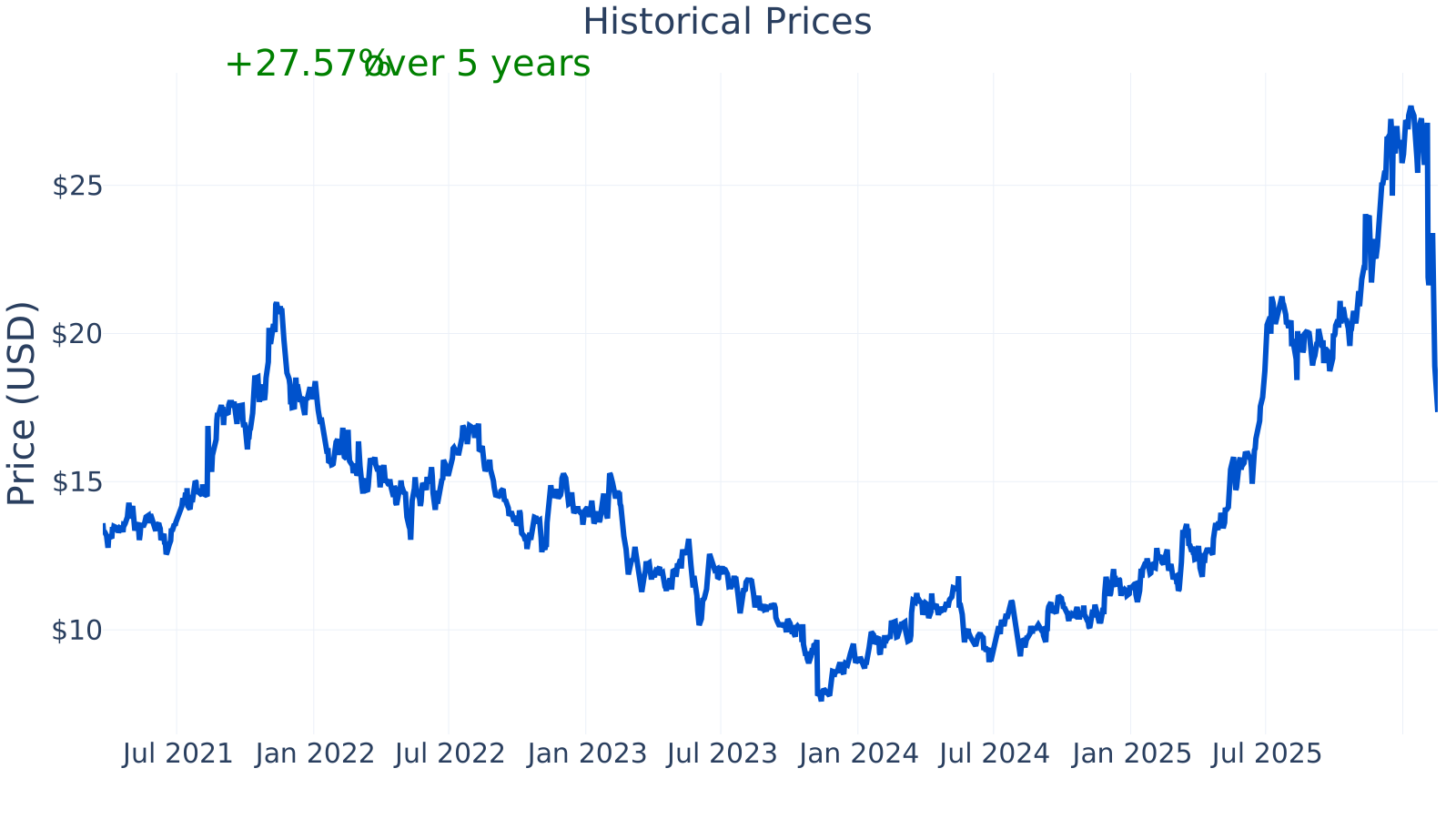
Magic Software’s market capitalization is about $853M and its beta of 0.75 indicates the share price has historically moved less than the broad market on average (though individual periods can differ). The company’s P/E ratio is ~21.2, compared with an industry median near 17.0. Profitability (profit margin) is about 6.6%, above the industry median near 4.8%. Recent year-over-year revenue growth is ~13.1%, also above the industry median near 7.0%. Leverage appears moderate with debt-to-equity ~34.7% versus an industry median near 60.4%. Trailing twelve-month free cash flow is about $64.3M, showing the business has been generating cash beyond operating needs and capital spending.
Growth (medium)
Magic Software operates in areas that are closely tied to long-running IT priorities: application modernization, integrating systems and data, moving to cloud infrastructure, and improving operational efficiency through software. These needs are driven by the steady shift of business processes toward digital workflows and the ongoing replacement of legacy systems. In that sense, the company participates in a broader industry with structural demand, even if quarterly results can fluctuate with customer budgets and project timing.
A key question for long-term growth is whether the company can consistently convert these broad trends into sustained expansion. Recent revenue growth has been uneven, with stronger periods followed by slower or negative periods, and then a return to growth later.
The year-over-year revenue growth pattern shows this variability: very strong growth in 2021, cooling through 2022, a contraction in parts of 2023 and early 2024, and then a recovery into positive growth by late 2024 and 2025 (reaching low-double-digit growth in the most recent points shown). This type of profile can be consistent with project-based IT services demand and shifting enterprise spending cycles.
Cash generation is another practical indicator of growth quality. Businesses that can grow while also producing cash may have more flexibility to invest, withstand downturns, or return capital to shareholders.
Free cash flow has been positive across the full period shown, peaking around 2024 and then pulling back in 2025. Even with the decline from the peak, the company is still producing substantial cash in absolute terms, which can support reinvestment and resilience if demand softens.
Potential growth catalysts are typically tied to improved enterprise IT spending, successful scaling of higher-value solution offerings, and effective execution across subsidiaries. Because parts of the business are service-oriented, maintaining utilization and controlling costs are also important drivers of profitable growth.
Risks (medium)
Magic Software faces a set of risks that are common for IT services and enterprise software-oriented companies. Customer demand can be sensitive to macroeconomic conditions, and large projects can be delayed, resized, or canceled. In services-heavy operations, profitability can depend on staffing levels, wage inflation, and the ability to keep teams utilized on billable work.
Competition is another central risk. The company competes with a wide range of firms, including global IT services providers, regional consulting companies, and software vendors that offer integration and modernization tools. Competitors can include large diversified IT services firms (with broader scale and deep client relationships) and specialized integration/platform providers (with strong product ecosystems). In many customer situations, Magic Software may compete on a combination of delivery capability, speed of implementation, domain expertise, and total cost.
Competitive advantages in this type of business are often about execution and relationships rather than a single defensible product. A diversified portfolio of services and solutions can help reduce reliance on any one customer or product line, but it can also make sustained differentiation more challenging versus larger or more specialized competitors.
Financial leverage and balance-sheet risk matter as well, particularly during slowdowns. Here, the company’s leverage looks moderate relative to peers.
Debt-to-equity has generally stayed below the industry median across the period shown, even though it rose from 2021 into 2023 and then eased back. The most recent level (about 34.7%) remains below the industry median (about 61.6%), suggesting comparatively lower balance-sheet leverage than many peers in the same broad industry grouping.
Profitability can also shift with utilization, pricing, and cost control.
Profit margin has been relatively stable in the mid-single digits, and it has often been above the industry median over the period shown. That said, the margin is not extremely high, which can be typical for services-influenced models and means operational discipline remains important.
Valuation
The P/E ratio has moved meaningfully over time. It was notably lower than the industry median for much of 2022–2024, but it increased in 2025 and, at the latest point shown, is above the industry median (company ~32.5 vs. industry median ~23.4 on that date). In the latest metrics snapshot, the company P/E is about 21.2 versus an industry median near 17.0, indicating a premium versus the median at that moment in time.
A higher P/E can be consistent with expectations of steadier earnings, higher growth, better balance-sheet positioning, or stronger margins versus peers. In Magic Software’s case, the company shows (1) revenue growth currently above the industry median, (2) profit margin above the industry median, and (3) lower debt-to-equity than the industry median—factors that can help explain why the multiple may not be at the low end of the peer range. At the same time, the company’s historical growth has been uneven, and free cash flow has fluctuated, which are important context points when interpreting a premium multiple.
Conclusion
Magic Software Enterprises is a profitable IT-focused business operating in long-duration areas of enterprise technology demand such as modernization, integration, and digital transformation services. Recent indicators show revenue growth above the industry median, profit margin above the industry median, and a comparatively moderate leverage profile. Cash generation has remained positive, although it has varied over time.
The main long-term uncertainties are tied to the competitive nature of IT services and enterprise solutions, the sensitivity of project-based demand to customer budget cycles, and the company’s ability to sustain growth and margins through changing conditions. Valuation, as reflected in P/E ratios, has increased at points and can sit above industry medians, which makes the growth and execution trajectory especially important to monitor over time.
Sources:
- SEC EDGAR — Magic Software Enterprises Ltd filings (Annual Reports / Form 20-F and other submitted reports, as available)
- Magic Software Enterprises Ltd Investor Relations — Annual reports and investor materials (company-hosted)
- Wikipedia — “Magic Software Enterprises” (basic company background)
This article is for informational purposes only and does not constitute financial advice. Some content is AI-generated. See Disclaimer


