Stock Analysis · Flutter Entertainment plc (FLUT)
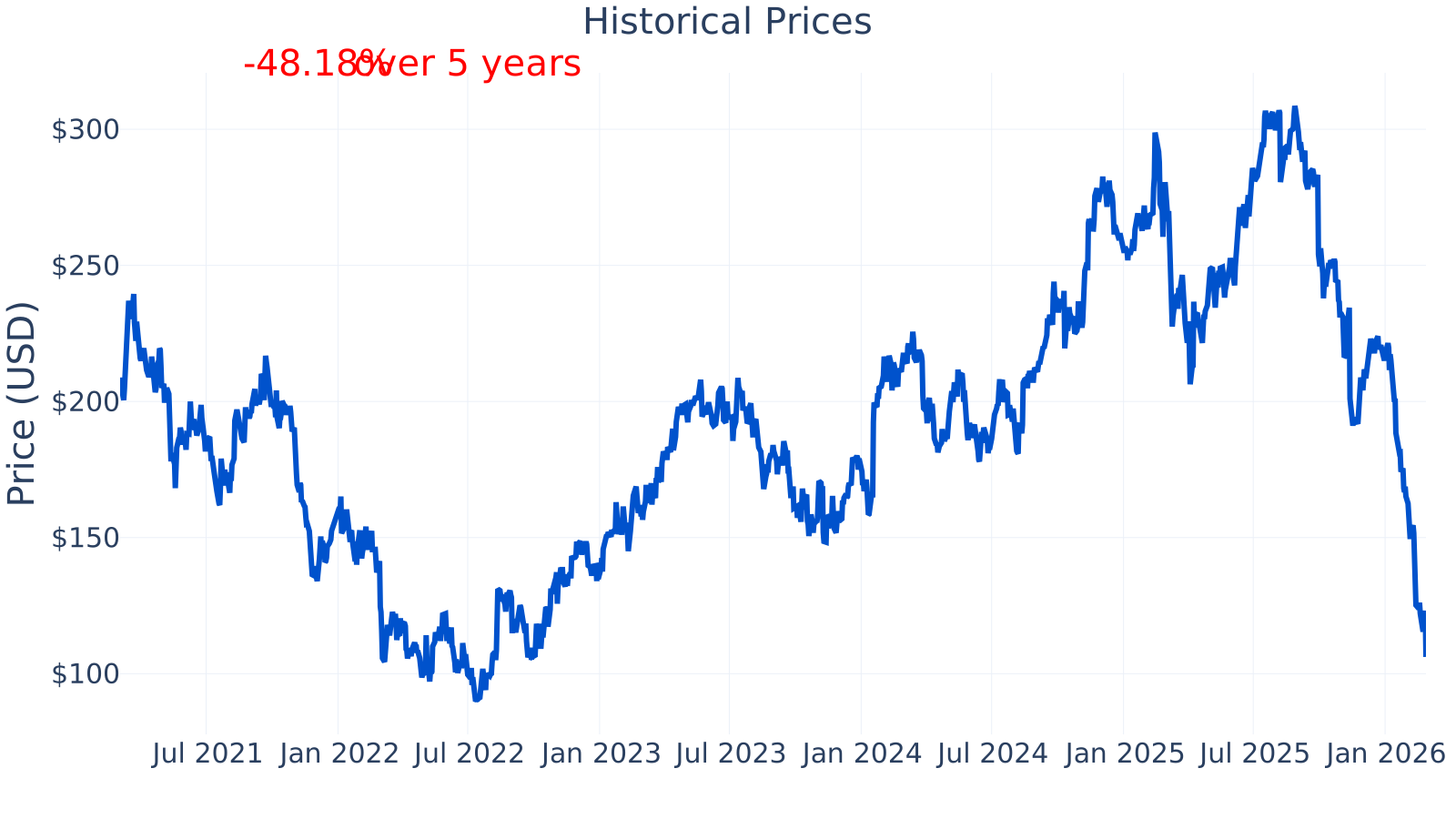
Overview
Flutter Entertainment plc is a global sports betting and online gaming company. It operates well-known consumer brands that let users place sports bets and play online casino-style games through mobile apps and websites. The group also has some retail (in-person) betting exposure in certain markets, but its long-term direction is centered on online channels, where customer activity and product development can scale more efficiently.
At a high level, Flutter’s business is built around (1) taking a small “take rate” on sports wagers (the portion retained after paying out winners) and (2) earning revenue from online gaming (for example, casino games), where outcomes are usually faster and customer engagement can be higher. The company’s filings typically describe revenue by product and by geography; exact revenue mix can shift year to year depending on sports calendars, customer behavior, regulation, and marketing intensity. Without relying on non-filing sources, a simplified view of the main revenue drivers is:
- Online sports betting (sportsbook revenue from betting activity)
- Online gaming / iGaming (casino-style games in regulated markets)
- Other and retail-related activity (where applicable, depending on the market)
The income profile shown below also highlights a key point for long-term readers: Flutter has been growing revenue meaningfully, while profitability has been more uneven over time due to operating costs, marketing, and financing expenses.
From 2021 to 2025, total revenue increases from about $8.3B to about $16.4B. Over the same period, operating income moves from negative territory (2021–2023) to positive (2024–2025), while net income remains volatile (including a positive year in 2024 followed by a loss in 2025). This pattern is consistent with a business that is scaling but still exposed to significant cost swings and non-operating items such as interest expense.
Key Figures
| Metric | Value | Industry ⓘ |
|---|---|---|
| Date | Mar 02, 2026 | |
| Context | ||
| Sector | Consumer Cyclical | |
| Industry | Gambling | |
| Market Cap ⓘ | $18.60B | |
| Beta ⓘ | 1.14 | |
| Fundamental | ||
| P/E Ratio ⓘ | N/A | 35.22 |
| Profit Margin ⓘ | -1.89% | 5.85% |
| Revenue Growth ⓘ | 24.90% | 17.80% |
| Debt to Equity ⓘ | 142.42% | 77.48% |
| PEG ⓘ | 0.08 | |
| Free Cash Flow ⓘ | $661.00M | |
Flutter’s market capitalization is about $18.6B and the stock’s beta of about 1.14 suggests it has tended to move somewhat more than the broader market. Recent profitability is thin: the latest profit margin is about -1.9% versus an industry median near +5.9%. On growth, the latest year-over-year revenue growth is about +24.9%, above the industry median near +17.8%. Balance-sheet leverage is notable: debt-to-equity is about 142% versus an industry median near 77%. Free cash flow over the trailing twelve months is about $661M, indicating the business has recently generated cash even while reported net income has been volatile.
Growth (medium)
Flutter operates in gambling with a heavy emphasis on online wagering and gaming. Structurally, online channels can benefit from mobile adoption, product innovation (better user experience, personalization, faster payments), and—in some jurisdictions—new regulation that moves activity from unregulated to regulated operators. This tends to favor scaled operators that can invest in technology, compliance, and responsible gaming controls.
Recent growth has been strong but uneven quarter to quarter:
After a decline in late 2023 (about -10.0% year over year), revenue growth turns positive and generally stays positive through 2024–2025, ending near +24.9% year over year. Relative to the industry median shown in the table, Flutter’s recent growth rate is higher, which can matter because scale is often important in customer acquisition and product development.
Cash generation is another practical lens for long-term business strength because it reflects the ability to fund operations, pay down debt, or reinvest without relying entirely on external financing:
Trailing free cash flow rises from roughly $548M (mid-2023) to about $801M (early 2024) and about $844M (early 2025), before the latest trailing figure of about $661M. Even with fluctuations, this indicates meaningful cash generation capacity, which can help support technology investment and market expansion—though it does not eliminate the impact of leverage and profitability swings discussed in the Risks section.
Potential long-term catalysts in this industry usually relate to regulatory change (new markets opening or expanding legal online betting/iGaming) and product execution (keeping apps competitive, improving retention, and optimizing marketing efficiency). These catalysts are real but inherently uncertain because they depend on governments, competitive behavior, and consumer demand.
Risks (high)
Flutter’s risk profile is meaningfully shaped by regulation, competition, and financial volatility. Gambling is highly regulated and rules can change by jurisdiction (tax rates, advertising restrictions, product permissions, licensing requirements). These changes can raise costs or limit growth even when customer demand is strong.
Leverage is another important risk factor because it can reduce flexibility during weaker periods:
Debt-to-equity trends upward over time, reaching about 142% by late 2025. That is higher than the industry median shown in the table (about 77%). Higher leverage can amplify outcomes: it can help fund expansion, but it also increases the importance of steady cash generation and can make earnings more sensitive to interest expense and downturns.
Profitability has also been inconsistent:
Profit margin improves from deeply negative levels in 2023–2024 to small positives in late 2024 and mid-2025, but turns negative again by late 2025 (about -2.0%). Compared with the industry median (about +2.9% at the latest point shown in the table), Flutter’s recent margin is lower. For a consumer-facing betting operator, margins can move with marketing intensity, promotional activity, product mix (sportsbook vs. iGaming), and changes in tax and compliance costs.
On competitive positioning, Flutter competes with other large global betting and gaming groups and also with strong regional operators in local markets. Competition is often fought on brand trust, app quality, odds/pricing, promotions, and breadth of content. A practical advantage for large operators is scale: bigger customer bases can support heavier investment in technology, risk management, and responsible gaming programs. However, scale does not eliminate the industry’s tendency toward aggressive marketing and price competition—especially in newer or rapidly growing regions.
Additional risks that long-term readers often consider in this sector include:
- Customer acquisition costs: promotional spending can rise quickly if competitors increase incentives.
- Execution risk: technology outages, product issues, or poor risk management can damage reputation and results.
- Responsible gaming and reputational risk: heightened scrutiny can lead to tighter regulation or penalties if standards are not met.
- Currency and geographic complexity: operating across many regions introduces FX exposure and compliance complexity.
Valuation
The most commonly cited simple valuation metric for stocks is the price-to-earnings (P/E) ratio, but it can be less informative when earnings are volatile or near zero. That limitation matters here because Flutter’s net income and profit margin have swung between profit and loss in recent years.
When the P/E ratio is available in the period shown, it varies widely (for example, readings around ~65 and ~138 appear in 2025). Wide swings often happen when earnings are unstable. For context, the industry median P/E in the latest table is about 35.2. A higher-than-median P/E can be consistent with higher expected growth, but it can also reflect temporarily depressed earnings (which mathematically inflates the ratio).
Given the combination of (1) relatively strong revenue growth, (2) inconsistent margins, and (3) higher leverage, valuation discussions tend to rely on multiple angles rather than a single ratio. The table’s PEG ratio of ~0.08 (a P/E adjusted for growth) mechanically looks low, but it should be interpreted carefully because it depends heavily on how “E” (earnings) and forward growth expectations are measured, and those inputs can be unstable when profitability is uneven.
Conclusion
Flutter Entertainment is a scaled global operator in online sports betting and online gaming, with revenue that has roughly doubled from 2021 to 2025 (about $8.3B to about $16.4B). Recent year-over-year revenue growth is higher than the industry median in the provided comparison, and the business has produced meaningful trailing free cash flow.
At the same time, the company’s fundamentals show a higher-risk mix for long-term analysis: profit margins have been volatile and recently negative, leverage is elevated (debt-to-equity around 142%), and valuation signals like P/E can swing widely due to unstable earnings. The long-term picture therefore depends heavily on whether Flutter can maintain growth while improving the consistency of profitability and managing regulatory and competitive pressures across its markets.
Sources:
- Flutter Entertainment plc — Annual Report (company filings)
- SEC EDGAR — Flutter Entertainment plc filings (registration statements and other submitted documents, as applicable)
- Flutter Entertainment plc — Investor Relations materials and press releases (company-hosted)
- Wikipedia — “Flutter Entertainment” (basic company background)
This article is for informational purposes only and does not constitute financial advice. Some content is AI-generated. See Disclaimer


