Stock Analysis · Seagate Technology PLC (STX)
Overview
Seagate Technology PLC (STX) designs and sells data storage products. In simple terms, it makes the devices that store large amounts of digital information for businesses and cloud providers (for example, the companies that run large data centers), as well as storage products used in some consumer and external storage use cases. Seagate’s core focus has historically been hard disk drives (HDDs), which are widely used when customers need very high capacity at a low cost per terabyte.
Seagate reports revenue primarily by product category, with most sales tied to mass-capacity storage used in data centers. Based on company reporting, the business is commonly described through these main revenue streams:
- Mass capacity storage (HDDs for cloud/data centers and enterprise applications) — typically the largest contributor
- Legacy / client-related storage (HDDs for PCs and other client devices) — generally smaller and more cyclical
- Systems, SSDs, and other (selected solid-state drives, storage systems, and related offerings) — usually the smallest portion
From a high-level financial view, Seagate’s results can swing meaningfully over time because storage demand (especially for HDDs) tends to move in cycles: periods of strong demand and pricing can be followed by inventory corrections and pricing pressure.
Across the periods shown, total revenue moved from about $11.7B (FY2022) down to about $7.4B (FY2023) before improving to about $9.1B (FY2025). Profitability followed the same pattern: operating income turned negative in FY2023 (about -$0.2B) and later rebounded strongly by FY2025 (about $1.8B). Interest expense stayed meaningful throughout (roughly $0.2B–$0.3B per year in the periods shown), which matters because it reduces the amount of profit left for shareholders.
Key Figures
| Metric | Value | Industry ⓘ |
|---|---|---|
| Date | Feb 07, 2026 | |
| Context | ||
| Sector | Technology | |
| Industry | Computer Hardware | |
| Market Cap ⓘ | $93.62B | |
| Beta ⓘ | 1.64 | |
| Fundamental | ||
| P/E Ratio ⓘ | 48.57 | 25.91 |
| Profit Margin ⓘ | 19.59% | 3.74% |
| Revenue Growth ⓘ | 21.50% | 21.50% |
| Debt to Equity ⓘ | 980.17% | 4.92% |
| PEG ⓘ | 0.90 | |
| Free Cash Flow ⓘ | $1.90B | |
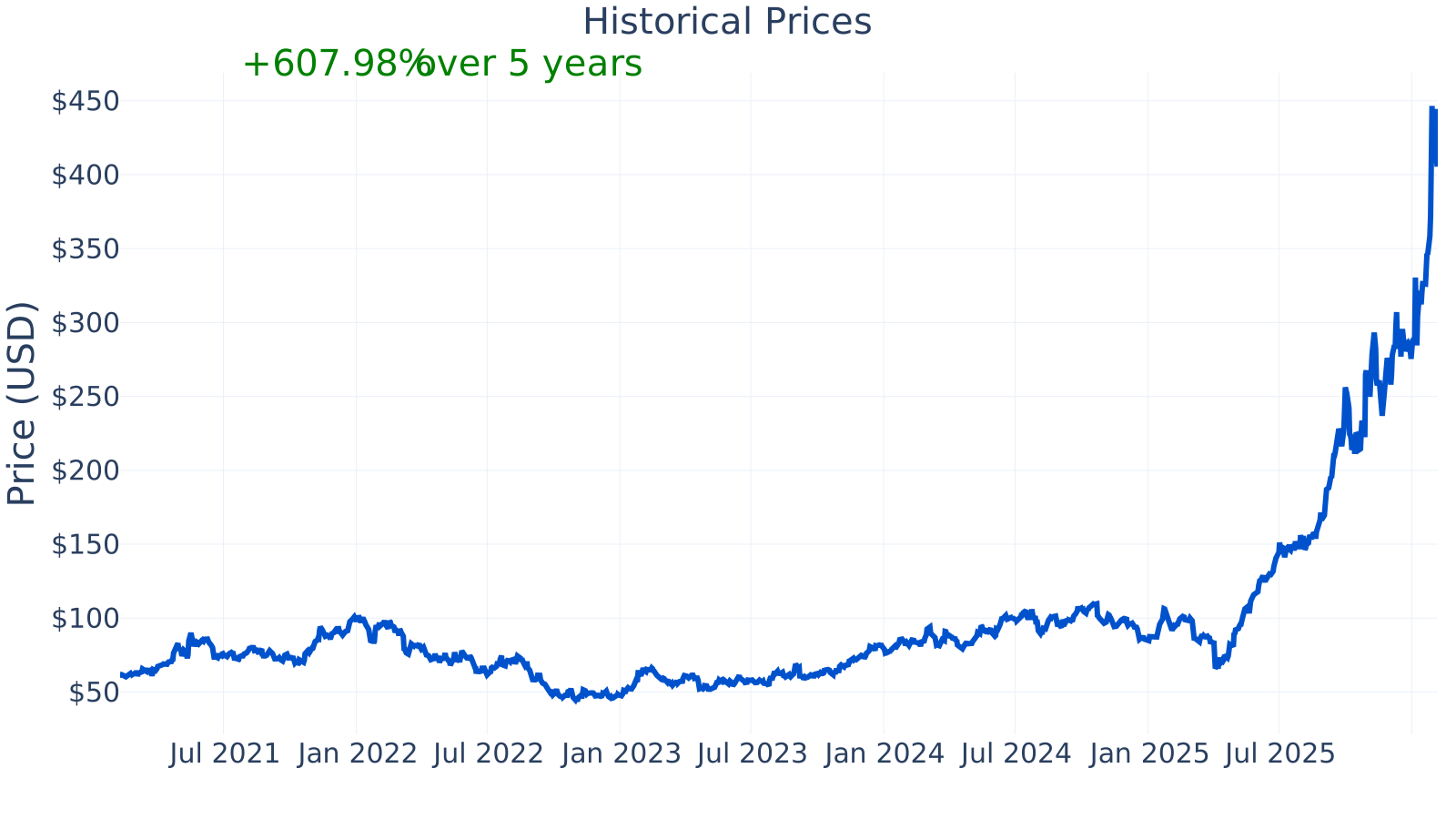
Seagate’s market capitalization is about $93.6B and the stock has a beta of ~1.64, which indicates it has tended to move more than the broader market (up and down). The latest P/E ratio is ~48.6 versus an industry median near 25.9, meaning the market price is relatively high compared to current earnings. The latest profit margin is ~19.6% (industry median ~3.7%), showing substantially stronger recent profitability than many peers. Year-over-year revenue growth is about 21.5%, in line with the industry median in this peer set. Debt-to-equity is shown as about 980% versus a much lower industry median (about 4.9%), signaling a capital structure that can look highly leveraged (and can also be affected by accounting equity levels). Trailing twelve-month free cash flow is about $1.90B.
Growth (Medium)
Seagate operates in the long-term growth trend of global data creation. As more digital services are used—cloud computing, streaming, enterprise software, cybersecurity logging, AI model training and storage—more data must be stored somewhere. A meaningful portion of that storage sits in large data centers where capacity and cost efficiency are critical, which is a traditional strength of HDD technology.
However, the storage hardware market is not a straight-line growth story. Demand can surge when cloud customers expand capacity and then drop when they work through excess inventory. Seagate’s strategy, as described in its public filings, emphasizes high-capacity drives and technology improvements aimed at increasing areal density (more data per disk) to keep lowering the cost per terabyte—an important buying criterion for large-scale customers.
The revenue trend shown reflects the cyclical nature of the business: deep declines through 2022–2023 (with year-over-year declines reaching roughly -39% at points) and then a strong rebound starting in 2024, rising to roughly +21% by the latest point shown. In this context, the key question for long-term growth is less about whether one quarter is up or down, and more about whether the company can sustain demand for high-capacity products through future data center buildouts.
Free cash flow (cash left after operating needs and capital spending) weakened during the downturn—from about $1.52B (TTM ending 2022-03-31) down to about $0.45B (TTM ending 2024-03-31)—and then improved to about $0.77B (TTM ending 2025-03-31). The latest snapshot in the table shows $1.90B TTM, suggesting a more recent step-up. For a hardware company with cyclicality, sustained free cash flow through the cycle is often a central indicator of resilience.
Risks (High)
This article is for informational purposes only and does not constitute financial advice. Some content is AI-generated. See Disclaimer