Stock Analysis · Adient PLC (ADNT)
Overview
Adient plc is an automotive supplier focused on vehicle seating. In practical terms, it designs and manufactures complete seats and key seat components used by global automakers. Seating is a high-volume, production-focused business: suppliers typically work closely with car manufacturers on engineering, then produce at scale near vehicle assembly plants to meet demanding cost, quality, and delivery requirements.
Based on the company’s segment reporting in its annual filings, Adient’s revenue is primarily generated from:
- Seating (core business) — the vast majority of total revenue (the company’s dominant segment)
- Other / smaller activities — depending on the year, this can include smaller operations and eliminations between segments (not typically the main driver)
In recent fiscal years, Adient’s total revenue has generally been in the mid-teens (in billions of dollars). Its cost structure is heavily tied to manufacturing and materials, so changes in production volumes, commodity costs, and labor efficiency can meaningfully affect profits.
The company’s revenue has stayed in a similar range over the period shown, but profitability has been much more volatile. Operating income and net income swing meaningfully from year to year, and interest expense remains a recurring cost—an important detail for a manufacturing business that uses debt financing.
Key Figures
| Metric | Value | Industry ⓘ |
|---|---|---|
| Date | May 04, 2026 | |
| Context | ||
| Sector | Consumer Cyclical | |
| Industry | Auto Parts | |
| Market Cap ⓘ | $1.67B | |
| Beta ⓘ | 1.48 | |
| Fundamental | ||
| P/E Ratio ⓘ | N/A | 24.76 |
| Profit Margin ⓘ | -2.06% | 3.56% |
| Revenue Growth ⓘ | 4.30% | 5.40% |
| Debt to Equity ⓘ | 137.81% | 76.35% |
| PEG ⓘ | 0.14 | |
| Free Cash Flow ⓘ | $175.00M | |
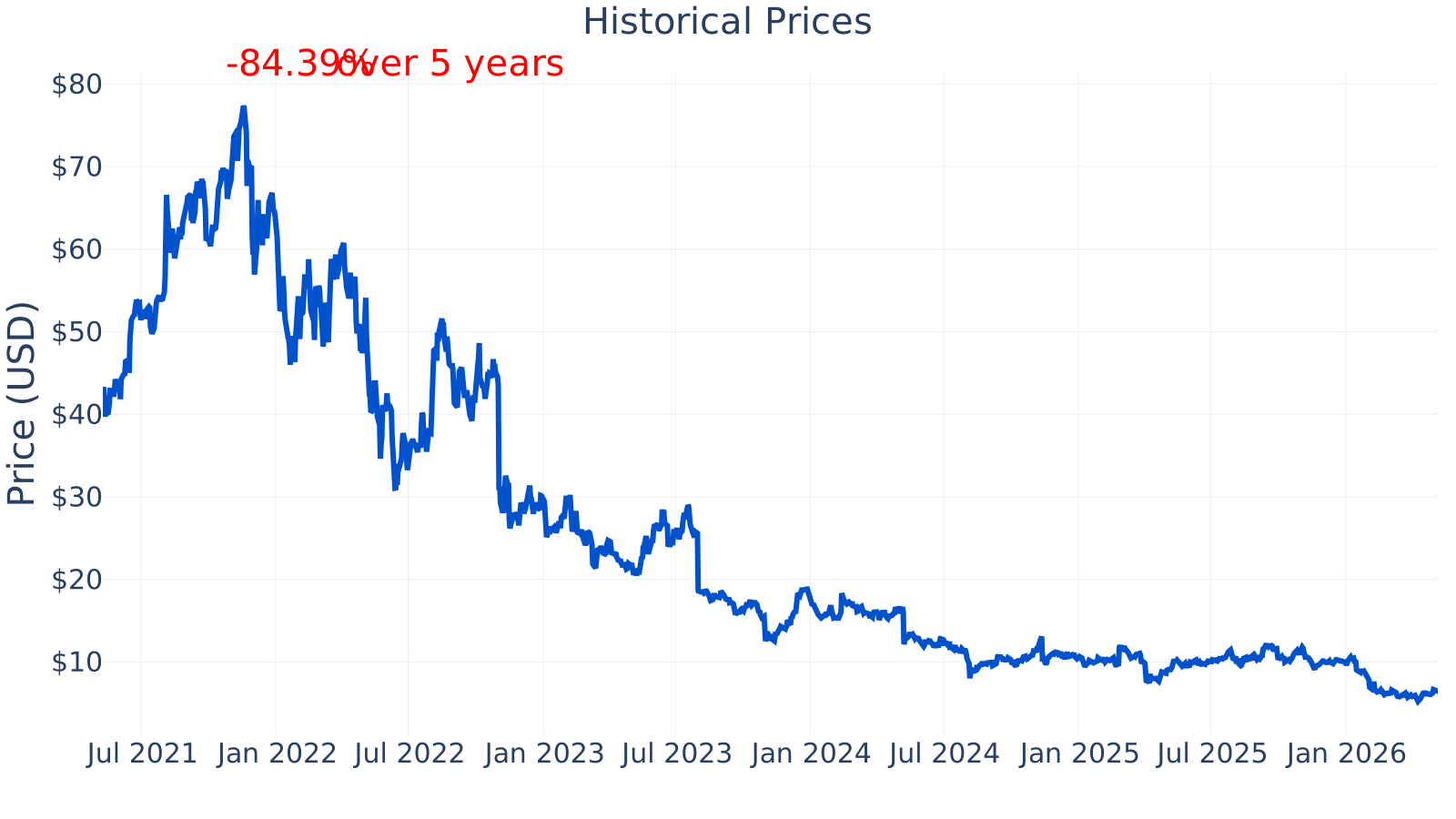
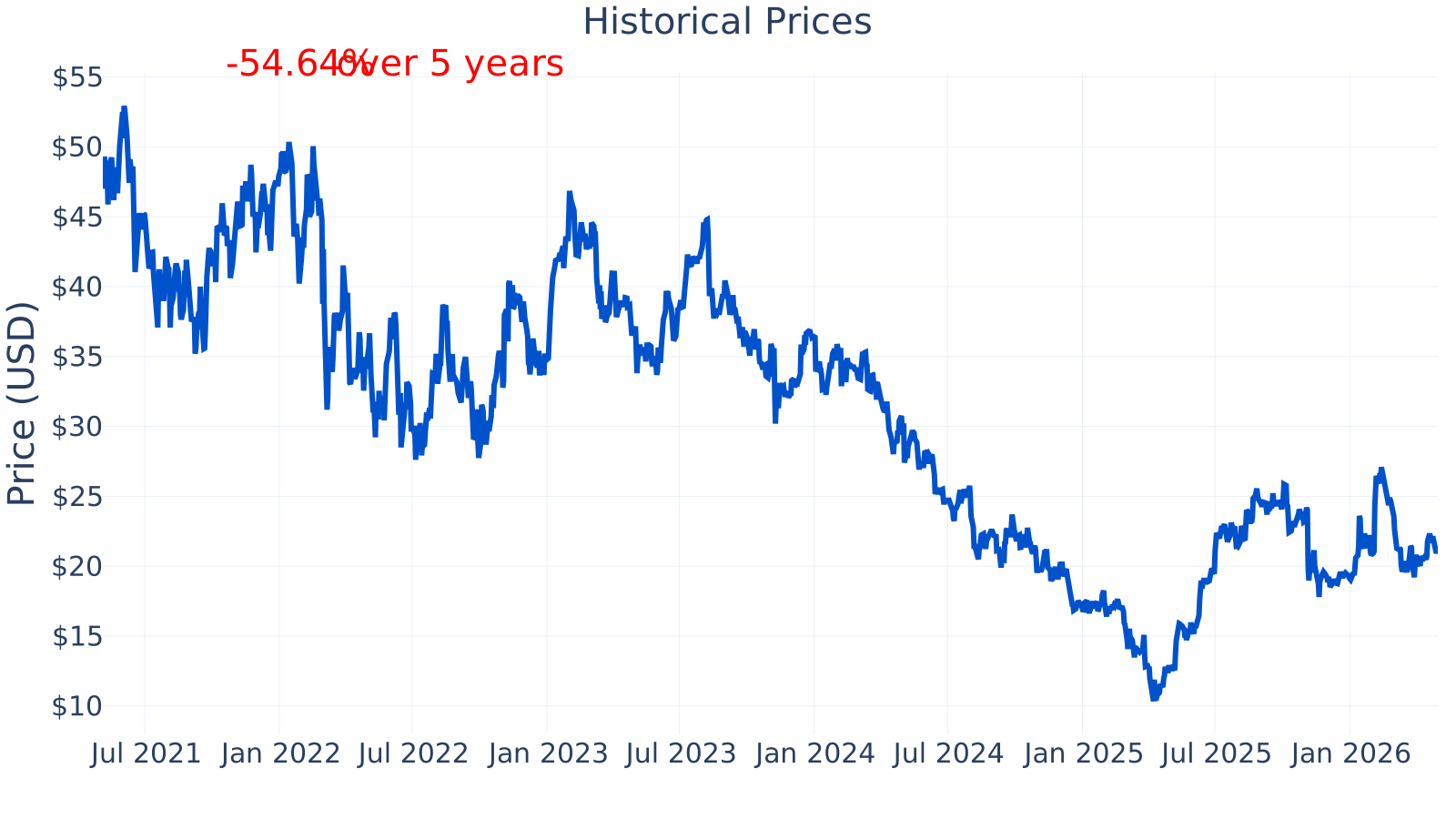
Adient’s equity value is about $1.67B, which places it in the small-to-mid-cap range. The stock’s beta (~1.48) suggests it has historically moved more than the overall market (both up and down). Profitability is currently a key weak point: the latest profit margin is about -2.06% versus an industry median near +3.57%. Revenue growth is positive at roughly +4.3% year over year, slightly below the industry median of about +5.4%. Balance-sheet leverage is elevated: debt-to-equity is about 138% compared with an industry median near 76%. Free cash flow over the last twelve months is positive at about $175M, which matters because cash generation can support debt repayment and reinvestment.
Growth (Medium)
Adient operates in the auto parts industry, which is mature and closely linked to global vehicle production cycles. Over the long term, demand is influenced by factors like consumer vehicle purchases, automaker production schedules, and the mix of vehicles being built. Seating is a required component in every vehicle, so the business is tied to overall build volumes rather than being a niche “optional” feature.
Strategically, a seating supplier’s growth typically comes from winning new vehicle programs, expanding content per vehicle (more features or higher-value seat systems), improving plant performance, and managing costs and materials efficiently. Because automakers prioritize reliable delivery and cost discipline, execution tends to matter as much as (or more than) headline market growth.
The year-over-year revenue growth rate has been uneven. After periods of stronger growth earlier in the timeline, the most recent readings show a return to modest positive growth (ending around +4.26%), following several quarters that were negative. This pattern fits an industry exposed to production variability and pricing/mix changes.
Free cash flow has improved compared with earlier periods: it moved from negative territory (about -$115M in 2022) to positive levels in subsequent years, reaching about $360M (2024), then moderating to around $235M (2025) and about $175M most recently. For long-term fundamentals, sustained positive free cash flow can be a meaningful support—especially in a capital-intensive manufacturing business.
Risks (High)
Adient’s risk profile is largely driven by three factors: (1) cyclical end-demand (global auto production), (2) tight operating margins typical of large-scale auto supply manufacturing, and (3) leverage (debt levels relative to equity). When production volumes weaken or costs rise faster than pricing adjustments, profitability can compress quickly.
Debt-to-equity has trended down from very high levels earlier in the period but remains elevated. The latest value is about 138%, above the industry median near 76%. Higher leverage can amplify outcomes: it can help returns in strong periods, but it also increases sensitivity to downturns through interest costs and refinancing needs.
Profit margins have deteriorated versus earlier periods. The latest profit margin is about -2.06%, while the industry median is about +3.40%. This gap suggests Adient has recently been operating with weaker bottom-line efficiency than a typical peer, which can stem from program economics, plant performance, pricing vs. cost inflation timing, restructuring, or other non-recurring items (details typically discussed in annual/quarterly filings).
Competitive dynamics are another important consideration. Seating is a specialized segment, but it is still highly competitive with large global suppliers. Major competitors in automotive seating commonly include:
- Lear Corporation
- Forvia (including seating activities through its interior businesses)
- Magna International (broader supplier with interior/seating-related activities)
Adient’s competitive position is shaped by scale, global manufacturing footprint, engineering capabilities, and long-running relationships with automakers. However, automakers typically maintain strong negotiating power over suppliers, and contracts/program awards can shift over time based on cost, quality, and execution. This limits “moat-like” pricing power and helps explain why consistent margins are difficult across the cycle.
Valuation
The price-to-earnings (P/E) picture is not stable over time. The chart shows periods where the P/E is in the teens or lower (for example, mid-teens around parts of 2024), but also spikes to very high levels in some quarters. These spikes typically happen when earnings become very small or volatile, making the P/E ratio less informative. In addition, some dates show the P/E as blank/zero on the chart due to non-meaningful values (for example, negative earnings).
Compared with the industry median P/E (often in the high teens to around 20 in the period shown), Adient sometimes trades below and sometimes above—driven largely by swings in earnings rather than steady changes in the share price alone. In this context, valuation discussions usually need to be paired with operating fundamentals such as margins, cash generation, and leverage, because a single snapshot P/E can be misleading when profitability is unstable.
Conclusion
Adient is a global, scaled manufacturer in a necessary auto component category (seating), with revenue that has been relatively steady in the mid-teens (billions of dollars) over recent years. The company’s recent financial profile, however, shows a mix of signals: modest positive revenue growth and positive free cash flow on one hand, but negative profit margins and higher-than-median leverage on the other.
For a long-term view, the central questions tend to revolve around whether profitability can normalize toward (or above) peer levels through improved execution and cost management, and whether cash flow remains durable enough to support investment needs while managing debt. The combination of cyclical end-demand, competitive pricing pressure, and leverage makes results more sensitive to operational setbacks than in less cyclical industries.
Sources:
- SEC EDGAR — Adient plc Form 10-K (Annual Report)
- SEC EDGAR — Adient plc Form 10-Q (Quarterly Reports)
- Adient plc — Investor Relations materials (company-hosted filings and presentations)
- Wikipedia — “Adient” (basic company background)
This article is for informational purposes only and does not constitute financial advice. Some content is AI-generated. See Disclaimer