Stock Analysis · Smurfit WestRock plc (SW)
Overview
Smurfit WestRock plc (SW) is a packaging company focused on paper-based materials and finished packaging products. In simple terms, it makes the boxes and packaging used to ship, protect, and display many everyday products—especially in retail and e-commerce supply chains. Its operations typically include producing containerboard (paper used to make corrugated boxes), converting that paper into corrugated packaging, and offering other paper-based packaging formats and related services.
Because packaging is used across many end markets (food and beverage, consumer goods, industrial products, and online shopping), demand is usually linked to broad economic activity and shipping volumes. This also means results can be cyclical: when manufacturing and consumption slow down, packaging volumes and pricing can soften; when activity rebounds, they often improve.
Public filings are the right place to find a precise revenue breakdown by business line and geography (for example, how much comes from corrugated packaging vs. other formats). A ranked, percentage-based split is not included here because it should be taken directly from the company’s most recent annual report/10-K segment note to avoid guesswork.
Across the years shown, revenue rises significantly (from about $10.5B in 2021 to about $31.2B in 2025), while interest expense also increases materially by 2024–2025. That combination can happen after major corporate actions and/or a higher debt load, and it helps explain why net income does not rise in a straight line even as the top line expands.
Key Figures
| Metric | Value | Industry ⓘ |
|---|---|---|
| Date | May 04, 2026 | |
| Context | ||
| Sector | Consumer Cyclical | |
| Industry | Packaging & Containers | |
| Market Cap ⓘ | $20.65B | |
| Beta ⓘ | 1.05 | |
| Fundamental | ||
| P/E Ratio ⓘ | 54.76 | 17.20 |
| Profit Margin ⓘ | 1.22% | 5.65% |
| Revenue Growth ⓘ | 0.70% | 1.40% |
| Debt to Equity ⓘ | 5.43% | 112.14% |
| PEG ⓘ | 0.26 | |
| Free Cash Flow ⓘ | $1.02B | |
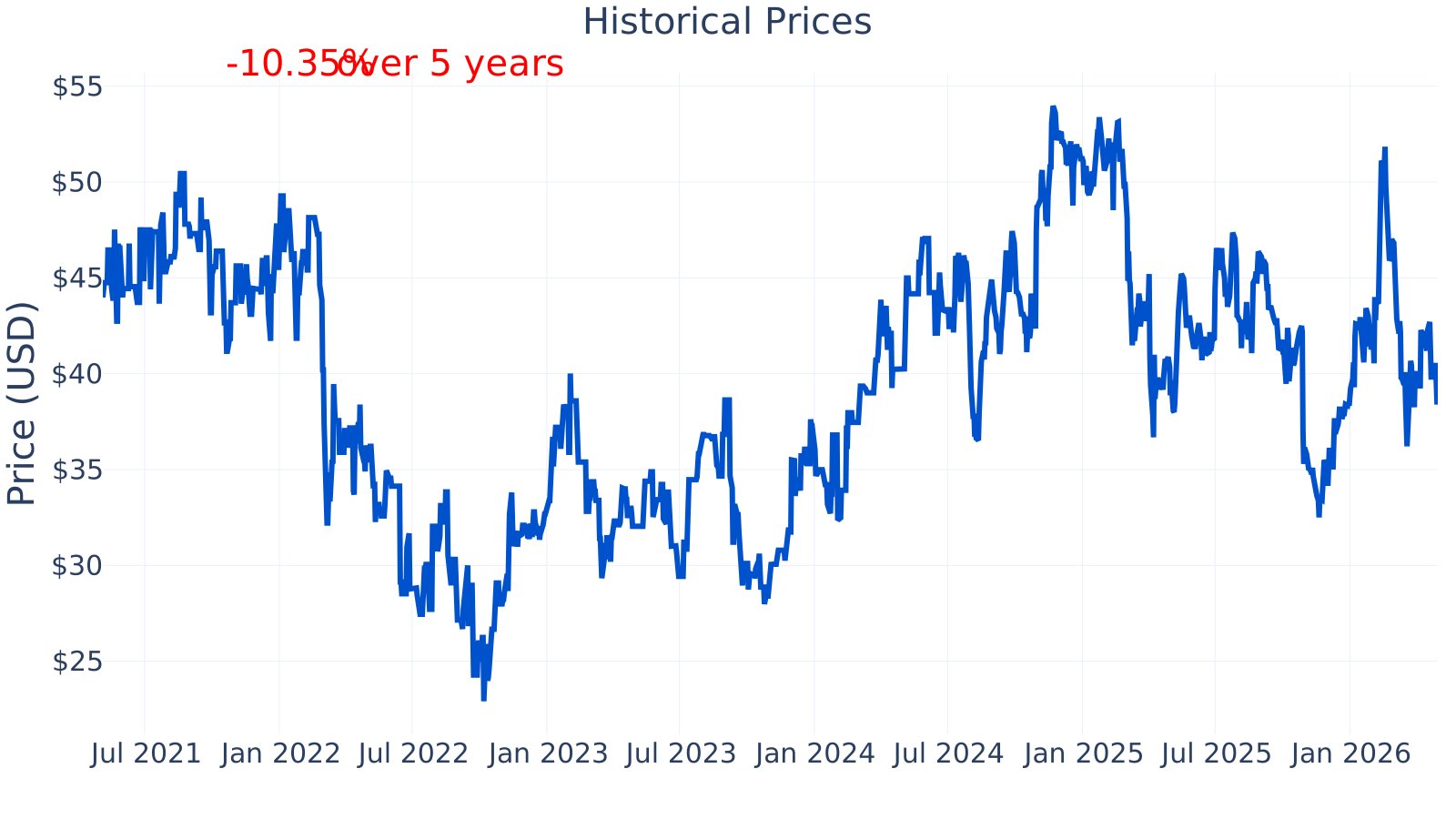
Smurfit WestRock’s market capitalization is about $20.7B. The stock’s beta is about 1.05, which is close to the broader market (meaning day-to-day moves have historically been roughly market-like, not extremely defensive or extremely volatile).
Profit margin is about 1.2%, which is well below the industry median shown (about 5.7%). This low margin level matters because packaging can be a high-volume, price-competitive business where small cost changes (energy, labor, freight, and raw materials) can have a big impact on the bottom line.
Year-over-year revenue growth is about 0.7% versus an industry median of about 1.4%, suggesting recent growth has been modest at the moment the metric was captured. Debt-to-equity is about 5.4% versus an industry median above 100% (about 112%), which—if comparable on the same accounting basis—would indicate a relatively low leverage position. However, debt-to-equity can move sharply based on equity levels, merger accounting, and timing, so it is best interpreted alongside the balance sheet in filings.
The P/E ratio shown is about 54.8 versus an industry median of about 17.2. A high P/E can reflect high expected future earnings growth, temporarily depressed earnings, or one-time items that reduce current earnings.
Growth (Medium)
Paper-based packaging participates in long-running trends such as e-commerce shipping, brand presentation in retail, and substitution away from certain plastic packaging formats. At the same time, it remains a mature, competitive industry where growth is often driven by a mix of (1) overall shipment volumes, (2) pricing cycles for containerboard and corrugated products, and (3) company-specific efficiency gains.
For Smurfit WestRock, a key growth question is whether its scale and operating footprint can translate into steadier volumes, better plant utilization, and cost advantages over time. In packaging, durable improvement often comes from operational execution: running mills and box plants efficiently, controlling input costs, and optimizing logistics.
The year-over-year revenue growth line is volatile: it is strongly positive in some quarters (including very large spikes) and near-flat more recently (about 0.7% most recently). Large spikes often occur around major structural changes (for example, combinations of businesses) and can fade as comparisons normalize.
Trailing free cash flow also swings widely: it declines from about $799M (2022) to about $145M (2024), turns slightly negative around 2025 (about -$57M), and then rebounds strongly to about $1.02B (2026). For a capital-intensive manufacturer, this pattern can reflect a combination of earnings changes, working-capital timing (inventory/receivables), and periods of heavier capital spending. Over the long run, consistency of free cash flow is often a key indicator of business quality in packaging.
Risks (High)
Packaging is cyclical. Demand can weaken when consumer spending slows, industrial production declines, or inventories are drawn down. In addition, pricing for containerboard and corrugated products can move in cycles; when industry capacity is high relative to demand, price pressure can compress profitability.
Input costs are another major risk. Energy, labor, transportation, and raw materials can shift quickly, and contracts do not always allow immediate pass-through. Environmental and forestry-related regulation can also affect costs and operational flexibility, depending on geography and sourcing.
Debt-to-equity trends show the company generally below the industry median for much of the period shown (often around the 60%–110% range earlier), with a sharp drop to about 5% most recently. A sudden move like that can be driven by balance-sheet changes (including equity changes) and is worth reconciling with the company’s latest balance sheet, net debt, and interest expense disclosures rather than relying on a single ratio.
Profit margin has fallen meaningfully over time—from roughly 7%–9% in 2022–2023 to around 1%–2% through much of 2024–2026, and it is below the industry median in the most recent periods shown. This highlights a core risk: when margins get thin, small operational setbacks or pricing pressure can have an outsized impact on net income.
Competitive positioning in packaging often depends on scale, mill integration (owning paper production that supplies box plants), customer relationships, service reliability, and cost efficiency. Large players can have advantages in procurement, logistics, and the ability to serve national or multinational customers consistently. Even so, switching costs can be moderate in some packaging categories, and competition tends to remain intense.
Main competitors in Packaging & Containers commonly include other large, integrated paper and packaging producers and regional corrugated box manufacturers. Relative positioning is best assessed using the company’s own filings (segment results, capacity, major customer concentration, and geographic footprint) because “leadership” can differ by region and product type.
Valuation
The current P/E ratio shown (about 54.8) is notably above the industry median (about 17.2), and the company’s P/E has risen sharply compared with much of 2022–2024 when it was often in the low teens. When a P/E increases this much, it often means one (or both) of the following is true: the stock price rose faster than earnings, and/or earnings fell (making the “E” smaller) due to weaker margins, higher costs, higher interest expense, or one-time items.
Given the recent profit margin level (about 1.2%), valuation multiples that rely on earnings can be harder to interpret without adjusting for unusual items and without judging whether margins are temporarily depressed or structurally lower. For a company like this, readers often look at several angles in filings and presentations—profitability normalization, free cash flow generation across a cycle, and debt/interest burden—to understand whether the market’s valuation is consistent with longer-run earning power.
Conclusion
Smurfit WestRock operates in a large, essential, and economically sensitive industry: paper-based packaging. The business benefits from long-term demand for shipping and product protection, but it also faces meaningful cyclicality and cost/price swings that can compress profitability.
The figures shown highlight three important realities: revenue has expanded substantially over several years, profit margins have recently been low versus peers, and free cash flow has been volatile but most recently strong. At the same time, the P/E ratio is high relative to the industry median, which can happen when earnings are temporarily depressed or when the market is pricing in a material improvement in future profitability.
From a long-term, fundamentals-first perspective, the key items to monitor in upcoming filings are whether margins recover toward more typical levels for the business, whether free cash flow stays consistently positive through the cycle, and whether interest expense and overall leverage remain manageable relative to operating income and cash generation.
Sources:
- SEC EDGAR — Smurfit WestRock plc filings (Annual Report/10-K, Quarterly Reports/10-Q, Current Reports/8-K)
- Smurfit WestRock plc — Investor Relations materials (annual report, filings, and company-hosted presentations)
- Wikipedia — “Smurfit WestRock” (basic company background and history)
This article is for informational purposes only and does not constitute financial advice. Some content is AI-generated. See Disclaimer


