Stock Analysis · Brightstar Lottery PLC (BRSL)
Overview
Brightstar Lottery PLC (BRSL) operates in the Gambling industry within the Consumer Cyclical sector. In simple terms, it is a lottery-focused gaming business that generates revenue from lottery-related operations and associated gaming activities.
From a “big picture” perspective, Brightstar’s recent financial profile looks like a business with steady total revenue in the last few years (around $2.5B annually from 2023–2025), but with meaningful movement underneath the surface in costs, operating expenses, and bottom-line profitability.
Based on the available information here, a detailed revenue mix (business lines with percentages) is not provided, so it cannot be broken down reliably into “largest to smallest” categories without using additional disclosures.
Across 2021–2025, total revenue decreased from about $4.1B (2021) to around $2.5B (2023–2025), while operating income remained positive each year shown. Interest expense stayed significant (roughly $203M–$355M per year in the periods displayed), which matters when thinking about the company’s use of debt and sensitivity to interest rates.
Key Figures
| Metric | Value | Industry ⓘ |
|---|---|---|
| Date | Mar 09, 2026 | |
| Context | ||
| Sector | Consumer Cyclical | |
| Industry | Gambling | |
| Market Cap ⓘ | $2.48B | |
| Beta ⓘ | 1.08 | |
| Fundamental | ||
| P/E Ratio ⓘ | 157.27 | 42.41 |
| Profit Margin ⓘ | 5.85% | 5.85% |
| Revenue Growth ⓘ | 2.60% | 17.80% |
| Debt to Equity ⓘ | 485.71% | 227.00% |
| PEG ⓘ | N/A | |
| Free Cash Flow ⓘ | -$455.95M | |
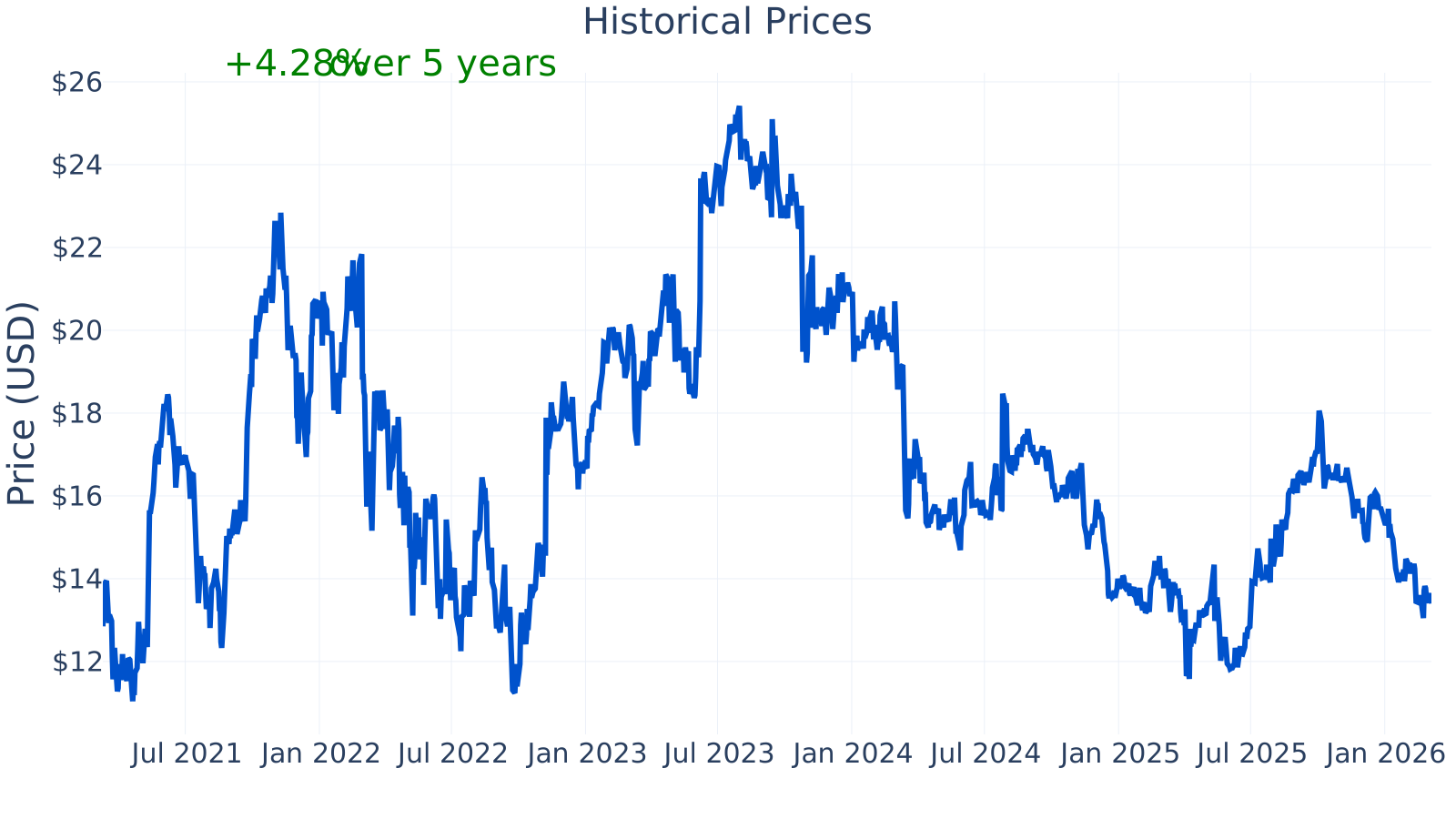
Brightstar’s market capitalization is about $2.48B, placing it in the mid-cap range. The stock’s beta of ~1.08 suggests price movements that have been roughly in line with (slightly more volatile than) the overall market.
On profitability, the latest profit margin is ~5.85%, which matches the industry median shown (also ~5.85%). On growth, the latest year-over-year revenue growth is ~2.6%, which is far below the industry median shown (~17.8%), indicating Brightstar’s recent top-line growth has been comparatively modest.
On financial leverage, the latest debt-to-equity is ~486% versus an industry median of about 227%, signaling higher-than-typical balance sheet leverage relative to peers in the same comparison group.
Growth (Medium)
The lottery and gaming space can benefit from long-run demand tied to entertainment spending, digital distribution, and product innovation. That said, it is also a heavily regulated area, and growth can depend on licensing outcomes, regulatory frameworks, and the competitive landscape.
Recent revenue growth has been uneven: the year-over-year revenue change moved from negative readings in late 2024 and early 2025 (about -4.3% and -11.8%) to positive territory later in 2025 (peaking around +7.3% in Q3 2025), and ending 2025 at roughly +2.5%. This pattern points to stabilization rather than consistently strong expansion.
Free cash flow is an important long-term signal because it reflects cash left after operating costs and necessary investments. Here, free cash flow (TTM) is shown as negative (~-$456M) in the latest metrics table, while the time-series chart shows positive readings around $945M–$969M in late 2024 to early 2025. This mismatch suggests free cash flow may be volatile, may depend on timing effects, or may differ by calculation/period definitions. For long-term analysis, this is typically something to reconcile directly against the company’s filings (cash flow statement details, working-capital swings, and capital expenditures).
In terms of potential catalysts, the most common “drivers” in lottery-style businesses tend to be (1) winning or renewing contracts/licenses, (2) expanding distribution (including digital channels), and (3) improving product mix and operating efficiency. Confirming whether these are actively occurring for Brightstar requires direct reference to its official filings and investor materials.
Risks (High)
Brightstar’s risk profile is strongly influenced by financial leverage and the cost of servicing debt, alongside the usual gaming-industry factors (regulation, licensing, and reputation considerations).
The company’s debt-to-equity ratio has been consistently elevated and generally above the industry median across the periods shown, ending at roughly 486% (vs. industry median ~306% at the same date). Higher leverage can amplify outcomes: it may help returns in strong periods, but it also tends to increase sensitivity to downturns, refinancing conditions, and interest rate changes.
Profit margin has fluctuated notably over time, ranging from about 4.8% (Q3 2024) up to roughly 13.9% (Q4 2024), ending 2025 at about 5.9%. Across much of 2025, Brightstar’s margins appear above the industry median shown on the chart, but the variability suggests profitability can change meaningfully from period to period.
On competitive position, the gambling/lottery ecosystem typically includes other lottery operators, gaming service providers, and broader gambling companies. Without using non-permitted sources, naming a definitive competitor set and ranking Brightstar’s market position would require confirmation from the company’s filings (which often describe “competition” and key peers). In general, competitive advantages in this space often come from long-standing licensing relationships, scale, technology platforms, and distribution networks—but whether Brightstar is a clear leader cannot be concluded here without those disclosures.
Additional key risks often associated with lottery and gaming operators include:
- Regulatory and licensing risk: changes in rules, tax rates, or license outcomes can materially affect results.
- Contract concentration risk: dependence on a limited number of major contracts (if applicable) can increase volatility when renewals occur.
- Reputation and compliance risk: operational or compliance failures can lead to penalties or loss of trust with regulators and partners.
- Consumer spending cyclicality: as a consumer-cyclical area, demand can weaken in economic slowdowns.
Valuation
Valuation is often discussed using the price-to-earnings (P/E) ratio, which compares the stock price to company earnings. In the latest metrics table, Brightstar’s P/E is shown at about 157x, well above the industry median of roughly 42x. All else equal, a higher P/E typically implies the market is pricing in higher future growth, higher future profitability, or lower perceived risk.
However, the P/E time series shown on the chart is much lower in the more recent historical points (roughly 9x–28x over the plotted dates). Differences like this can happen due to timing (different periods), shifts in earnings (including one-time items), or different methodologies. Practically, it means the valuation picture is not straightforward and should be cross-checked against the earnings figure being used (e.g., trailing twelve months vs. a single fiscal year, and whether earnings include unusual items).
Given (1) relatively modest recent revenue growth compared with the industry median, (2) a high leverage profile, and (3) somewhat variable margins, valuation multiples that are materially above peers would generally require a clear explanation in the company’s filings (for example, durable contract advantages, unusually stable cash generation, or a well-supported growth plan).
Conclusion
Brightstar Lottery PLC shows a mixed long-term profile based on the information available here. The company operates in a regulated consumer gaming segment, has maintained positive profitability in the periods shown, and has had periods where margins compared favorably to the industry median.
At the same time, several factors raise the importance of careful due diligence for a long-term view: revenue has been broadly flat around ~$2.5B in recent years after a much higher 2021 level, year-over-year revenue growth has been comparatively modest, leverage appears higher than the industry median, and the valuation picture (especially P/E) is inconsistent across snapshots and time-series points.
Putting these pieces together, the core questions that typically determine how this company is assessed over the long run are whether it can (1) sustain and expand revenue through contract wins/renewals and distribution, (2) keep margins resilient, and (3) manage debt levels and interest costs through the cycle.
Sources:
- U.S. Securities and Exchange Commission — EDGAR database (Registrant filings for Brightstar Lottery PLC)
- Brightstar Lottery PLC — Investor Relations materials (annual reports, SEC filings, and press releases, where applicable)
- Wikipedia — “Brightstar Lottery PLC” (basic company background; to be validated against filings)
This article is for informational purposes only and does not constitute financial advice. Some content is AI-generated. See Disclaimer


