Stock Analysis · Sensata Technologies Holding NV (ST)
Overview
Sensata Technologies Holding NV designs and manufactures sensors and other device-level components that help machines measure, protect, and control how they operate. In simple terms, its products help vehicles and industrial equipment “sense” conditions like pressure, temperature, position, or electrical current, and then use that information to improve safety, efficiency, and reliability.
Based on the company’s public filings, Sensata is organized around two main areas that reflect where most revenue comes from: solutions tied to transportation (especially automotive) and solutions tied to industrial uses. The company generally sells to large original equipment manufacturers (OEMs) and their suppliers, so results are influenced by production volumes in end markets like cars, trucks, heavy equipment, and factory systems.
Main revenue streams (largest to smallest; exact percentages vary by year and are reported in filings by segment):
- Performance Sensing (Transportation-focused): sensors and related solutions widely used in automotive and other mobility applications.
- Sensing Solutions (Industrial & selected electrification uses): sensing and protection products used across industrial equipment and other non-auto applications.
Business snapshot from the income statement trend (recent years): revenue has been around the ~$3.7B–$4.1B range, while profitability has been more uneven. For example, operating income was materially higher in 2021–2022 than in 2023–2025, and interest expense has remained a meaningful recurring cost.
From 2021 to 2025, total revenue in the chart moves from about $3.81B to $3.70B, while operating income declines significantly versus 2021–2022 levels. Net income is also more volatile over this period (including a small loss in 2023), which highlights that the company’s earnings can shift notably even when revenue is relatively stable.
Key Figures
| Metric | Value | Industry ⓘ |
|---|---|---|
| Date | Feb 23, 2026 | |
| Context | ||
| Sector | Technology | |
| Industry | Scientific & Technical Instruments | |
| Market Cap ⓘ | $5.59B | |
| Beta ⓘ | 1.15 | |
| Fundamental | ||
| P/E Ratio ⓘ | N/A | 38.42 |
| Profit Margin ⓘ | 0.85% | 12.96% |
| Revenue Growth ⓘ | 1.10% | 7.45% |
| Debt to Equity ⓘ | 0.76% | 23.85% |
| PEG ⓘ | 0.39 | |
| Free Cash Flow ⓘ | $490.30M | |
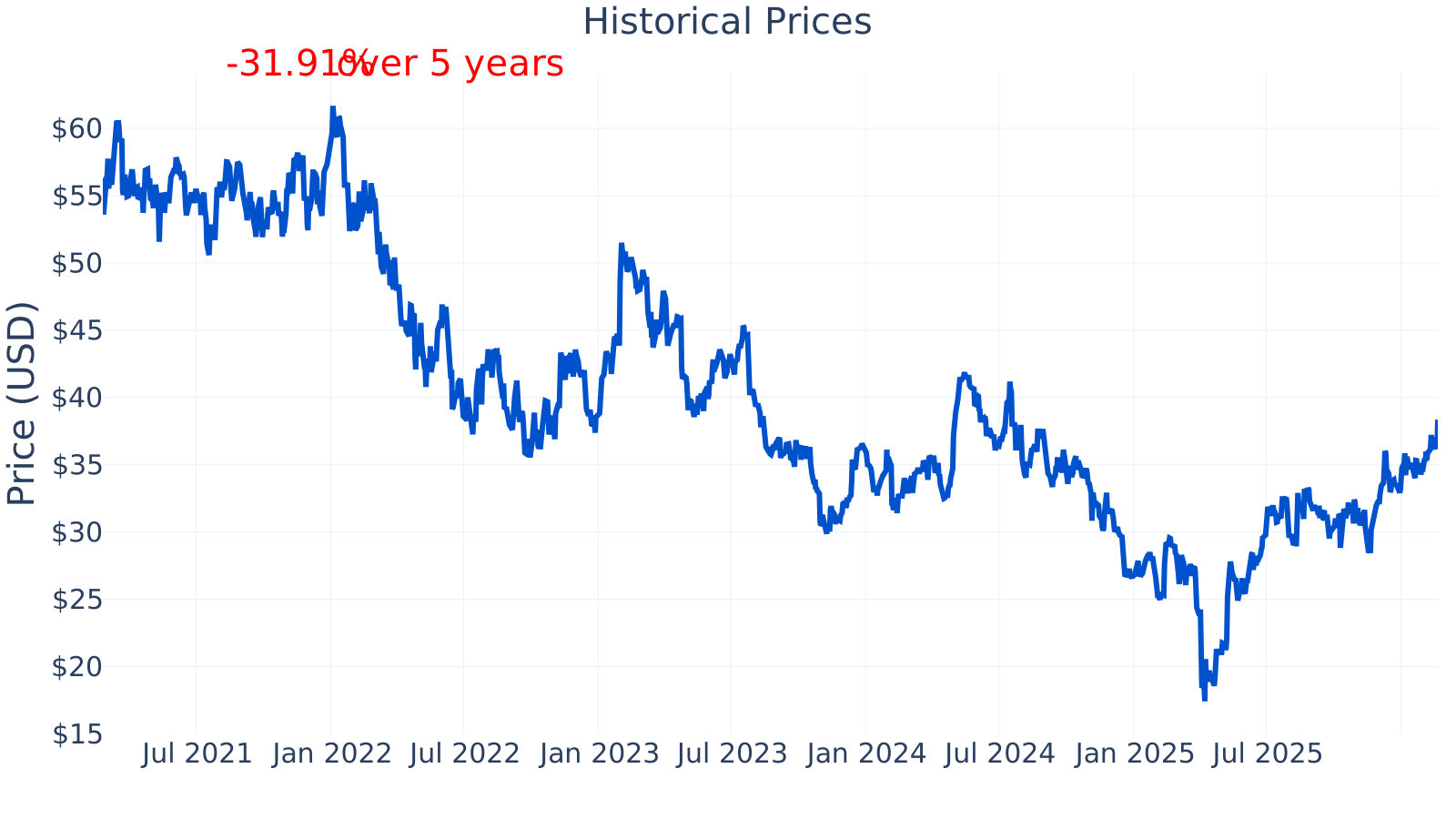
Sensata’s market capitalization is about $5.6B, and the stock’s beta (~1.15) suggests it has tended to move somewhat more than the broader market. The table shows a profit margin of ~0.85%, which is well below the industry median shown (~12.96%), indicating that recent profitability has been comparatively thin. Year-over-year revenue growth is shown at about 1.1% versus the industry median of about 7.45%, pointing to slower top-line momentum recently. Free cash flow over the trailing twelve months is listed at about $490M, which is an important support for servicing debt, reinvesting in products, and other corporate needs.
Growth (Medium)
Sensata operates in markets that are influenced by long-cycle trends rather than purely short-term consumer demand. Over time, vehicles and industrial systems have generally required more sensing and monitoring to meet expectations around safety, efficiency, emissions, uptime, and automation. Electrification in transportation (including the broader move toward higher-voltage electrical architectures and more electronics content) can also increase the need for certain sensing and protection components. These are supportive “directional” factors for the industry.
That said, the company’s recent revenue pattern has looked more like modest growth and periods of decline rather than a consistently rising trajectory, which implies growth depends not only on long-term themes but also on cyclical production volumes and execution in product mix.
The year-over-year revenue growth line shows strong growth in parts of 2021, followed by a long stretch of low-to-negative growth through 2023–2025, with a small positive reading at the end of the series (about +1.0%). This shape is consistent with a business exposed to cycle-driven demand and/or customer inventory adjustments.
Free cash flow has varied meaningfully over time: roughly $482M (2021), down to about $331M (2022), then around $352M (2023), dipping to about $274M (2024), and improving to about $410M (2025). This matters because steady free cash flow can help fund product development and manage leverage during weaker periods.
Potential catalysts in this type of business typically include improving auto/industrial production cycles, new program wins with major OEMs, and successful ramp-up of higher-content products (for example, products linked to electrification and safety). Whether these translate into faster growth depends on competitive positioning, customer adoption, and cost discipline—items that are usually discussed in detail in the company’s quarterly and annual filings.
Risks (High)
Sensata’s results are closely tied to end-market production volumes, particularly in automotive and industrial markets. If global vehicle builds slow, if industrial demand weakens, or if customers reduce inventories, revenue can soften quickly. The company also faces typical manufacturing-and-supply-chain risks, including input cost pressures, the need to maintain quality, and the challenge of managing many customer programs at once.
A second major area is profitability consistency. The profit margin trend has been notably below the industry median in the period shown, and it has dipped negative in several quarters—this can happen due to restructuring charges, impairment items, pricing/cost mismatches, or unfavorable mix. For long-term business durability, a key question is whether margins normalize closer to peers over a cycle.
The profit margin series shows Sensata below the industry median for most of the period and dipping below zero at times (for example, around late 2023 and parts of 2024, and again briefly in 2025). Even when positive, the levels shown are generally far under the industry median line, which suggests either lower structural profitability, temporary headwinds, or both.
Balance sheet structure is another important risk factor. Sensata has carried meaningful leverage historically, and interest expense has been a recurring cost (visible in the income-statement flow above). This can reduce flexibility during downturns. The debt-to-equity chart shows high ratios for most of 2021–2025, with a sharp drop at the end of the series that may reflect a major balance-sheet change or accounting impact that should be verified in the corresponding filing.
From 2021 through most of 2025, the debt-to-equity ratio is shown around 110%–146%, above the industry median line (generally around 38%–49% in the chart). The final point drops to less than 1%, which is an abrupt change compared with prior quarters and warrants careful reading of the company’s latest balance sheet and footnotes to understand what drove it.
Competition is meaningful in sensors and controls because large OEMs expect high reliability, global manufacturing support, and continuous cost improvements. Sensata competes with other global sensor and industrial-technology suppliers and, in some categories, with specialized niche manufacturers. Competitive advantages in this space often come from long customer relationships, qualification requirements (it can take time to replace a validated component), scale, and application know-how. Sensata’s positioning and whether it is a “leader” can vary by product category; filings typically describe competitive dynamics at a segment level rather than claiming leadership across the entire sensor market.
Valuation
The P/E ratio history shown for Sensata is often below the industry median from 2021 through 2023 (for example, mid-teens to mid-20s for the company versus higher industry medians in the mid-20s to 40s). In parts of 2024 and late 2025 the chart shows 0 values, which commonly occurs when earnings are near zero or negative (making a P/E not meaningful). In 2025, the series shows readings in the low-30s to low-40s at times, roughly around or above the industry median in some periods.
Interpreting valuation here requires pairing the multiple with the business context already discussed: revenue growth has been modest recently and profit margins have been comparatively low, so a higher earnings multiple would typically rely on the expectation of improved profitability and/or a return to stronger growth. When earnings are volatile, P/E ratios can swing quickly and may not be the most stable single measure to compare across time.
Conclusion
Sensata is a global supplier of sensors and related components that are important building blocks in transportation and industrial equipment. The company operates in areas supported by long-term needs for more monitoring, safety, efficiency, and electrification-related content, but recent performance shows that revenue growth has not been consistently strong and profitability has been uneven relative to the industry median shown.
For a long-term assessment, the central items to track in future filings are (1) whether revenue returns to steadier growth, (2) whether margins and operating income stabilize at healthier levels over a cycle, (3) how leverage and interest expense evolve, and (4) whether free cash flow remains resilient enough to support investment in the business and financial flexibility through downturns.
Sources:
- Sensata Technologies Holding NV — Annual Report (Form 10-K)
- Sensata Technologies Holding NV — Quarterly Report (Form 10-Q)
- SEC EDGAR — Sensata Technologies Holding NV filings repository
- Sensata Technologies — Investor Relations (company materials and filings)
- Wikipedia — “Sensata Technologies” (basic company background)
This article is for informational purposes only and does not constitute financial advice. Some content is AI-generated. See Disclaimer


