Stock Analysis · Sensata Technologies Holding NV (ST)
Overview
Sensata Technologies Holding NV designs and manufactures sensors and other device-level components that help machines measure, protect, and control how they operate. In simple terms, its products help vehicles and industrial equipment “sense” conditions like pressure, temperature, position, or electrical current, and then use that information to improve safety, efficiency, and reliability.
Based on the company’s public filings, Sensata is organized around two main areas that reflect where most revenue comes from: solutions tied to transportation (especially automotive) and solutions tied to industrial uses. The company generally sells to large original equipment manufacturers (OEMs) and their suppliers, so results are influenced by production volumes in end markets like cars, trucks, heavy equipment, and factory systems.
Main revenue streams (largest to smallest; exact percentages vary by year and are reported in filings by segment):
- Performance Sensing (Transportation-focused): sensors and related solutions widely used in automotive and other mobility applications.
- Sensing Solutions (Industrial & selected electrification uses): sensing and protection products used across industrial equipment and other non-auto applications.
Business snapshot from the income statement trend (recent years): revenue has been around the ~$3.7B–$4.1B range, while profitability has been more uneven. For example, operating income was materially higher in 2021–2022 than in 2023–2025, and interest expense has remained a meaningful recurring cost.
From 2021 to 2025, total revenue in the chart moves from about $3.81B to $3.70B, while operating income declines significantly versus 2021–2022 levels. Net income is also more volatile over this period (including a small loss in 2023), which highlights that the company’s earnings can shift notably even when revenue is relatively stable.
Key Figures
| Metric | Value | Industry ⓘ |
|---|---|---|
| Date | Feb 23, 2026 | |
| Context | ||
| Sector | Technology | |
| Industry | Scientific & Technical Instruments | |
| Market Cap ⓘ | $5.59B | |
| Beta ⓘ | 1.15 | |
| Fundamental | ||
| P/E Ratio ⓘ | N/A | 38.42 |
| Profit Margin ⓘ | 0.85% | 12.96% |
| Revenue Growth ⓘ | 1.10% | 7.45% |
| Debt to Equity ⓘ | 0.76% | 23.85% |
| PEG ⓘ | 0.39 | |
| Free Cash Flow ⓘ | $490.30M | |
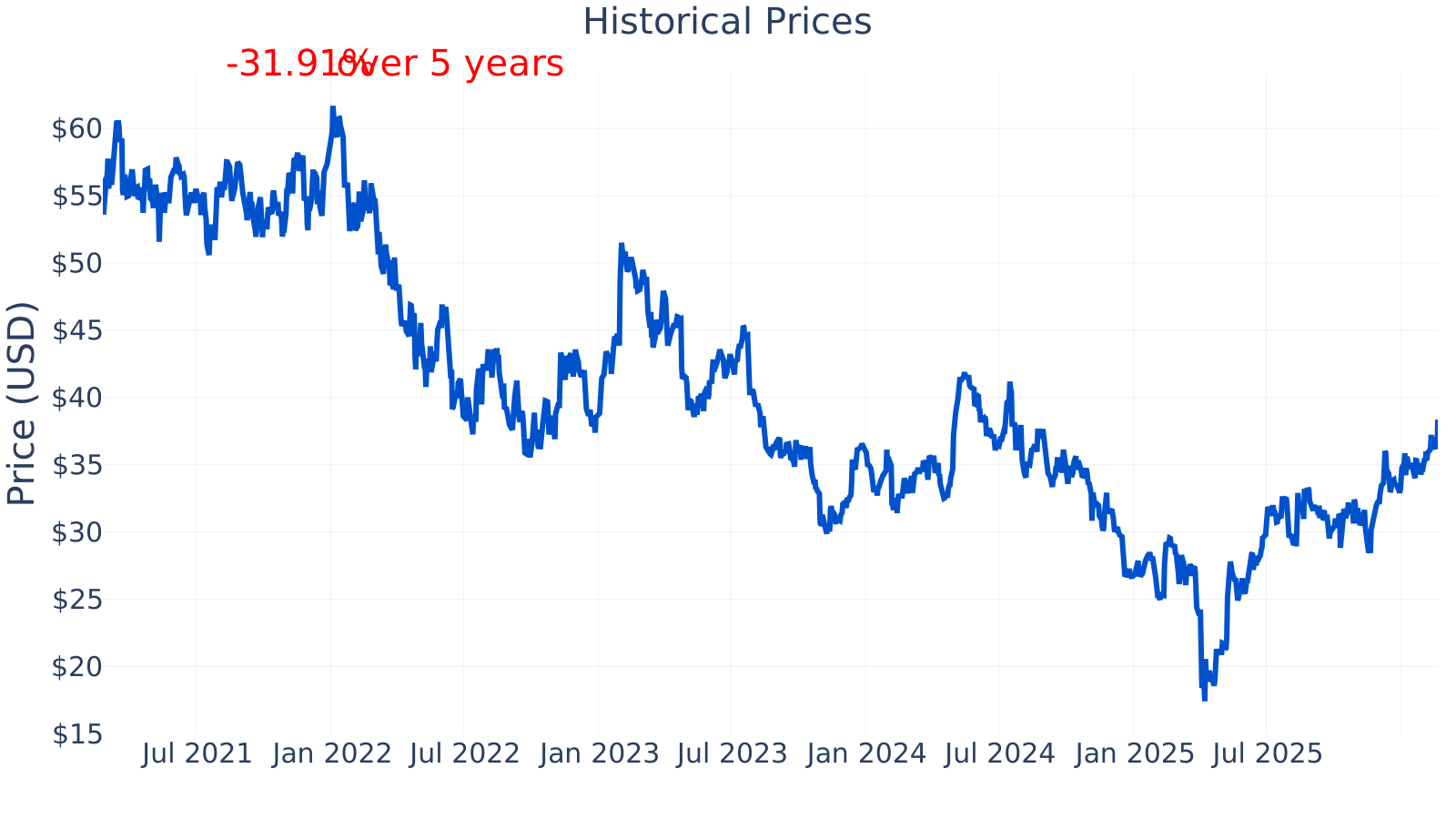
Sensata’s market capitalization is about $5.6B, and the stock’s beta (~1.15) suggests it has tended to move somewhat more than the broader market. The table shows a profit margin of ~0.85%, which is well below the industry median shown (~12.96%), indicating that recent profitability has been comparatively thin. Year-over-year revenue growth is shown at about 1.1% versus the industry median of about 7.45%, pointing to slower top-line momentum recently. Free cash flow over the trailing twelve months is listed at about $490M, which is an important support for servicing debt, reinvesting in products, and other corporate needs.
Growth (Medium)
Sensata operates in markets that are influenced by long-cycle trends rather than purely short-term consumer demand. Over time, vehicles and industrial systems have generally required more sensing and monitoring to meet expectations around safety, efficiency, emissions, uptime, and automation. Electrification in transportation (including the broader move toward higher-voltage electrical architectures and more electronics content) can also increase the need for certain sensing and protection components. These are supportive “directional” factors for the industry.
That said, the company’s recent revenue pattern has looked more like modest growth and periods of decline rather than a consistently rising trajectory, which implies growth depends not only on long-term themes but also on cyclical production volumes and execution in product mix.
The year-over-year revenue growth line shows strong growth in parts of 2021, followed by a long stretch of low-to-negative growth through 2023–2025, with a small positive reading at the end of the series (about +1.0%). This shape is consistent with a business exposed to cycle-driven demand and/or customer inventory adjustments.
Free cash flow has varied meaningfully over time: roughly $482M (2021), down to about $331M (2022), then around $352M (2023), dipping to about $274M (2024), and improving to about $410M (2025). This matters because steady free cash flow can help fund product development and manage leverage during weaker periods.
Potential catalysts in this type of business typically include improving auto/industrial production cycles, new program wins with major OEMs, and successful ramp-up of higher-content products (for example, products linked to electrification and safety). Whether these translate into faster growth depends on competitive positioning, customer adoption, and cost discipline—items that are usually discussed in detail in the company’s quarterly and annual filings.
Risks (High)
This article is for informational purposes only and does not constitute financial advice. Some content is AI-generated. See Disclaimer