Stock Analysis · Liberty Global PLC (LBTYB)
Overview
Liberty Global PLC is a telecommunications company focused on delivering fixed-line connectivity in parts of Europe. In practical terms, it provides broadband internet, video/TV services, and fixed-line telephony to homes and businesses, typically through cable and fiber networks. These networks are expensive to build but can be scaled over time by adding customers and offering higher-speed tiers and additional services.
In its filings, Liberty Global describes a strategy centered on upgrading network infrastructure (including fiber upgrades), managing a portfolio of operating businesses and investments, and using partnerships or joint ventures in some markets. The goal of these efforts is generally to improve network quality, customer experience, and long-run cash generation.
Main revenue streams typically include (categories used by cable operators; exact splits can vary by reporting period and footprint):
- Broadband (internet) subscriptions
- Video/TV subscriptions
- Fixed-line voice services
- Business-to-business connectivity and related services (where applicable)
- Other items (equipment, installation, and various fees)
The income statement flow highlights how results can swing materially from year to year: revenue is relatively stable in the mid-single-digit billions in the most recent years shown, while net income has been highly volatile (large profits in some years and large losses in others). This pattern often reflects a mix of operating performance plus significant non-operating items (for example, gains/losses, remeasurement items, impairments, and financing-related effects) that can dominate the bottom line.
Key Figures
| Metric | Value | Industry ⓘ |
|---|---|---|
| Date | May 05, 2026 | |
| Context | ||
| Sector | Communication Services | |
| Industry | Telecom Services | |
| Market Cap ⓘ | $5.54B | |
| Beta ⓘ | 0.71 | |
| Fundamental | ||
| P/E Ratio ⓘ | N/A | 14.31 |
| Profit Margin ⓘ | -109.66% | 7.29% |
| Revenue Growth ⓘ | 8.80% | 4.10% |
| Debt to Equity ⓘ | 97.31% | 102.25% |
| PEG ⓘ | 0.35 | |
| Free Cash Flow ⓘ | $606.60M | |
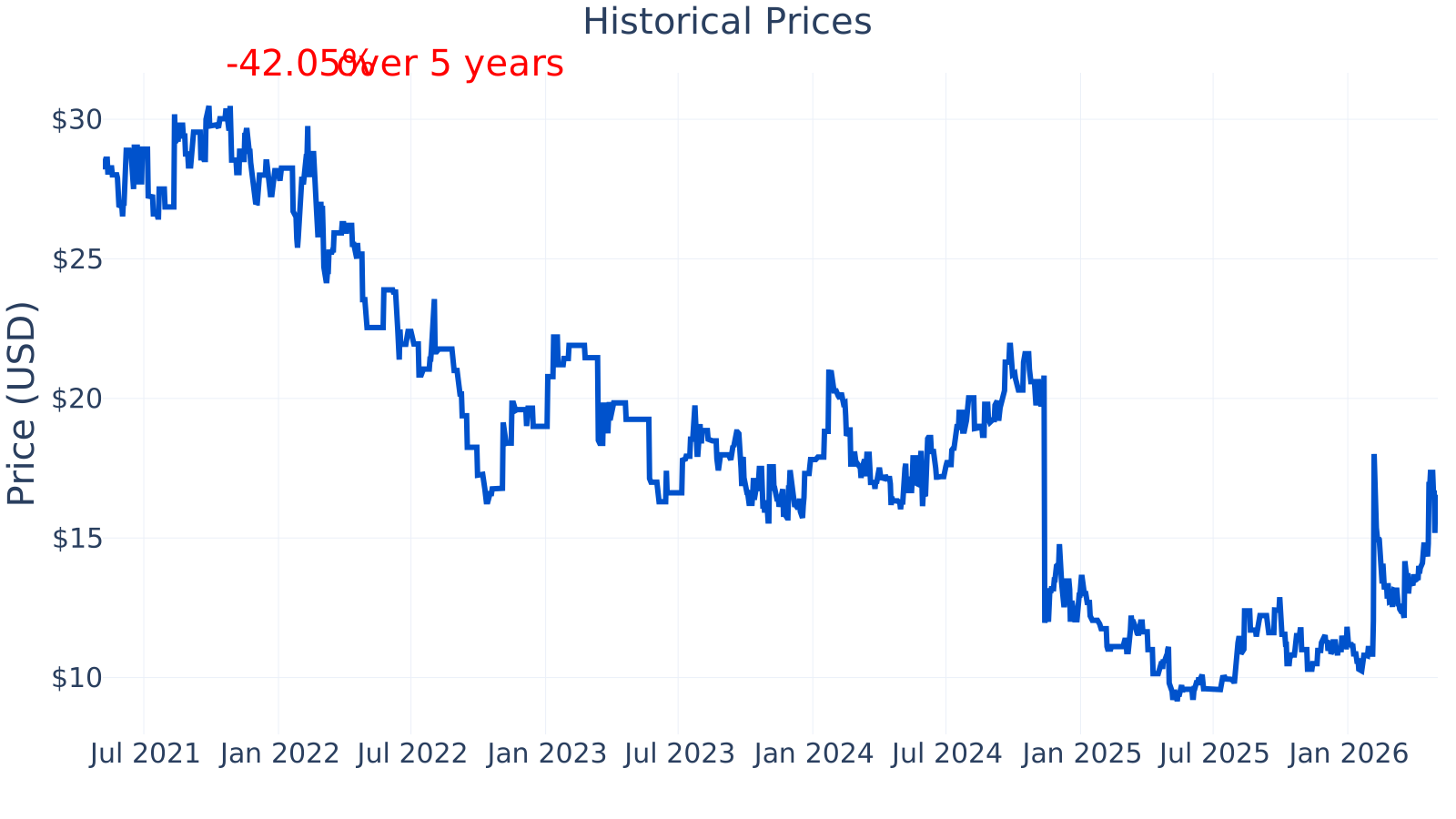
Liberty Global’s market capitalization is about $5.54B, and the stock’s beta (~0.71) suggests it has tended to move less than the broader market on average. The company shows free cash flow (TTM) of about $606.6M, which matters for a capital-intensive telecom business because free cash flow is what remains after operating costs and network investment. At the same time, the profit margin is negative (about -109.66%) versus an industry median near 7.29%, indicating that recent bottom-line profitability has been weak and/or affected by sizable non-operating charges. Reported year-over-year revenue growth is about 8.8% versus an industry median near 4.1%. The debt-to-equity ratio is ~97%, close to the industry median (~102%), consistent with the reality that telecom businesses often use meaningful leverage.
Growth (Medium)
Telecom connectivity is a mature but essential category: households and businesses continue to demand faster and more reliable internet, and usage tends to rise over time. That said, in many developed markets, subscriber growth can be limited, so much of the growth focus typically shifts to (1) upgrading customers to higher-speed plans, (2) reducing churn, (3) expanding fiber coverage, and (4) improving operating efficiency.
Liberty Global’s strategy of investing in network upgrades can be consistent with long-run demand for higher bandwidth and reliability. Network quality is a key part of competing for customers, especially as fiber deployment expands and fixed wireless options improve in some regions.
Revenue growth has been uneven over time, with several periods of contraction and some rebounds. The most recent data point shown is unusually high, which can happen due to portfolio changes, currency effects, or comparisons to a weak prior period, in addition to underlying operating performance. For long-term analysis, investors often look for multi-year consistency rather than a single quarter’s jump.
Free cash flow over the last few years trends downward in the period shown (from about $2.07B to about $0.97B, with the latest table showing $606.6M TTM). In a network business, this can reflect a combination of factors such as competitive pressure, higher operating costs, and/or elevated capital spending (for example, fiber buildouts). Sustained free cash flow is important because it supports debt service and provides financial flexibility.
Risks (High)
The biggest risk profile for many cable/fiber operators is a combination of (1) heavy ongoing investment needs and (2) intense competition. Building and maintaining modern networks requires steady capital spending, and customer acquisition/retention can be costly when rivals promote aggressively or when consumers “trade down” in weaker economic periods.
The debt-to-equity ratio has generally moved upward over the time window shown, ending around 104% in the latest quarter displayed. While this is broadly in line with the industry median, leverage still increases sensitivity to interest rates, refinancing conditions, and business setbacks. In telecom, debt is common, but higher leverage can narrow strategic options during downturns.
Profit margins have been volatile and frequently negative in recent periods, ending at about -146.32% in the latest quarter shown, compared with an industry median near 7.81%. For long-term readers, this volatility is a reminder that net income can be heavily influenced by items beyond day-to-day service revenue (for example, asset revaluations, impairments, restructuring charges, and financing-related impacts). It also underscores that operational improvements and cost discipline matter, especially when competitive pressure limits pricing power.
Competitive advantages in fixed networks often come from local scale, network quality (coverage and speed), and customer relationships. However, advantages can be challenged by:
- Fiber overbuilds from incumbents or new infrastructure players
- Mobile substitution for some households (including fixed wireless access in certain markets)
- Content and streaming shifts that reduce the stickiness of traditional pay-TV bundles
Competition typically includes incumbent telecom operators with national footprints, other cable operators, and alternative fiber providers depending on the country/region. Liberty Global’s positioning therefore tends to be market-specific: it can be strong where it has dense network coverage and brand recognition, and more challenged where rivals are expanding fiber rapidly or competing heavily on price.
Valuation
Telecom valuation is often discussed using earnings-based metrics (like the P/E ratio) as well as cash-flow and leverage measures, because depreciation, amortization, and financing structure can meaningfully affect reported earnings. For Liberty Global, earnings-based valuation can be difficult to interpret when net income is volatile or negative.
The P/E ratio shown for Liberty Global is frequently not meaningful in the periods displayed (often appearing as 0 on the chart, which typically occurs when earnings are negative or the metric is otherwise not interpretable). When it does appear, it has been far below the industry median in the periods shown (for example, low single digits versus an industry median often in the low-to-high teens). In practice, that gap can reflect the market discounting earnings quality/consistency, the impact of one-time items, and uncertainty about the stability of future profitability. In this situation, valuation discussions often shift toward questions like: how durable is free cash flow, how large are required network investments, and how manageable is the debt load across different business conditions.
Conclusion
Liberty Global operates in essential connectivity services, where long-term demand for fast and reliable broadband remains supportive, and where network upgrades can help defend competitiveness. At the same time, the company’s recent financial profile shows notable volatility in profitability, alongside meaningful leverage that is typical for the sector but still adds sensitivity to refinancing conditions and operating setbacks.
From a long-term, fundamentals-focused perspective, the key items to monitor over time are the stability of service revenue, the ability to sustain free cash flow after network investment, and whether profitability becomes less volatile. Competitive intensity (especially fiber buildouts and price pressure) and the company’s leverage remain central factors that can influence outcomes.
Sources:
- SEC EDGAR — Liberty Global PLC — Annual Report on Form 10-K (latest available)
- SEC EDGAR — Liberty Global PLC — Quarterly Reports on Form 10-Q (latest available)
- Liberty Global — Investor Relations — SEC Filings / Reports (company-hosted)
- Wikipedia — “Liberty Global” (general company background)
This article is for informational purposes only and does not constitute financial advice. Some content is AI-generated. See Disclaimer