Stock Analysis · Liberty Global PLC (LBTYB)
Overview
Liberty Global PLC is an international telecommunications company. Through its operating businesses and joint ventures, it provides fixed-line broadband internet, video/TV, and mobile services, mainly in European markets. In simple terms, it owns and operates communications networks (including cable and fiber-based infrastructure) and sells monthly subscriptions to households and businesses.
In its SEC filings, Liberty Global describes its operations as being centered on “converged” connectivity—bundling broadband, mobile, and entertainment—because customers often prefer one provider for multiple services. This model typically emphasizes recurring subscription revenue, with additional revenue coming from device sales and business services.
At a high level, the company’s revenue usually comes from these types of activities (largest to smallest can vary by market and year):
- Broadband internet subscriptions (recurring monthly fees)
- Mobile services (recurring service revenue, plus handset sales in some cases)
- Video/TV (subscription fees, content-related revenue)
- Business-to-business services (connectivity and related services for companies)
- Other revenue (installation, equipment, and miscellaneous items)
Important note on revenue mix: Liberty Global’s exact revenue split by product (with percentages) depends on the reporting period and the specific operating units included in continuing operations. Those details are typically provided in the company’s annual report (Form 10-K) within segment and operating statistics disclosures.
The company’s results show that reported net income can swing sharply from year to year, while revenue has been more stable in comparison. For long-term analysis, this usually means it is important to look beyond net income alone and also consider cash flow, interest costs, and the drivers of one-time gains or losses described in filings.
Key Figures
| Metric | Value | Industry ⓘ |
|---|---|---|
| Date | Feb 23, 2026 | |
| Context | ||
| Sector | Communication Services | |
| Industry | Telecom Services | |
| Market Cap ⓘ | $4.43B | |
| Beta ⓘ | 0.84 | |
| Fundamental | ||
| P/E Ratio ⓘ | N/A | 15.13 |
| Profit Margin ⓘ | -146.32% | 6.50% |
| Revenue Growth ⓘ | 9.60% | 2.00% |
| Debt to Equity ⓘ | 104.39% | 113.97% |
| PEG ⓘ | N/A | |
| Free Cash Flow ⓘ | $1.45B | |
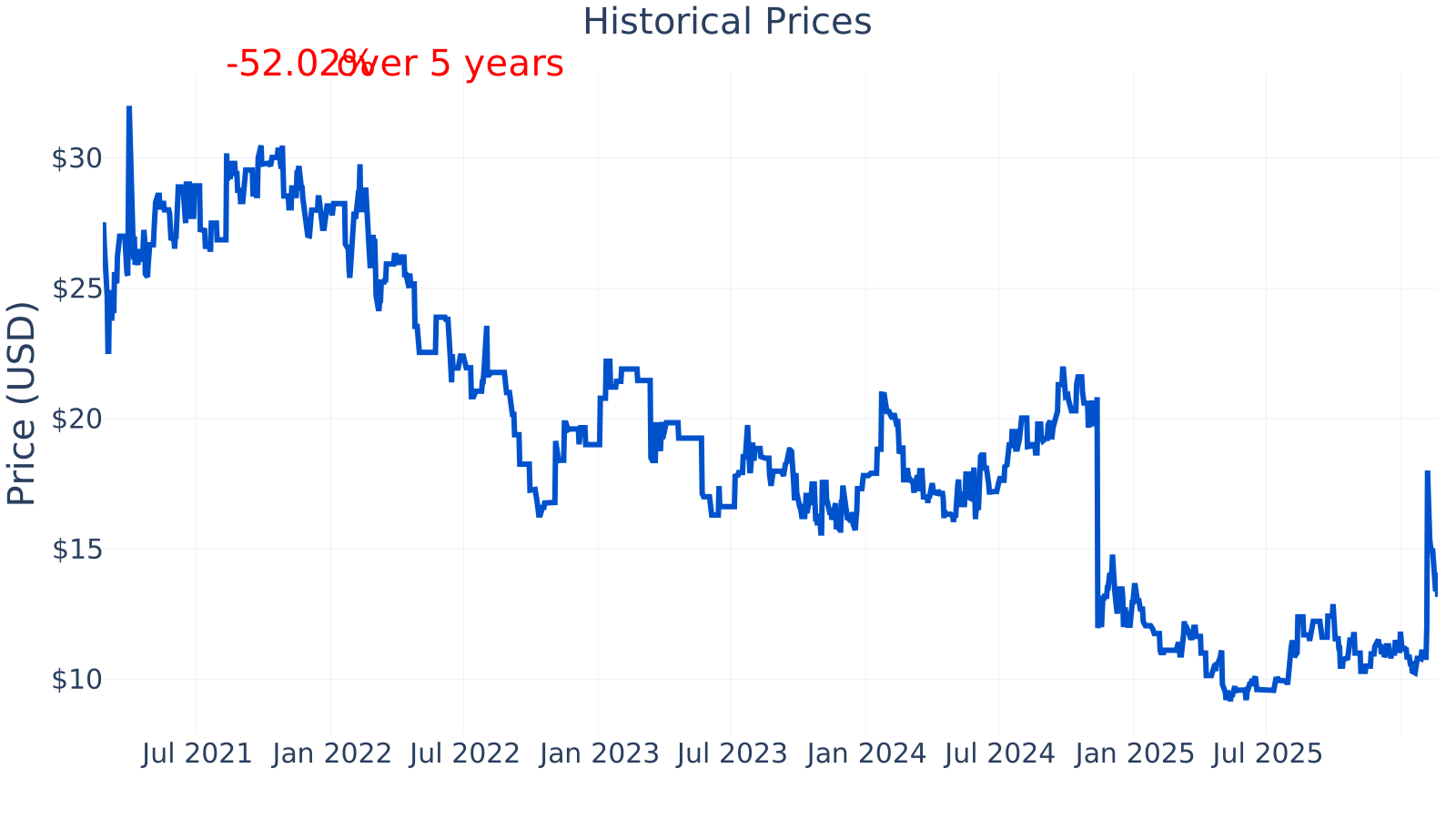
Liberty Global’s equity market value is about $4.43 billion, placing it in a mid/small-cap range. The stock’s beta of 0.84 suggests it has historically moved somewhat less than the overall market on average (though company-specific events can still create large moves). The company shows ~9.6% year-over-year revenue growth versus an industry median near ~2%, while its profit margin is negative (company about -146% vs an industry median around 6.5%), highlighting that reported earnings have been volatile. Leverage is meaningful but not unusual for telecom: debt-to-equity ~104% compared with an industry median around 114%. Trailing twelve-month free cash flow is about $1.45 billion, which is often a key indicator to watch in capital-intensive network businesses.
Growth (Medium)
Telecom and broadband are generally considered mature industries in many developed markets, but demand for fast and reliable connectivity continues to rise over time due to streaming, remote work, gaming, and an increasing number of connected devices. For cable and fiber operators, growth is often less about explosive customer growth and more about (1) upgrading network speeds and reliability, (2) winning/retaining customers in competitive footprints, and (3) increasing revenue per customer through bundles (broadband + mobile + entertainment).
Liberty Global’s strategy, as described in its public filings, has emphasized network investment (including next-generation broadband) and converged offerings (fixed and mobile together), often using partnerships/joint ventures in certain markets. Potential catalysts in this type of business typically include successful network upgrades that reduce customer churn, improved pricing discipline in competitive markets, and operational simplification that lowers ongoing costs.
The company’s year-over-year revenue growth has been uneven across quarters, including periods of contraction and periods of growth. More recently, the latest year-over-year figure shown is about 7.3% to 20.0% in some quarters, but with at least one later quarter showing a decline again. This pattern suggests that growth has not been steady and may be influenced by portfolio changes, competitive dynamics, and market-specific factors.
Free cash flow over the last several years shows a downward trend from roughly $3.15 billion (2021) to around $0.97 billion (2025), with a partial stabilization in between (about $1.35 billion in 2024 and $1.45 billion in the latest trailing period shown in the table). Because telecom networks require ongoing capital spending, long-term progress is often judged by the ability to produce durable free cash flow while maintaining network quality and competitiveness.
Risks (High)
This article is for informational purposes only and does not constitute financial advice. Some content is AI-generated. See Disclaimer