Stock Analysis · Garmin Ltd (GRMN)
Overview
Garmin Ltd (GRMN) designs and sells connected devices and software that use GPS and other sensors to track location, movement, health, and performance. The company is best known for fitness watches and outdoor handheld devices, but it also has meaningful businesses in marine electronics (for boats), aviation avionics (for aircraft), and automotive products. Garmin generally focuses on specialized markets where reliability, durability, and deep product features matter, rather than competing only on low price.
In its financial reporting, Garmin groups revenue into five main product categories (segments): Fitness, Outdoor, Garmin Marine, Aviation, and Auto OEM. Across these segments, revenue is primarily generated from device sales (hardware). The company also earns revenue from software features, subscriptions, and services (for example, certain mapping, safety, and connectivity-related offerings), which can support longer-term customer relationships beyond the initial device purchase.
The overall business mix is designed to balance consumer demand (which can move with trends and the economy) with more specialized categories such as aviation and marine, where purchase decisions may be less frequent but often involve higher-value products and longer product cycles.
Over the 2021–2025 period shown, total revenue rises meaningfully (from about $5.0B to about $7.2B), while spending on research and development also increases (from about $0.84B to about $1.13B). Net income trends upward as well (from about $1.08B to about $1.66B), suggesting that growth has not been driven solely by higher spending, but also by improved scale and profitability.
Key Figures
| Metric | Value | Industry ⓘ |
|---|---|---|
| Date | Feb 23, 2026 | |
| Context | ||
| Sector | Technology | |
| Industry | Scientific & Technical Instruments | |
| Market Cap ⓘ | $47.91B | |
| Beta ⓘ | 1.00 | |
| Fundamental | ||
| P/E Ratio ⓘ | 30.69 | 38.42 |
| Profit Margin ⓘ | 22.96% | 12.96% |
| Revenue Growth ⓘ | 16.60% | 7.45% |
| Debt to Equity ⓘ | 1.84% | 23.85% |
| PEG ⓘ | 3.71 | |
| Free Cash Flow ⓘ | $1.36B | |
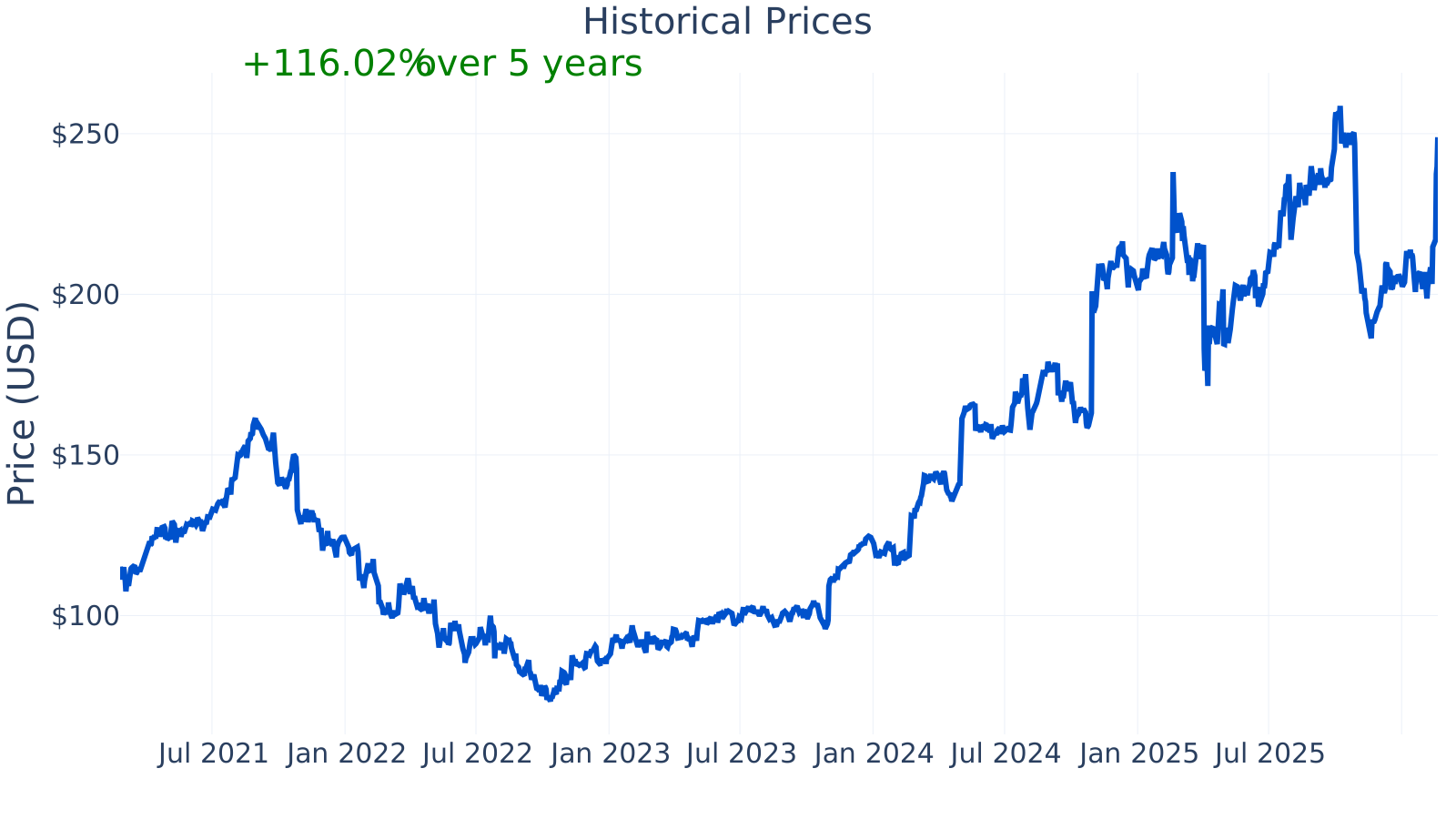
Garmin’s market capitalization is about $47.9B, placing it among the larger publicly traded companies in its product categories. Its beta (~1.0) indicates that the stock has tended to move roughly in line with the overall market, though real-world volatility can still be significant over shorter periods.
On profitability, Garmin’s profit margin is ~23.0%, which is notably above the listed industry median of ~13.0%. On growth, its year-over-year revenue growth is ~16.6%, also above the industry median of ~7.5%. Financial leverage appears low: debt-to-equity is ~1.8% versus an industry median near ~23.9%. The company’s TTM free cash flow is ~$1.36B. The table also shows a P/E ratio of ~30.7 (below the industry median of ~38.4) and a PEG ratio of ~3.7, which can indicate that the valuation is relatively high compared with certain growth expectations embedded in that metric.
Growth (Medium)
Garmin operates in multiple markets with long-term demand drivers: health and fitness tracking, outdoor recreation, marine electronics, and connected aviation systems. Several of these areas benefit from ongoing trends such as increased interest in personal health metrics, greater adoption of connected devices, and continued upgrades of navigation, safety, and situational-awareness systems in boats and aircraft.
Strategically, Garmin’s approach centers on building feature-rich products for specific user groups (runners, cyclists, hikers, sailors, pilots) and supporting them with software ecosystems (training features, maps, connectivity, and related services). This specialization can help reduce direct comparability with general-purpose consumer electronics, and it can support pricing power when customers value accuracy, battery life, ruggedness, and mission-critical reliability.
The pattern of revenue growth is not perfectly smooth. After a period of declines around 2022 into early 2023, growth turns positive and strengthens through 2024 and remains positive into 2025, with multiple quarters showing double-digit expansion. This profile suggests demand can be cyclical (or affected by product cycles and channel inventory), but recent periods indicate renewed momentum.
Free cash flow (a rough measure of cash generated after operating costs and necessary investments) drops sharply in 2022, then recovers strongly by 2024, and remains solid into 2025. For long-term business durability, sustained free cash flow can matter because it supports continued product development, resilience during downturns, and flexibility in capital allocation.
Risks (Medium)
Garmin faces several business risks typical for hardware-centric technology companies. Demand can fluctuate due to consumer spending cycles, competitive product launches, and changes in customer preferences. Product execution also matters: missteps in design, software quality, or inventory management can lead to discounting or lost market share. In addition, the company depends on a global supply chain, which can expose it to component constraints, logistics issues, and cost volatility.
Competition is a central risk. In fitness wearables and smartwatches, Garmin competes with large consumer technology brands and specialized sports-focused brands. In marine and aviation, it competes with other established electronics and avionics providers. Garmin’s competitive advantages tend to be strongest where domain expertise, safety-related features, mapping/navigation know-how, and brand trust are especially important. However, large competitors may have advantages in scale, marketing, or integration with broader smartphone ecosystems.
Leverage appears very low versus the industry median, with debt-to-equity around 1–2% across the period shown, compared with a much higher industry median (often around 38–49% earlier in the series and still materially higher later). Low leverage can reduce financial risk (for example, less sensitivity to refinancing conditions), though it does not eliminate operating or competitive risks.
Profit margin stays consistently above the industry median across the full period displayed. It dips from 2021 into 2022, then improves meaningfully in late 2023 and remains elevated through 2025. Strong and resilient margins can indicate a mix of differentiated products, disciplined pricing, and effective cost control—but margins can still compress if competition intensifies or if the product mix shifts toward lower-margin categories.
Valuation
Valuation is often discussed using the price-to-earnings (P/E) ratio, which compares the stock price to the company’s earnings. Garmin’s latest P/E is about 30.7, which is below the listed industry median of about 38.4, but still represents a valuation level that typically assumes the business can maintain solid profitability and avoid major setbacks.
The historical P/E series shows that Garmin’s multiple has moved across a wide range since 2021—falling into the mid-to-high teens during parts of 2022, then rising into the mid-to-high 20s and around 30 at points in 2024–2025. This indicates that the market’s expectations (and willingness to pay for each dollar of earnings) can change substantially with sentiment, growth rates, and profitability trends. The current context combines above-industry profitability, recently strong revenue growth, and low leverage, which can help explain why the valuation is not near the lower end of its recent range.
Conclusion
Garmin is a diversified GPS- and sensor-based device and software company with meaningful positions across fitness, outdoor, marine, and aviation markets. The business shows a combination of high profit margins relative to its industry median, very low leverage, and a recent rebound in revenue growth after a weaker stretch around 2022–early 2023. Free cash flow has also been strong in the most recent periods shown, supporting the view of a financially resilient operating model.
The main long-term uncertainties center on competitive intensity (especially in wearables), product-cycle execution, and how demand behaves across consumer and specialized categories during weaker economic environments. The valuation, as reflected in the P/E history and current level, suggests the market is pricing in continued solid fundamentals rather than a pessimistic scenario, which can increase sensitivity to any slowdown or margin pressure.
Sources:
- Garmin Ltd — Annual Report (Form 10-K) (Business description, segment information, risk factors, financial statements)
- SEC EDGAR — Garmin Ltd filings (Forms 10-K, 10-Q, 8-K as applicable)
- Garmin — Investor Relations materials (earnings releases and other press releases)
- Wikipedia — “Garmin” (basic company background; non-financial overview only)
This article is for informational purposes only and does not constitute financial advice. Some content is AI-generated. See Disclaimer


