Stock Analysis · Garmin Ltd (GRMN)
Overview
Garmin Ltd (GRMN) designs and sells connected devices and software that use GPS and other sensors to track location, movement, health, and performance. The company is best known for fitness watches and outdoor handheld devices, but it also has meaningful businesses in marine electronics (for boats), aviation avionics (for aircraft), and automotive products. Garmin generally focuses on specialized markets where reliability, durability, and deep product features matter, rather than competing only on low price.
In its financial reporting, Garmin groups revenue into five main product categories (segments): Fitness, Outdoor, Garmin Marine, Aviation, and Auto OEM. Across these segments, revenue is primarily generated from device sales (hardware). The company also earns revenue from software features, subscriptions, and services (for example, certain mapping, safety, and connectivity-related offerings), which can support longer-term customer relationships beyond the initial device purchase.
The overall business mix is designed to balance consumer demand (which can move with trends and the economy) with more specialized categories such as aviation and marine, where purchase decisions may be less frequent but often involve higher-value products and longer product cycles.
Over the 2021–2025 period shown, total revenue rises meaningfully (from about $5.0B to about $7.2B), while spending on research and development also increases (from about $0.84B to about $1.13B). Net income trends upward as well (from about $1.08B to about $1.66B), suggesting that growth has not been driven solely by higher spending, but also by improved scale and profitability.
Key Figures
| Metric | Value | Industry ⓘ |
|---|---|---|
| Date | Feb 23, 2026 | |
| Context | ||
| Sector | Technology | |
| Industry | Scientific & Technical Instruments | |
| Market Cap ⓘ | $47.91B | |
| Beta ⓘ | 1.00 | |
| Fundamental | ||
| P/E Ratio ⓘ | 30.69 | 38.42 |
| Profit Margin ⓘ | 22.96% | 12.96% |
| Revenue Growth ⓘ | 16.60% | 7.45% |
| Debt to Equity ⓘ | 1.84% | 23.85% |
| PEG ⓘ | 3.71 | |
| Free Cash Flow ⓘ | $1.36B | |
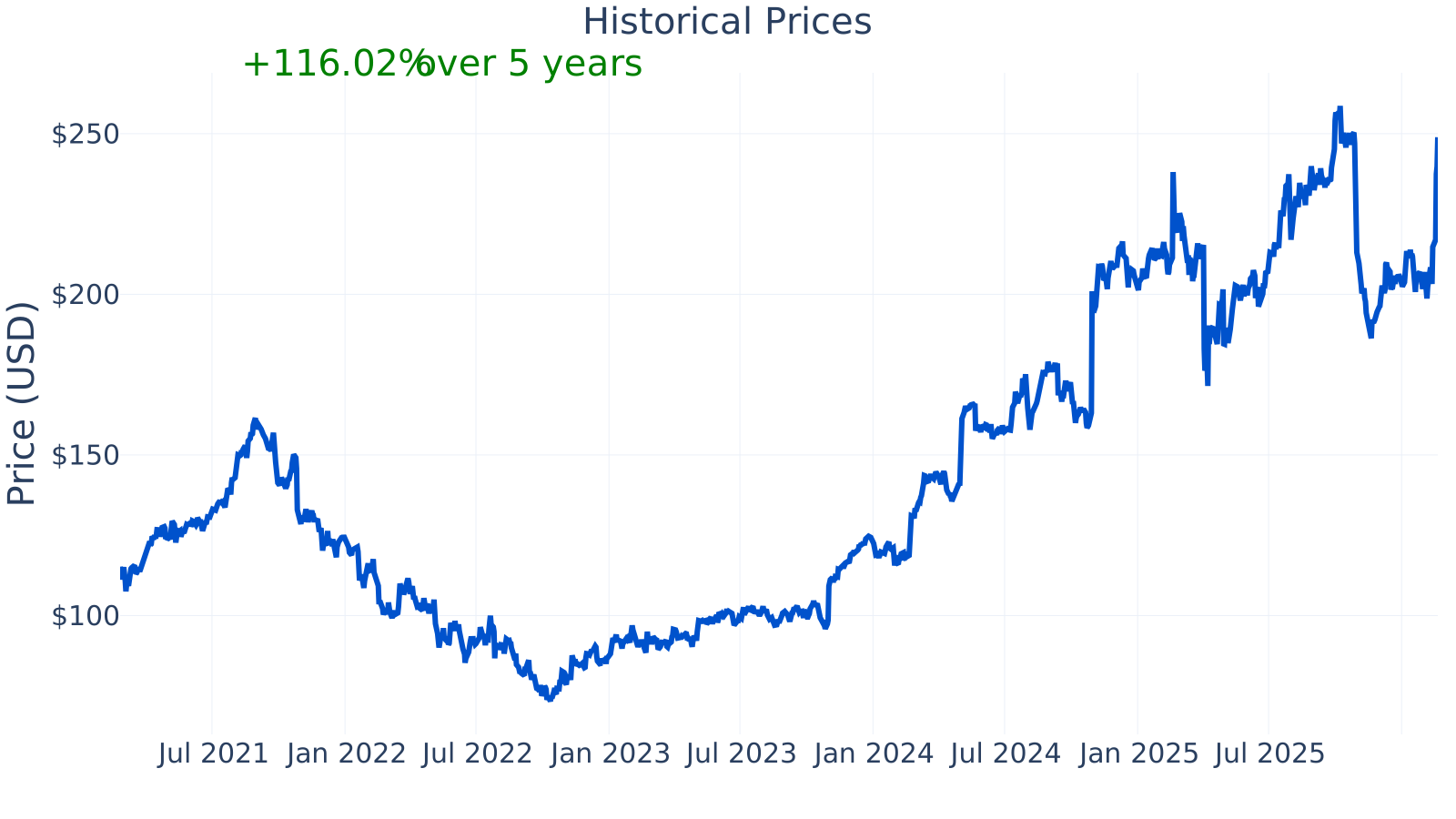
Garmin’s market capitalization is about $47.9B, placing it among the larger publicly traded companies in its product categories. Its beta (~1.0) indicates that the stock has tended to move roughly in line with the overall market, though real-world volatility can still be significant over shorter periods.
On profitability, Garmin’s profit margin is ~23.0%, which is notably above the listed industry median of ~13.0%. On growth, its year-over-year revenue growth is ~16.6%, also above the industry median of ~7.5%. Financial leverage appears low: debt-to-equity is ~1.8% versus an industry median near ~23.9%. The company’s TTM free cash flow is ~$1.36B. The table also shows a P/E ratio of ~30.7 (below the industry median of ~38.4) and a PEG ratio of ~3.7, which can indicate that the valuation is relatively high compared with certain growth expectations embedded in that metric.
Growth (Medium)
Garmin operates in multiple markets with long-term demand drivers: health and fitness tracking, outdoor recreation, marine electronics, and connected aviation systems. Several of these areas benefit from ongoing trends such as increased interest in personal health metrics, greater adoption of connected devices, and continued upgrades of navigation, safety, and situational-awareness systems in boats and aircraft.
Strategically, Garmin’s approach centers on building feature-rich products for specific user groups (runners, cyclists, hikers, sailors, pilots) and supporting them with software ecosystems (training features, maps, connectivity, and related services). This specialization can help reduce direct comparability with general-purpose consumer electronics, and it can support pricing power when customers value accuracy, battery life, ruggedness, and mission-critical reliability.
The pattern of revenue growth is not perfectly smooth. After a period of declines around 2022 into early 2023, growth turns positive and strengthens through 2024 and remains positive into 2025, with multiple quarters showing double-digit expansion. This profile suggests demand can be cyclical (or affected by product cycles and channel inventory), but recent periods indicate renewed momentum.
Free cash flow (a rough measure of cash generated after operating costs and necessary investments) drops sharply in 2022, then recovers strongly by 2024, and remains solid into 2025. For long-term business durability, sustained free cash flow can matter because it supports continued product development, resilience during downturns, and flexibility in capital allocation.
Risks (Medium)
This article is for informational purposes only and does not constitute financial advice. Some content is AI-generated. See Disclaimer


