Stock Analysis · Shopify Inc (SHOP)
Overview
Shopify Inc. is a software company that provides tools for businesses to set up, run, and grow an online store. In simple terms, it helps merchants create storefronts, manage products and inventory, process payments, market to customers, and handle orders across online and offline channels. The company’s platform is designed to serve a wide range of customers, from small businesses launching their first store to larger brands that need more advanced features and customization.
Shopify’s revenue is generally described in two main categories in its filings, reflecting (1) subscription-based access to its software and (2) merchant-related services that scale with customer activity. In practice, this means revenue tends to rise when Shopify adds more merchants, and also when existing merchants sell more and use more of Shopify’s add-on services.
Main sources of revenue (as commonly presented in company filings):
- Merchant Solutions: Revenue tied to merchant activity and usage of Shopify’s services (for example, payments-related and other merchant services).
- Subscription Solutions: Recurring subscription fees paid by merchants for access to Shopify’s platform and features.
Over the last several years, overall revenue has expanded meaningfully, with total revenue increasing from about $4.6B (2021) to about $11.6B (2025) based on the values shown below, indicating a much larger business footprint than a few years ago.
The revenue and profit flow over time shows a company that has grown substantially (from roughly $4.6B revenue in 2021 to roughly $11.6B in 2025). Profitability also looks less “one-time” and more operating-driven than earlier periods: operating income is shown as negative in 2022, then positive in 2023, and higher in 2024–2025, alongside sizable ongoing spending on research and development.
Key Figures
| Metric | Value | Industry ⓘ |
|---|---|---|
| Date | Mar 09, 2026 | |
| Context | ||
| Sector | Technology | |
| Industry | Software - Application | |
| Market Cap ⓘ | $169.92B | |
| Beta ⓘ | 2.90 | |
| Fundamental | ||
| P/E Ratio ⓘ | 138.51 | 27.00 |
| Profit Margin ⓘ | 10.65% | 7.87% |
| Revenue Growth ⓘ | 30.60% | 16.65% |
| Debt to Equity ⓘ | 2.66% | 25.51% |
| PEG ⓘ | 9.56 | |
| Free Cash Flow ⓘ | $2.01B | |
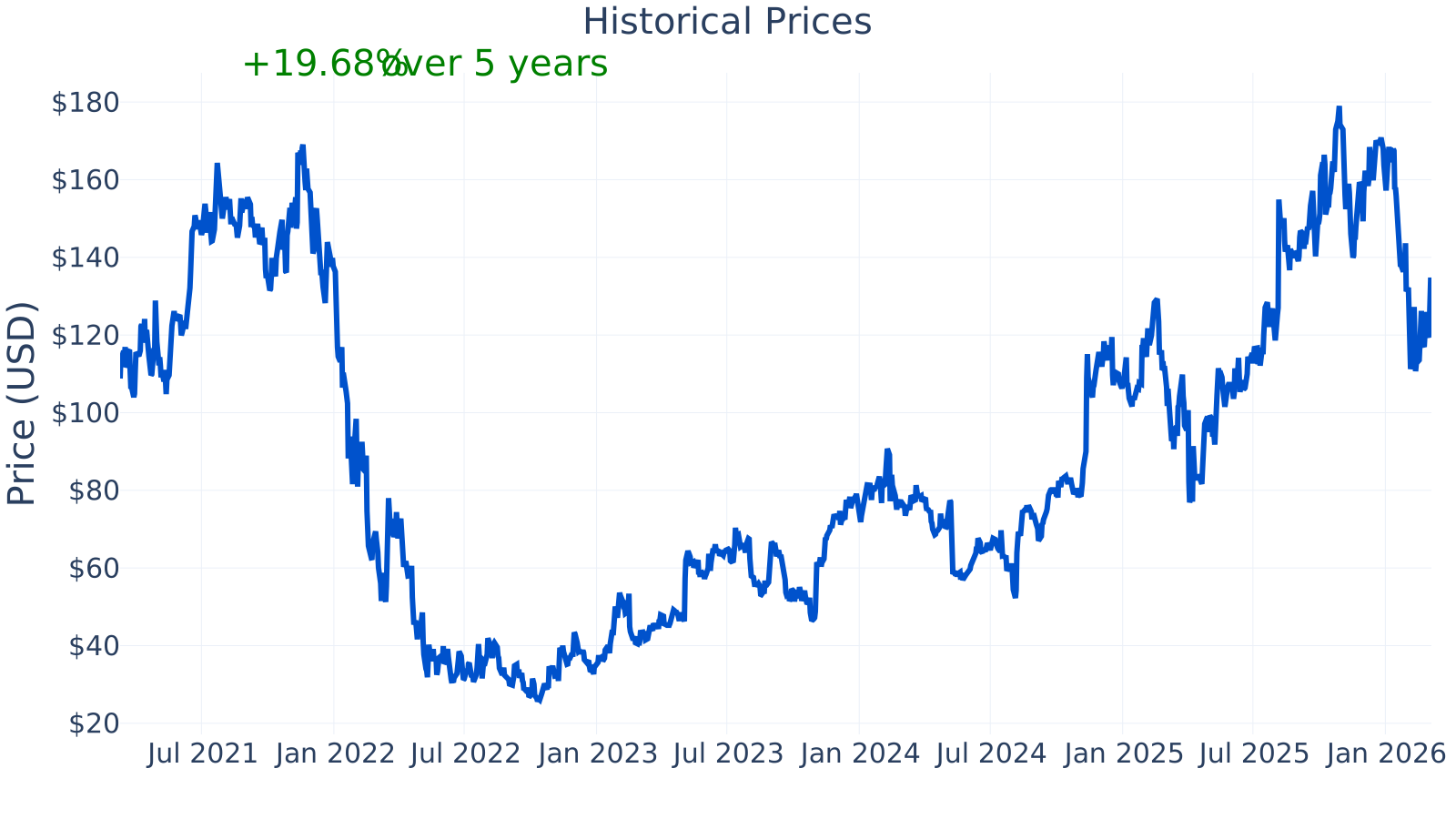
Shopify is a large company by market value (about $169.9B) with a historically volatile stock profile (beta about 2.9, which is often interpreted as meaning the shares can move more sharply than the broader market). Recent operating metrics shown here include year-over-year revenue growth of about 30.6% and a profit margin of about 10.7%, alongside trailing twelve-month free cash flow of about $2.0B. The balance sheet leverage shown is low, with debt-to-equity around 2.7%, below the listed industry median.
Growth (medium)
Shopify operates in the broader e-commerce and digital commerce enablement space, where long-term growth is often linked to ongoing shifts toward online purchasing, omnichannel selling (online plus physical), and merchants outsourcing more of the “commerce stack” (storefront, payments, and operations) to specialized platforms. In that context, Shopify’s strategy of offering an integrated platform—while also supporting an ecosystem of third-party apps and partners—aligns with the needs of merchants that want flexibility without building everything from scratch.
The year-over-year revenue growth trend shows a normalization after very high growth rates earlier in the period, with more recent quarters clustering around the mid-20% to low-30% range. The latest value shown is about 30.6%, above the listed industry median (about 16.7%), suggesting Shopify has recently been growing faster than a typical peer in its industry group.
Free cash flow (trailing twelve months) has risen over time in the values shown, from about $0.62B (2021) to about $1.73B (2025), with a notable step-up starting around 2024 (about $1.05B). For long-term business durability, this matters because free cash flow represents cash generated after operating costs and necessary investments, which can support reinvestment, resilience during downturns, or other corporate uses.
Potential catalysts (in a factual, business-model sense) often relate to higher merchant adoption, greater usage of merchant-related services (which typically scale with payment volume and order volume), and product expansion that increases value per merchant. At the same time, growth can be sensitive to consumer spending trends and the health of small and medium-sized businesses.
Risks (high)
Shopify’s risk profile includes both business and stock-related factors. On the stock side, the high beta indicates the shares have historically been prone to large swings. On the business side, Shopify’s performance is closely tied to merchant success, e-commerce demand, and competition from well-capitalized technology and commerce companies.
Debt-to-equity has trended downward across the period shown and ends at about 2.7% (versus an industry median around 32.8% at the same point). Lower leverage can reduce financial risk in challenging periods, though it does not eliminate operating risks like pricing pressure or demand shifts.
Profit margin has been volatile across the timeline shown, including negative periods in 2022–2023, followed by improvement into positive territory. The latest value shown is about 10.7%, which is above the listed industry median (about 8.2%). This improvement may indicate better cost discipline and/or more efficient scaling, but the historical volatility is a reminder that margins can shift with investment cycles, competitive dynamics, and changes in merchant activity.
Competition is a central risk. Shopify operates in a crowded environment that includes major commerce marketplaces, enterprise commerce software providers, and website-building platforms that also offer selling tools. Merchants can compare Shopify with alternatives depending on their needs (for example, ease of use for small businesses, deeper customization for larger brands, or an all-in-one marketplace model). Shopify’s competitive advantages often cited in company descriptions include its brand recognition among merchants, the breadth of its partner and app ecosystem, and the way it combines storefront tools with merchant services that can deepen adoption over time. However, larger competitors can bundle products, use aggressive pricing, or leverage existing customer relationships.
Other notable risks include platform reliability and security expectations, regulatory and compliance obligations (especially for payments-related and data-related activities), and the possibility that merchants reduce spending on subscriptions or add-on services during weak economic periods.
Valuation
Valuation is where expectations for future growth and profitability are most clearly reflected in the stock. One commonly referenced metric is the price-to-earnings (P/E) ratio, which compares the stock price to earnings. Higher P/E ratios often imply the market expects faster growth, higher future margins, or both—while also leaving less room for disappointment if results fall short.
The latest P/E ratio shown is about 138.5, which is materially above the listed industry median of about 27.0. The historical series shown also indicates that Shopify’s P/E has moved substantially over time (with some periods not shown due to the way very high or non-meaningful values were excluded). A higher-than-industry P/E can be consistent with above-industry growth (as also shown by recent revenue growth), but it typically corresponds to a higher valuation bar: future results may need to stay strong to justify such a premium, and the stock can be more sensitive to changes in growth expectations.
Conclusion
Shopify is a large digital commerce platform with a business model built around subscriptions and merchant-linked services. The company’s revenue has increased substantially across the period shown (from roughly $4.6B in 2021 to roughly $11.6B in 2025), with recent year-over-year growth around 30% and improving profitability compared with earlier loss-making periods. Free cash flow has also increased meaningfully in the timeline shown, and leverage appears low based on debt-to-equity.
At the same time, the profile includes notable uncertainty: the stock has historically been volatile, competition in commerce software and merchant services is intense, and profitability has been uneven across cycles. The valuation metrics shown—particularly a P/E far above the industry median—suggest the market is embedding strong expectations about future performance, which can amplify reactions to changes in growth or margin trends.
Sources:
- SEC EDGAR — Shopify Inc. annual and quarterly filings (Form 10-K, Form 10-Q)
- Shopify Investor Relations — Annual Report materials and shareholder letters (company-hosted)
- Shopify Investor Relations — Press releases and financial results announcements (company-hosted)
- Wikipedia — “Shopify” (basic company background information)
This article is for informational purposes only and does not constitute financial advice. Some content is AI-generated. See Disclaimer